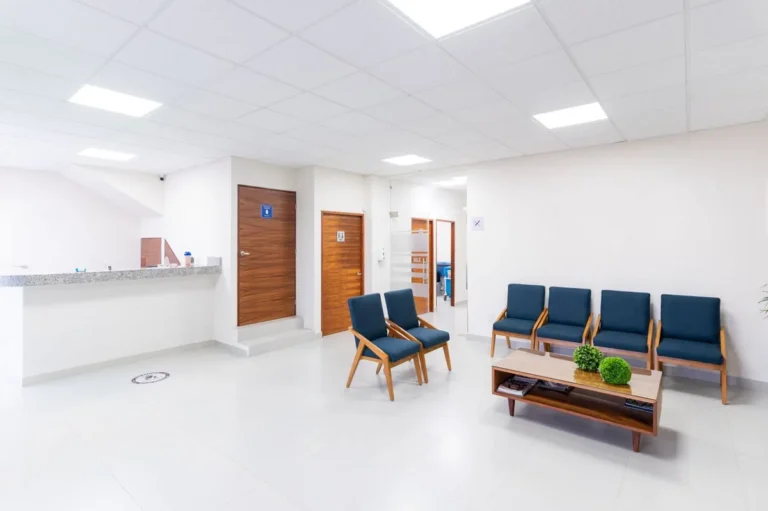
Cleanable upholstery for healthcare seating is specified by the covering, by how the covering is joined, and by where dirt can collect between the seat, back and arms. A quotation that says only “wipe-clean vinyl” leaves all three open, and the facility finds out when the cleaning team uses the product it already owns.
This guide is for procurement teams buying waiting-room, ward and day-room seating from China. It does not give cleaning protocols or performance figures, because the facility’s infection prevention team sets the cleaning regime and the covering maker publishes what each covering tolerates. What it does is turn that regime into written questions that a factory must answer for the exact model it quotes. For the wider product range, see our guides to healthcare furniture manufacturers for UK hospital projects and fabric versus vinyl upholstery for commercial seating.
Start from the cleaning regime, not the covering
The first line of the specification should be the cleaning regime the facility will use, written by the facility: which products, how often and by what method. Everything else follows from it. A covering is only suitable if its maker says it tolerates that regime, so the specification should name the regime and ask the factory to confirm, in writing, the covering maker’s cleaning guidance for the exact covering reference quoted.
Do not accept a general statement such as “bleach-cleanable” without the covering reference and the covering maker’s own document behind it. Ask for the document, check that the reference on it matches the reference on the quotation, and keep both with the purchase order.
What to state about the covering
- Covering reference: the maker’s name and reference, colour and batch rule, so a cheaper covering cannot replace it after approval.
- Covering type: vinyl, polyurethane-coated, woven or another type, as the designer names it.
- Backing and construction: what the covering is backed with, as the covering maker describes it.
- Cleaning guidance: the covering maker’s published guidance for the cleaning products the facility uses, supplied for the reference quoted.
- Approved sample: a physical sample of the covering, approved in writing and kept as the reference for bulk production.
- Supply and replacement: whether spare covering or spare covers will be bought, and how the covering reference will be matched later.
Seams: where cleaning products and soil collect
A seam is a joint in the covering, and the way it is made affects how easily it can be cleaned. Seams may be stitched, welded or covered by a piping or trim. Ask the factory to state, for each model, how every seam on the seat, back and arms is made, and to show it on a drawing or photograph of a finished sample. The facility’s infection prevention team can then decide whether the seam type suits its regime.
Ask also about stitching thread and any piping or trim: what they are made of, and whether the covering maker’s cleaning guidance covers them. A covering that tolerates the cleaning regime can still be let down by a thread or trim that does not, so the answer should cover every visible material.
Crevices: where the seat meets the frame
Dirt and fluids collect where parts meet: between seat and back, under arm pads, around fixings and where a cushion rests on a frame. Ask the factory to show these joints on a drawing, and ask what is done about each: closed with a continuous covering, sealed, or left open for cleaning access. The designer or the infection prevention team decides which is acceptable for each area.
- Seat to back: is there a gap, and can it be reached with the cleaning method the facility uses?
- Arms: are arm pads fixed or removable, and are fixing points visible on the cleanable surface?
- Legs and base: how does the base meet the seat, and can the floor under the chair be cleaned?
- Fixings: where screws or rivets are visible, what they are made of, and whether they sit in a recess.
- Zips and openings: are there any, and how are they closed against fluids?
Foam, frame and covers: what sits under the covering
The cleanable surface is only the top layer. If fluid gets through a seam or a damaged covering, it reaches the foam and the frame. Ask the factory to describe the foam and what lies between foam and covering, and to say whether covers can be removed and replaced without dismantling the chair. Replaceable covers can lower the cost of repair, but only if the covering reference will still be available when they are needed.
For fire-related requirements on upholstered seating, which differ by country and by building type, see our guide to UK fire rules for upholstered furniture and, for foam, contract seating foam. The facility’s specification decides which apply.
Sourcing this for a commercial project?
FBM Sourcing manages the entire China procurement package for overseas construction projects. We work with Developers · General Contractors · Builders · Commercial Project Owners · Interior Design & Construction Companies · FF&E Solution Providers. Send your BOQ, drawings or product schedule for review.
Samples and mock-up: test with the facility’s own products
Ask for a finished sample chair with the approved covering, not a swatch on a card. Give it to the facility’s cleaning team to clean using the regime written in the specification, and ask the infection prevention team to review the seams and joints. Record the result in writing against the item code, and treat the approved chair as the reference for bulk production.
Repeat the approval if the covering, foam, seam method or frame changes. A change that looks small in the factory, such as a different thread, a different backing or a changed seam, can alter how the chair cleans, so every change should be proposed in writing and approved before it is made.
What to request from the factory
- The covering maker’s name, reference and cleaning guidance for the reference quoted.
- A drawing or photographs of every seam and joint on a finished sample, with the seam method stated.
- A description of the foam, the layers under the covering and whether covers are removable.
- A list of fixings and trims, with their materials.
- A finished sample chair for review by the facility’s cleaning team and infection prevention team.
- Confirmation of the packing method, so coverings arrive without creases, scuffs or contamination.
Common mistakes in healthcare seating specifications
- Naming a cleaning claim without the covering reference and the covering maker’s document behind it.
- Approving a swatch and then receiving a chair made with a different covering batch or backing.
- Leaving the seam method to the factory, so the sample and the bulk order use different methods.
- Reviewing the front of the chair and not the joints under the arms and between seat and back.
- Forgetting spare covers, so the covering reference has to be found again years later.
What changes when the order comes from China
Buying from a factory abroad does not change the cleaning regime, but it raises the cost of a mistake. A wrong covering found after shipment cannot be exchanged quickly, so the evidence has to be collected before the order. Put the covering reference, the cleaning guidance and the approved sample into the purchase order, and state that a substitution needs your written approval.
Language matters too. Ask for the covering maker’s guidance in English or a language the facility can read, so the cleaning team works from the same document you approved. FBM Sourcing manages the quotation, sample and approval steps for the project; our own team performs one inspection after bulk production is complete and before shipment, and the client’s project team is welcome to attend. The facility remains responsible for deciding which products and methods are suitable for its patients and staff.
Questions buyers ask about cleanable healthcare seating
Who decides the cleaning regime for healthcare seating?
The facility, through its infection prevention team. Write the regime into the specification, then ask the factory to confirm the covering maker’s guidance for that regime for the exact covering reference quoted.
Is a welded seam better than a stitched seam?
This guide does not rank them. Ask the factory to state the seam method used on every seam, and let the designer and infection prevention team decide which suits the regime.
What should we ask about gaps between the seat and the back?
Ask for a drawing of the joint, and ask whether it is closed, sealed or left open for cleaning access. The designer decides which is acceptable for each area.
Can replacement covers be bought later?
Only if the covering reference stays available. Ask the factory how a matching covering will be supplied later and whether spare covers should be bought with the order.
How does FBM Sourcing support a healthcare seating order?
We review the brief, collect comparable quotations and manage the package for the project. For suppliers you nominate, we charge a 5% commission; for products we source for you, we quote a direct price. Our own team performs one inspection after bulk production is complete and before shipment, and the client’s project team is welcome to attend.
FBM Sourcing manages the entire China procurement package for overseas construction projects. We work with Developers · General Contractors · Builders · Commercial Project Owners · Interior Design & Construction Companies · FF&E Solution Providers.