Buying restaurant booths and banquette seating from China works in four steps: fix your dimensions and layout (booth modules, seat height, table match), specify contract-grade construction (hardwood ply frame, high-density foam, commercial upholstery with the fire certificate your market requires), order through a factory or furniture sourcing agent and sourcing partner with a sample or trial unit approved before bulk production, and ship knocked-down or assembled depending on quantity. Booth pricing is quoted per linear foot of banquette or per booth module and is driven by upholstery grade, back height and certification requirements — with 30–45 day production and practical minimums of about half a container. The economics work at restaurant-chain and full-venue scale; the risks are real too, and they concentrate in foam density, fire certificates and dimensional accuracy.
This guide covers the specification, pricing and QC detail that project buyers — chain operators, FF&E contractors, hotel F&B teams — need before placing a booth order.
Booth and Banquette Types: What Chinese Factories Build
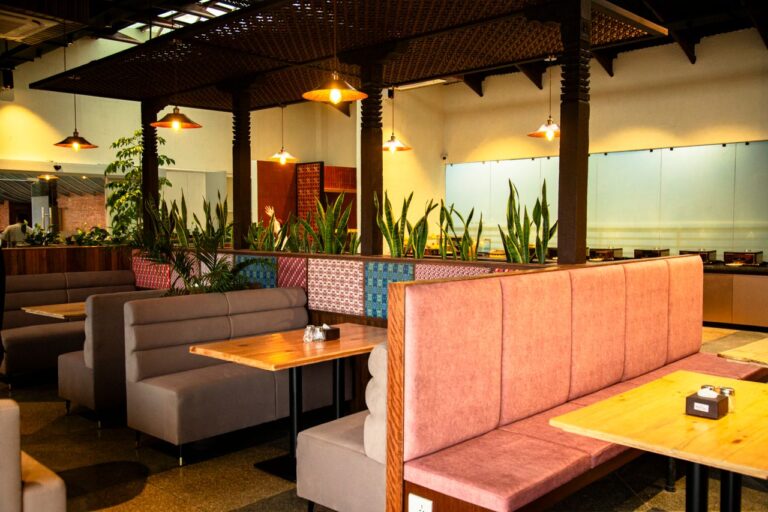
- Single and double booths — standard 48″ (two-seat) and 60–72″ (family) modules; double-sided units share a common back between bays.
- Wall benches / banquettes — continuous runs built in 1.2–2.4 m sections to your floor plan, with inside/outside corner units for L- and U-shaped layouts.
- Back styles — plain upholstered, channel-tufted (vertical or horizontal), diamond-buttoned, or wood-capped; back heights from 36″ (open sightlines) to 48–60″ (privacy and acoustic separation).
- Bases — upholstered closed base, recessed kick, or raised on legs for cleaning access; storage bases available for hotel F&B.
- Matching tables — laminate, veneer, solid wood or stone tops with cast-iron or stainless bases, sized to the booth module so seat-to-table clearance lands right.
Standard dimensions worth fixing early: seat height 18″ (457 mm), seat depth 16–18″, table height 30″ with 10–12″ of knee clearance to the booth base, and 42″ minimum module depth per seating side. Chinese factories build fully custom, so US-standard and European-standard dimensions are equally available — but they build what the drawing says, so the drawing must say it.
What Specification Separates Contract-Grade Booths from Cheap Ones?
Two booths can look identical in photos and diverge completely at year three. The specification lines that matter:
- Frame — 18 mm hardwood plywood, glued and screwed (not stapled chipboard); corner-blocked stress points.
- Foam — seat foam at 1.9–2.5 lb/ft³ (30–40 kg/m³) high-resilience grade; anything under 1.8 lb/ft³ will pancake within 18 months of daily service.
- Upholstery — contract vinyl at 100,000+ double rubs (Wyzenbeek) for high-turn venues, or contract fabric at 50,000+; hospitality-grade PU and genuine leather for hotel F&B.
- Fire performance — CAL TB117-2013 for the US, BS 7176 (medium hazard) for the UK, AS/NZS 3837/1530.3 pathways for Australia; certificates must name the actual foam and fabric batch, not the factory generally.
- Seams and wear points — double-stitched seams, reinforced front-edge wear strip, replaceable seat cushions on hotel-grade units.
- Cleanability — antimicrobial vinyl options and sealed base details for food-service hygiene regimes.
Put every line above into the purchase order as measurable numbers. “Commercial grade” as a phrase has no enforcement value at inspection; “seat foam 35 kg/m³ HR, certified TB117-2013” does.
Sourcing this for a commercial project?
FBM Sourcing works with project owners, developers, main contractors and FF&E contractors on hotel, apartment, school, office and other commercial building projects. Send us your BOQ, drawings or product list — our team will review it and get back to you.
How Is Restaurant Booth Pricing from China Structured?
Booth and banquette quotations are structured per linear foot (for continuous banquette runs) or per booth module (for standard units), with matching tables quoted separately. Four specification choices move the price more than anything else:
- Upholstery grade — contract vinyl vs contract fabric vs hospitality leather, and the double-rub rating behind each.
- Back height and style — plain upholstered backs price differently from channel-tufted and diamond-buttoned work, which carry real labor content.
- Foam specification — high-resilience density costs more per unit and is the single line cheap quotes cut first.
- Fire certification — certified foam and fabric batches for your destination market add cost and lead time, and are non-negotiable for commercial venues.
Ask every bidder for the same two columns — ex-factory and estimated landed to your port — and model duty on the actual HS codes rather than a flat guess, so quotes are comparable at the same specification. For volume planning: a 40ft high-cube carries roughly 55–75 linear meters of knocked-down banquette plus tables, or 40–60 assembled booth modules, and half-container orders are the practical minimum for the economics to work. Multi-unit operators fold booths into per-store container kits alongside kitchen equipment — the rollout logic is covered in our restaurant chain buildout sourcing guide and its OS&E companion on kitchen equipment sourcing.
How Does Ordering and QC Actually Run?
The sequence that protects a booth order: send your floor plan and finish schedule → receive a quotation itemized to the specification lines above → approve a physical sample (one booth module, or a corner section for banquette runs) → release bulk production against the approved sample → inspect before balance payment and shipment. During pre-shipment inspection we check foam density by cut sample against the certified batch, upholstery pattern alignment and seam quality across units, frame rigidity, module dimensions against the floor plan (a banquette run 40 mm long does not fit a fixed alcove), and fire-certificate paperwork matched to the shipped materials.
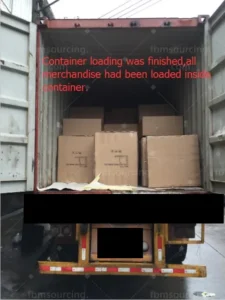
Shipping choice: knocked-down (backs, seats and bases packed flat) maximizes container use and suits chains with install crews; fully assembled suits single venues that want drop-and-place delivery. FBM Sourcing has run both — including chain restaurant furniture for a Dubai operator where booths, marble tables and outdoor seating consolidated into one container program.
Once you know how to buy booth and banquette seating, it helps to see the category broken out by construction type — see top restaurant booth and banquette seating manufacturers in China for fixed, modular and curved booth construction compared side by side.
Get a China Procurement Quote for Your Project
FBM Sourcing procures booth and banquette packages from audited contract furniture factories in Guangdong — custom dimensions, certified foam and upholstery, sample-first ordering, QC and consolidated shipping to your port. Send your floor plan, linear meters or booth count with destination and timeline through our building materials and FF&E procurement page, and our team will review your requirements and get back to you.
Frequently Asked Questions
What foam density separates contract-grade booth seating from residential-grade?
Contract-grade seat foam runs 1.9-2.5 lb/cu ft (30-40 kg/cu m) high-resilience grade; anything under 1.8 lb/cu ft will pancake within about 18 months of daily restaurant service.
How is restaurant booth and banquette pricing structured?
Quotations are structured per linear foot for continuous banquette runs or per booth module for standard units, with matching tables quoted separately – upholstery grade, back height and style, and frame/foam specification move price the most.
What happens during pre-shipment inspection of a booth order?
Foam density is checked by cut sample against the certified batch, upholstery pattern alignment and seam quality are checked across units, and frame rigidity is tested before balance payment and shipment.