
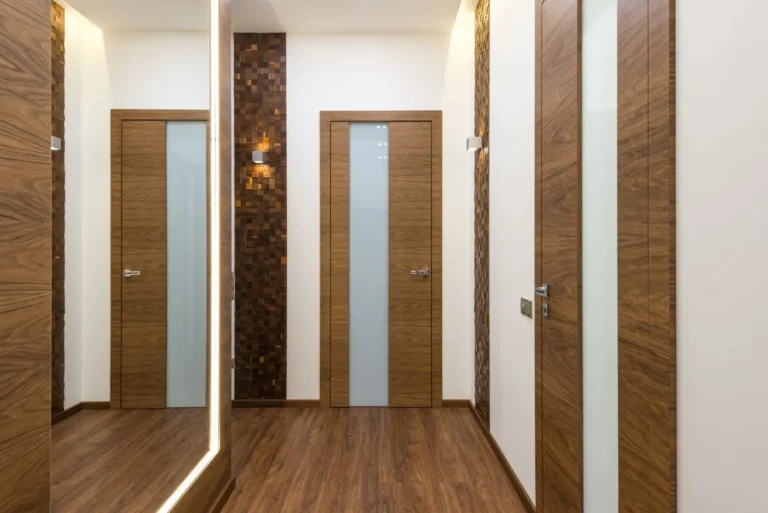
STC describes airborne-sound isolation through assemblies such as walls and floor-ceiling systems; IIC describes impact-sound performance of floor-ceiling assemblies. For hotel guestrooms, the project team should specify the required rating, laboratory or field method, and complete assembly rather than ask a Chinese supplier for an “acoustic door” or “soundproof floor” without a test basis.
This guide is for developers, general contractors, builders, commercial project owners, interior design and construction companies and FF&E solution providers coordinating hotel and serviced-apartment rooms.
What do STC and IIC measure?
ASTM E413 classifies single-number ratings from sound-attenuation measurements. Its public scope identifies the result from ASTM E90 laboratory testing as sound transmission class, or STC. It also distinguishes field ratings produced from measurements in completed buildings. ASTM warns that the rating for a partition built and tested in a building can be lower than the laboratory result because of flanking transmission or construction errors.
Impact insulation class is used for structure-borne impact through floor-ceiling assemblies. The 2021 International Building Code Section 1206 connects laboratory IIC with ASTM E492 and a field normalized impact sound rating with ASTM E1007. Airborne and impact performance are therefore separate schedule lines, even when both concern the same guestroom floor.
What does the International Building Code require?
For the sleeping-unit separations covered by IBC 2021 Section 1206, walls, partitions and floor-ceiling assemblies must achieve STC 50 in laboratory testing under ASTM E90, or normalized noise isolation class 45 in field testing under ASTM E336. Floor-ceiling assemblies must achieve IIC 50 under ASTM E492, or normalized impact sound rating 45 when field tested under ASTM E1007.
The section applies between adjacent dwelling or sleeping units, and between those units and adjacent public or service areas. It also says penetrations and openings for services, recessed cabinets, baths, soffits and ducts must be treated so the required rating is maintained. Entrance doors are excluded from the STC requirement in that section, but must fit tightly to the frame and sill. A project in another jurisdiction, or under another adopted code edition, needs its own code check.
Why is an assembly report more useful than a material claim?
| Scope | Evidence to request | Common mismatch |
|---|---|---|
| Guestroom partition | Complete tested wall build-up: boards, studs, insulation, layers and joints | A board brochure is offered instead of an assembly test. |
| Floor-ceiling system | Slab, underlay, finish floor and ceiling build-up tied to STC and IIC results | Only the underlay rating is shown. |
| Guestroom entrance door | Door-leaf, frame, seals, threshold and hardware set tested or specified together | A leaf value is quoted without the installed door set. |
| Service penetrations | Approved details for outlets, pipes, ducts and recessed items | The wall report is valid, but site penetrations bypass it. |
| Operable partition | Test report for the complete partition and installation details | A panel-core claim is treated as the installed rating. |
The same logic applies to acoustic wall panels and acoustic ceilings: room absorption products do not establish the sound-isolation rating of the boundary between rooms.
Pricing doors, partitions or floors for a hotel project?
Send the room details, assemblies and acoustic requirements. We will request evidence for the exact quoted configuration and coordinate the product package.
How should hotel doors be specified?
Write the door as a set: leaf construction and thickness, frame, seals, threshold or drop seal, hinges, latch and closer, vision panel if any, and the surrounding wall interface. If the project requires a tested acoustic value, the evidence should identify the set configuration rather than a generic core. The guide to interior wood door manufacturers explains how to read product scope, while the door hardware schedule keeps seals and hardware tied to each opening.
Acoustic requirements do not replace fire, smoke, accessibility or egress requirements. Where several performance requirements apply to one opening, the project team should approve one compatible door-set specification.
How should hotel floors be specified?
Identify the structural slab, ceiling below, finish floor and resilient layer as one system. A supplier’s IIC statement for an underlay alone does not prove the room assembly meets the project target. The RFQ should state the test method, rating, tested build-up and any limits on floor height, moisture or fire performance.
Finish selection still matters operationally. Carpet, engineered wood, SPC and resilient floors create different interfaces, but the acoustic result belongs to the assembly tested. Our hotel and apartment flooring guide helps place the finish choice inside the wider project brief.
What should be checked before the purchase order?
- Code edition and jurisdiction named by the project team.
- Required STC, IIC or field rating and the corresponding test method.
- Complete assembly drawing that matches the report.
- Door, seal, threshold, wall and floor interfaces.
- Penetration details for services and recessed items.
- Substitution rule: no board, insulation, underlay, seal or hardware change without evidence review.
FBM Sourcing can match quoted components to the schedule and collect the manufacturer’s supporting documents. The specifier and approving authority decide the required rating and whether the evidence is acceptable.
Frequently Asked Questions
What is the difference between STC and IIC?
STC is a single-number rating for airborne-sound isolation, while IIC is a single-number rating for impact-sound performance of a floor-ceiling assembly.
Does a high-STC board make a high-STC wall?
Not by itself. The rating belongs to the complete tested assembly, including layers, framing, insulation, joints and penetrations.
What STC and IIC values does IBC 2021 Section 1206 use?
For the separations in its scope, it uses laboratory STC 50 or field NNIC 45 for airborne sound, and laboratory IIC 50 or field NISR 45 for impact sound.
Does IBC 2021 Section 1206 give entrance doors an STC minimum?
The section excludes entrance doors from its STC requirement but states that they must fit tightly to the frame and sill. Other project or jurisdiction requirements may still apply.
Can an acoustic underlay report prove the whole hotel floor complies?
No. Compare the report’s full floor-ceiling build-up with the project assembly; a component claim alone does not establish the complete assembly rating.
Pricing doors, partitions or floors for a hotel project?
Send the room details, assemblies and acoustic requirements. We will request evidence for the exact quoted configuration and coordinate the product package.
About FBM Sourcing
FBM Sourcing manages the entire China procurement package for overseas construction projects. Since 2014 we have worked with developers, general contractors, builders, commercial project owners, interior design and construction companies and FF&E solution providers across more than 20 countries and over 1,000 containers, as their sourcing partner in China — from the schedule or BOQ through factory selection, sampling, inspection by our own team before shipment, consolidation and shipping. All quotations, invoices and shipping documents are issued by FBM Sourcing, and sea freight is quoted to you before shipment. If you have an acoustic door, partition or flooring package to price, start at China building materials and FF&E procurement.





