
Under Regulation (EU) 2023/1115 as amended by Regulation (EU) 2025/2650, the main obligations of the EU Deforestation Regulation apply from 30 December 2026, and from 30 June 2027 for operators that are natural persons or micro or small undertakings established as such by 31 December 2024. For wooden furniture, the company that first places the goods on the EU market files the due diligence statement, not the factory in China, and it cannot file it without the geolocation of every plot of land where the wood was produced. This states the position as of 24 September 2026, from the published legal text and the Commission’s own guidance.
It is written for developers, general contractors, builders, commercial project owners, interior design and construction companies and FF&E solution providers with wooden furniture on an EU-bound schedule: what is inside the scope, what must exist before the container is booked, and who carries the filing obligation.
What Changed in December 2025, and What Applies on 30 December 2026?
The base act is Regulation (EU) 2023/1115 of 31 May 2023. Regulation (EU) 2025/2650 of 19 December 2025, published in the Official Journal on 23 December 2025, amended it and replaced Article 38. The replacement reads: “Subject to paragraph 3 of this Article, Articles 3 to 13, Articles 16 to 24 and Articles 26, 31 and 32 shall apply from 30 December 2026.” Paragraph 3 sets 30 June 2027 for operators that are natural persons or micro or small undertakings within the meaning of Directive 2013/34/EU “who were established as such by 31 December 2024”. The same amendment replaced Article 37, so the old EU Timber Regulation is repealed with effect from 30 December 2026.
The amendment also rewrote the roles in the chain, and that restructuring, not the calendar, is the news.
Which Wooden Furniture Items Are Inside the Scope, and Which Are Not?
Scope is decided by Annex I, and only by Annex I. The Commission’s Frequently Asked Questions document, Version 5 of April 2026, states it plainly: “Products not included in Annex I are not subject to the requirements of the Regulation, even if they contain relevant commodities in the scope of the Regulation.” Below, Annex I is set against the Combined Nomenclature as amended by Commission Implementing Regulation (EU) 2025/1926, applying from 1 January 2026.
| Code | Description | Annex I |
|---|---|---|
| ex 9401 | Seats, and parts thereof, of wood | Listed as an extract |
| 9403 30, 9403 40, 9403 50 00 | Wooden furniture of a kind used in offices, in the kitchen, in the bedroom | Listed |
| 9403 60 | Other wooden furniture, including dining, living room and shop furniture | Listed |
| 9403 91 00 | Parts: of wood | Listed |
| 9406 10 00 | Prefabricated buildings: of wood | Listed |
| 9403 10, 9403 20, 9403 82 00, 9403 83 00, 9403 89 00, 9403 99 | Metal furniture; furniture of bamboo, rattan or other materials; parts of metal or other materials | Not listed |
| 9404, 9405 | Mattress supports and bedding; luminaires and lighting fittings | Headings not listed |
The panel headings sit upstream and are listed in their own right, among them 4410 particle board, 4411 fibreboard and 4412 plywood, so the choice between plywood, MDF and particleboard in casegoods now has a compliance dimension too.
Who Actually Files the Due Diligence Statement?
Article 2 as amended defines an “operator” as a person who places relevant products on the market or exports them, “excluding downstream operators”, and adds the downstream operator, a person placing on the market products made using relevant products “all of which are covered by a due diligence statement or by a simplified declaration”. Article 4(2) is then unambiguous: “Operators shall not place relevant products on the market or export them without prior submission of a due diligence statement.” The statement goes to the competent authorities through the information system referred to in Article 33, and by making it available the operator “shall assume responsibility for the compliance of the relevant product”.
Placing on the market is defined in Article 2 as “the first making available of a relevant commodity or relevant product on the Union market”, and Article 7 adds that where a person established outside the Union places relevant products on the market, “the first natural or legal person established in the Union who makes such relevant products available on the market shall be deemed to be an operator”. The Commission FAQ is blunt: “Only (upstream) operators, i.e., importers and primary producers placing directly on the EU market, are required to submit due diligence statements or simplified declarations.”
Everyone further down has different duties. Under the replaced Article 5, downstream operators and traders may place or make available relevant products only if they hold the information required by Article 5(3): the identity of their suppliers and corporate clients and, where the supplier is an operator, the reference numbers of the due diligence statements or declaration identifiers. Those that are not SMEs must also register in the information system beforehand, and Article 6 lets an operator mandate an authorised representative to file on its behalf while retaining responsibility.
So the EU-side contracting entity has to be identified early: if a European main contractor imports directly it is the operator, and if an EU distributor imports and the contractor buys from it, the distributor is the operator.
Geolocation for Every Wood Component: What It Means on a Real Piece of Furniture
Article 2 defines geolocation as “the geographical location of a plot of land described by means of latitude and longitude coordinates corresponding to at least one latitude and one longitude point and using at least six decimal digits; for plots of land of more than four hectares used for the production of the relevant commodities other than cattle, this shall be provided using polygons with sufficient latitude and longitude points to describe the perimeter of each plot of land”.
Article 9(1)(d) requires the geolocation of all plots of land where the commodities the product contains or was made using were produced, plus “the date or time range of production”. It states that “any deforestation or forest degradation on the given plots of land shall automatically disqualify all relevant commodities and relevant products from those plots of land from being placed or made available on the market or exported”.
The Commission FAQ applies this to furniture at question 1.3: “For relevant composite products, such as e.g. imported wooden furniture with different wood components, the operator needs to geolocate all the plots of land where the relevant commodity (wood, for example) used for the manufacturing process has been produced. The relevant commodities’ components may be neither of unknown origin nor from areas deforested or degraded after the cut-off date.” That date, in Article 2, is 31 December 2020.
The Commission Notice of 13 July 2026, C(2026) 4972 final, adds the sentence that matters most for a wardrobe: “If there is any deforestation or forest degradation on any of the plots of land that are identified for any of the relevant products within a relevant product that is a ‘composite product’, then that product cannot be placed or made available on the market or exported.”
Read against a contract wardrobe, the carcass board, the door substrate, the face veneer, the solid-wood edging and the drawer box each trace back to plots of land, and the set of plots is the union of all of them, per bill of materials variant. That is a different evidentiary standard from the older timber regimes, as against the timber legality regimes in the US, EU, UK and Australia, which ask for species and country of harvest rather than plot coordinates.
Wooden furniture on an EU-bound schedule for 2027 delivery?
Send us the furniture schedule or BOQ. We write the EUDR information requirements into the specification and collect species, country of production and plot-level origin from the factory as part of the order file.
Does a Low-Risk Country Classification Remove the Geolocation Requirement?
No. Commission Implementing Regulation (EU) 2025/1093 of 22 May 2025 lays down the list of countries presenting a low or high risk under Article 29. Its Annex lists China among the low risk countries and names four high risk countries: Belarus, the Democratic People’s Republic of Korea, Myanmar and the Russian Federation. The July 2026 guidance confirms in a footnote that this is the latest iteration of the list.
What the classification buys is set out in Article 13. The guidance states that operators sourcing from low-risk countries still have to exercise due diligence under Article 8, meet the information requirements of Article 9 and run a due diligence system under Article 12, but “are not required to fulfil the obligations under Article 10 and Article 11” once they have ascertained that all relevant commodities were produced exclusively in low-risk countries. Articles 10 and 11 are risk assessment and risk mitigation; Article 9, which carries the geolocation requirement, is not switched off.
A second point matters for furniture made in one country from timber grown in another. The classification that counts is that of the country of production, defined in Article 2 as where the commodity contained in the product was produced — where the tree was grown, not where the wardrobe was assembled. Article 13(3) requires a competent authority to act where commodities “produced in a standard-risk or high-risk country or a part thereof are subsequently processed in a low-risk country”. The guidance asks whether the product consists of more than one tree species and whether the timber has been traded in more than one country.
What If National Rules Prohibit Sharing Plot Data?
The Commission FAQ deals with this at question 1.31: “Operators cannot rely on the existence of national laws prohibiting the sharing of such (public) data with operators in order to be exempt from the obligation to collect and upload that data into the Information System. Operators must submit the geolocation information as part of their obligations; otherwise, the operators cannot comply with the requirements on due diligence according to Art. 8 and, therefore cannot place on or export relevant products from the EU market.”
A supply chain that cannot produce coordinates is not one with an excuse; it is one that cannot serve the EU market for that item, and that has to be established at specification stage, while there is still time to change the substrate, the species or the mill.
What Should Sit in the Specification and the Order File?
Article 9(1) reads as a procurement document as much as a legal one. For each relevant product it requires a description with trade name and type plus common and full scientific species names, the quantity, the country of production, the geolocation of all plots with the date or time range of production, contact details of the business supplying and the business supplied, “adequately conclusive and verifiable information that the relevant products are deforestation-free”, and equally conclusive information on production in accordance with the relevant legislation of the country of production, which Article 2(40) ties to laws on the legal status of the area of production, from land use rights to labour and human rights.
Certification and third-party verification schemes can support that file without replacing it, and the July 2026 guidance is explicit that chain-of-custody models permitting known and unknown origin material to be mixed are “not acceptable under the EUDR”.
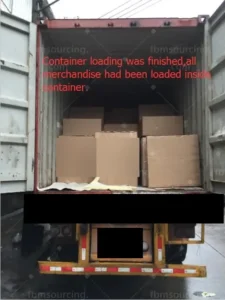
None of this changes how the goods move. Sometimes, on a large project, the wooden furniture items alone fill full containers; sometimes the wooden furniture items share containers with the other product categories of the same project; and sometimes, in one batch, we combine a dozen or more product categories from several projects of the same client into a few containers — always full containers, and for us this is routine, well-practised work.
Where FBM Sourcing Sits in This
FBM Sourcing does not file the due diligence statement and does not give legal or customs classification advice; the operator placing the goods on the EU market files the DDS. What we do as your sourcing partner in China sits upstream of that filing: we write the EUDR information requirements into the specification and purchase documents before the order is placed, we collect species, country of production and plot-level origin information from the factory and its board and timber suppliers as part of the order file, and we check that documentation against what was actually built at our inspection by our own team at the factory after bulk production is finished, before shipment, with photo and video records. An inspection report goes to the client before the balance is paid.
A factory already shipping into Europe that can name species and origin per component behaves differently from one that cannot. The same logic applies to other European requirements riding alongside deforestation rules, including the EU formaldehyde limit for furniture and contract furniture strength testing to EN 16139, while our overview of casegoods manufacturing hubs in China sets out how the supply base is distributed.
Wooden furniture on an EU-bound schedule for 2027 delivery?
Send us the furniture schedule or BOQ. We write the EUDR information requirements into the specification and collect species, country of production and plot-level origin from the factory as part of the order file.
Frequently Asked Questions
Does EUDR apply to a wooden furniture package shipped from China before 30 December 2026?
The trigger is placing on the market, defined in Article 2 as the first making available on the Union market and tied by the Commission FAQ to release for free circulation for imported goods, so with the substantive provisions applying from 30 December 2026 and FAQ 8.2 confirming that operators “do not have to comply with the requirements for products placed on the Union market before that date”, the sailing date is not the operative one and customs timing should be settled with the EU-side entity that will be the operator.
Does the Chinese factory submit the due diligence statement?
No, because Article 4(2) puts the obligation on the operator, Article 7 deems the first person established in the Union who makes the goods available to be the operator where the seller sits outside the Union, and the Commission FAQ states that persons placing relevant products on a market other than the EU market “have no obligation to interact with the EUDR Information System”.
Are upholstered chairs with metal frames covered?
Annex I lists heading 9401 only as an extract, seats “and parts thereof, of wood”, and the Commission FAQ explains that “code 9401 might include seats made of raw materials other than wood, but only wooden seats are subject to the requirements of the Regulation”; the Combined Nomenclature separates seats with wooden frames at 9401 61 00 and 9401 69 00 from seats with metal frames at 9401 71 00 and 9401 79 00, so classification of the item decides it.
Does a forest certification scheme satisfy EUDR on its own?
No, because the Commission Notice of 13 July 2026 states that using such schemes “does not imply a ‘green lane’, since the operator is still required to exercise due diligence”, and that third-party verification is “not a legal requirement, but a voluntary decision of the operator”.
Is there a minimum order size below which EUDR does not apply?
No, because the Commission FAQ at question 2.3 states that “There is no threshold volume or value of a relevant commodity or relevant product, including within processed products, below which the Regulation would not apply”.
About FBM Sourcing
FBM Sourcing manages the entire China procurement package for overseas construction projects. Since 2014 we have worked with developers, general contractors, builders, commercial project owners, interior design and construction companies and FF&E solution providers across more than 20 countries and over 1,000 containers, as their sourcing partner in China — from the schedule or BOQ through factory selection, sampling, inspection by our own team before shipment, consolidation and shipping. All quotations, invoices and shipping documents are issued by FBM Sourcing, and sea freight is quoted to you before shipment. If you have a wooden furniture package to price, start at China building materials and FF&E procurement.