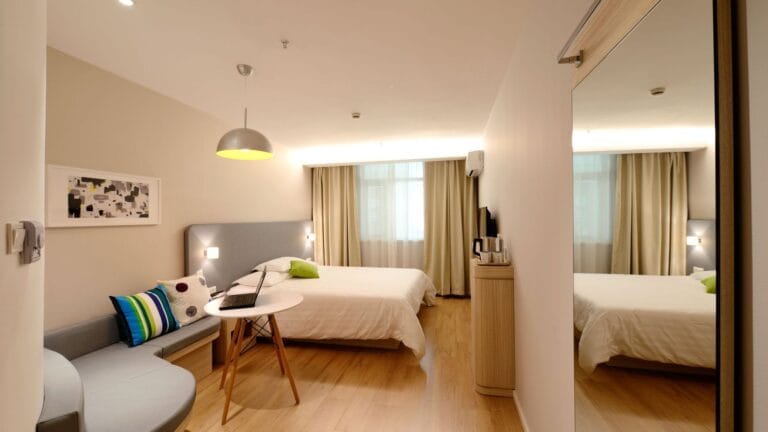
Hotel casegoods manufacturers in China are, for the most part, unbranded plants that build guestroom headboards, nightstands, wardrobes, desks, luggage benches and minibar cabinets to a project’s own drawings, so there is no public league table of them to copy. What can be verified is narrower and more useful: which manufacturer types exist, which listed Chinese groups describe hotel work in their own annual reports, where the supply chain clusters, and which documents show that a plant can repeat one room set across a whole key count. This article names only what we could check against an exchange record and an annual report.
It is written for developers, general contractors, builders, commercial project owners, interior design and construction companies and FF&E solution providers who hold a guestroom FF&E schedule or a set of room-type drawings and need to decide what kind of Chinese plant should build the casegoods.
What Counts as Guestroom Casegoods?
Casegoods are the box-built pieces of a guestroom, as opposed to seating, lighting and soft goods. In this article the term covers a fixed list, because the list decides what kind of plant you need:
- Headboards and bed surrounds, usually a wall-hung panel assembly with integrated power and reading lights.
- Nightstands, freestanding or cantilevered off the headboard panel.
- Wardrobes and open closets, with hanging rails, shelves and a safe housing.
- Desks, consoles and TV panels, often one continuous run along the wall.
- Luggage benches and racks, which take the hardest knocks in the room.
- Minibar and refreshment cabinets, which house a refrigerator and need ventilation cut-outs.
Some of these are loose furniture and some are fixed to the building, and the split changes who installs them and when they are needed on site. All six share one question underneath, the carcass board, which our article on plywood, MDF and particleboard for project casegoods covers. Vanities, seating, mattresses and lighting are outside the scope here. For the wider guestroom and public-area package, see our round-up of hotel furniture makers in China; this article stays with the box-built pieces and the panel and solid-wood construction behind them.
Which Types of Manufacturer Build Hotel Casegoods in China?
We group them by what the plant is set up to do, not by a ranking. There is no score column, because a plant that is right for a veneered upscale room is wrong for a laminate select-service room.
| Manufacturer type | What it is set up to do | Guestroom package it suits | Evidence to request |
|---|---|---|---|
| Dedicated hospitality casegoods plant (OEM, builds to drawings) | Veneer lay-up, panel machining, spray finishing and assembly under one roof, working from the project’s shop drawings | Full casegoods set for one or more room types, including headboard walls with integrated electrics | Shop drawings from a past room set of similar construction, its signed-off finish samples, and board and adhesive declarations for your market |
| Custom cabinetry and wardrobe group with a project channel | Automated panel lines built for repeat carcasses: wardrobes, closets, cabinets, wall panels and doors in large unit counts | Wardrobes, closets, minibar carcasses, kitchenettes and wall panelling in long-stay and select-service rooms | Panel specification with board type, thickness and edge banding, the hardware model list, and a sample carcass in the project finish |
| Solid-wood furniture plant | Kiln-dried timber machining, joinery and finishing; less dependent on veneered panel | Lodge and resort rooms that specify solid timber frames, legs, luggage racks and headboard frames | Timber species declaration, moisture content records for the batch, and joint details on the drawing |
| Panel plant with metal and stone partners | Builds the carcass in-house and buys in metal frames, stone tops, mirrors and LED components | Rooms where desks, minibars and luggage benches mix metal and stone with panel | A bill of materials naming the bought-in parts, plus the electrical component documents your market requires |
| Veneer and finishing specialist | Sequenced and book-matched veneer work, open-pore and high-build lacquer finishes | Upscale and luxury headboard walls, feature wardrobes and suites where veneer matching across rooms matters | Veneer flitch samples with the agreed colour range, and a finished control sample kept by both sides |
A single hotel often needs two of these types at once, and one finish sample then has to govern both.
Which Listed Chinese Companies Could We Verify, and What Is Their Actual Role?
We checked the current Shanghai Stock Exchange list, the Shenzhen Stock Exchange company record, the Hong Kong securities list and the companies’ 2025 annual reports on 21 September 2026. We did not find a currently listed Chinese company, free of a risk-warning designation, whose annual report presents hotel casegoods as a reported product segment. Two listed custom-furniture groups do describe hotel work inside their project channels, and we name them with exactly that role:
- Zbom Home Collection Co., Ltd (Shanghai Stock Exchange, 603801), registered in Hefei, Anhui. Its 2025 annual report reports three product segments: kitchen cabinets, custom wardrobes, and wooden doors with wall panels. It describes a domestic project channel that supplies developers of finished residential units, apartments, hotels and senior housing, says the company is developing project product lines that include hotel furniture, and reports separate overseas project sales. Its role here is a cabinet and wardrobe group with a project channel, not a dedicated hospitality casegoods plant.
- Suofeiya Home Collection Co., Ltd. (Shenzhen Stock Exchange, 002572), registered in Zengcheng, Guangzhou, Guangdong. Its 2025 annual report reports wardrobes and related products as its largest segment, followed by cabinets and wooden doors, and describes a project channel that takes on hotels, long-stay rental apartments, schools, hospitals, and enterprises and institutions alongside finished residential developments. Its role is the same: a custom wardrobe group whose project channel includes hotel work.
Neither annual report breaks out hotel revenue, and we draw no conclusion about how much hotel casegoods either company makes. Some furniture groups that are often cited in this field currently trade under a risk-warning designation or no longer appear on the exchange list, so we have not named them. The dedicated hospitality casegoods plants are private companies with no exchange filing a reader could check, which is why they appear here as a manufacturer type with evidence to request, not as company names.
Where Does the Casegoods Supply Chain Cluster?
The Shunde District government’s profile of Longjiang town, in Foshan, Guangdong, states that the town holds the national titles of furniture manufacturing town and furniture materials capital, and counts more than 2,000 furniture manufacturing enterprises and more than 3,000 furniture materials trading enterprises there. The same government page describes neighbouring Lecong as a national furniture trading capital. We read that page in September 2026; it does not date the figures.
For casegoods, the materials count matters as much as the factory count. A materials trade on that scale means boards, veneers, laminates, edge banding, hinges, runners and lacquers can be bought locally, so a panel plant there can change a finish or a hardware model without reorganising its supply. Our article on hospitality casegoods manufacturing hubs in China maps the clusters, including the solid-wood and premium veneer centres outside Foshan. FBM Sourcing is based in Guangzhou, one hour from Foshan.
Have a guestroom casegoods schedule to price?
Send us the FF&E schedule and room-type drawings. We will match each piece to the right type of Chinese plant and name the compliance evidence in the enquiry.
Panel or Solid Wood: How Does Construction Decide the Plant?
Most guestroom casegoods are panel furniture: a board core with a decorative face, edged and machined, then assembled with connectors or glued joints. Solid wood appears where it earns its place, in legs, frames, luggage rack slats and exposed edges. The construction you specify narrows the manufacturer type more than any other decision:
- Laminate-faced panel. High-pressure laminate or melamine-faced board on a particleboard or MDF core. It suits automated panel lines and gives the most consistent colour across a large key count. Edges and cut-outs are the weak points, so edge banding and cut-out sealing belong on the drawing.
- Veneered panel. Wood veneer laid on MDF or plywood, then stained and lacquered. It needs a plant with its own veneer room and spray line, and an agreed colour range, because timber varies from flitch to flitch. Our comparison of HPL laminate and wood veneer for hotel casegoods goes through wear, repair and consistency.
- Solid-wood frame with panel infill. Timber frames and legs with veneered or laminate panels set in. This calls for a plant that controls timber moisture content as well as panel machining.
- Mixed-material pieces. Metal frames, stone tops, glass and integrated lighting. The casegoods plant becomes the assembler, and the drawing should say which parts it buys in.
What Formaldehyde Evidence Follows Casegoods to Each Market?
Board emissions are the one compliance subject that touches every casegood, and the rules differ by destination. The points below are taken from the published texts.
United States: TSCA Title VI, 40 CFR Part 770.
- The emission standards, based on test method ASTM E1333-14, are 0.05 ppm for hardwood plywood with a veneer or composite core, 0.11 ppm for medium-density fibreboard, 0.13 ppm for thin MDF and 0.09 ppm for particleboard, and they apply whether the board is a panel, a component part or incorporated into a finished good.
- The label on the finished good, or on the box or bundle, must carry at minimum, in legible English, the fabricator’s name, the production date in month and year format, and a statement that the finished goods are TSCA Title VI compliant.
- Importers must keep, for three years, bills of lading, invoices or comparable documents that include the supplier’s written statement of compliance, and must be able to give EPA records identifying the panel producer and the production date within 30 calendar days of a request.
- Veneered casegoods carry an extra point. The regulation defines a laminated product as a wood veneer affixed to a particleboard, MDF or veneer core, and states that, beginning 22 March 2024, laminated product producers are also hardwood plywood panel producers, except as provided in section 770.4. That section exempts laminated products where the veneer is attached with a phenol-formaldehyde resin, or with a resin formulated with no added formaldehyde, to a compliant platform. A casegoods plant that lays its own veneer should be able to say which route it follows and show the resin records.
Our guide to CARB Phase 2 and TSCA Title VI for furniture and cabinets from China covers the certification chain in more detail.
European Union: REACH Annex XVII, entry 77.
Commission Regulation (EU) 2023/1464 provides that articles shall not be placed on the market after 6 August 2026 if, under the Appendix 14 test conditions, the formaldehyde released exceeds 0.062 mg/m³ for furniture and wood-based articles. The recitals state that this value is applied to the whole complex product. The limit therefore sits on the finished piece rather than on a board class; our article on the EU 0.062 mg/m³ formaldehyde limit for casegoods made in China explains the test methods and the exemptions.
China: the standards a plant quotes by default.
When a Chinese plant says its boards are compliant without naming a market, it usually means the domestic mandatory standards. According to the national standards database, GB 18580-2025, on formaldehyde release limits for wood-based panels and their products used in interior decoration, was issued on 30 May 2025, took effect on 1 June 2026 and is current, and the 2017 edition is marked as withdrawn. GB 18584-2024, on limits of harmful substances in furniture, took effect on 1 July 2025, and the recommended standard GB/T 3324-2024 sets general technical requirements for wooden furniture from 1 May 2025. A report citing a withdrawn edition is a reason to ask for a current one, and a domestic report does not replace the US or EU evidence above.
How Does FBM Sourcing Run a Guestroom Casegoods Package?
FBM Sourcing works as the sourcing partner in China for the company that holds the package, from the schedule to the loaded container:
- Read the schedule and drawings. We list each casegood by room type with its construction, face material, hardware and quantity.
- Match the manufacturer type. Laminate rooms, veneered rooms and solid-wood rooms go to different plants.
- Quote on one basis. Each plant quotes the same specification, so the quotations can be compared like for like. Our quotation covers the goods, and sea freight is quoted to you before shipment.
- Shop drawings and a model room set. The plant draws every piece for approval and builds one complete room set. The approved set and its finish samples become the reference for bulk production.
- One inspection. After bulk production is finished and before shipment, our own team inspects at the factory, with photo and video records, checking dimensions, finish against the control sample, hardware, labels and packing. The inspection report goes to the client before the balance is paid.
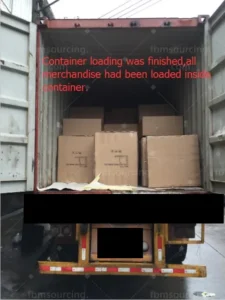
- Packing and loading. Casegoods ship assembled or knocked down depending on the piece and the site, in cartons labelled by room type.
Sometimes, on a large project, the casegoods alone fill full containers; sometimes the casegoods share containers with the other product categories of the same project; and sometimes, in one batch, we combine a dozen or more product categories from several projects of the same client into a few containers — always full containers, and for us this is routine, well-practised work.
Have a guestroom casegoods schedule to price?
Send us the FF&E schedule and room-type drawings. We will match each piece to the right type of Chinese plant and name the compliance evidence in the enquiry.
Frequently Asked Questions
What are hotel casegoods?
Hotel casegoods are the box-built furniture pieces in a guestroom: headboards and bed surrounds, nightstands, wardrobes and closets, desks and TV panels, luggage benches and minibar cabinets. They are made mainly from laminate-faced or veneered board and are normally built to the project’s own drawings.
Are there publicly listed hotel casegoods manufacturers in China?
As of 21 September 2026 we found no currently listed Chinese company, free of a risk-warning designation, whose annual report presents hotel casegoods as a reported product segment. Two listed custom-furniture groups, Zbom Home Collection (Shanghai, 603801) and Suofeiya Home Collection (Shenzhen, 002572), describe hotel projects within their project sales channels in their 2025 annual reports.
Where are most hotel casegoods made in China?
Foshan’s Shunde district in Guangdong is one of the main centres. The Shunde District government’s profile of Longjiang town counts more than 2,000 furniture manufacturing enterprises and more than 3,000 furniture materials trading enterprises there. Our article on hospitality casegoods hubs covers the other clusters.
What formaldehyde documents should come with casegoods shipped to the United States?
Under 40 CFR Part 770, finished goods containing hardwood plywood, MDF or particleboard must be labelled with the fabricator’s name, the production date in month and year format and a statement of TSCA Title VI compliance, and the importer must keep the supplier’s written compliance statement for three years along with records identifying the panel producer.
Does FBM Sourcing inspect casegoods before they ship?
Yes. FBM Sourcing carries out one inspection by our own team at the factory after bulk production is finished and before shipment, with photo and video records. The inspection report goes to the client before the balance is paid.
About FBM Sourcing
FBM Sourcing manages the entire China procurement package for overseas construction projects. Since 2014 we have worked with developers, general contractors, builders, commercial project owners, interior design and construction companies and FF&E solution providers across more than 20 countries and over 1,000 containers, as their sourcing partner in China — from the schedule or BOQ through factory selection, sampling, inspection by our own team before shipment, consolidation and shipping. All quotations, invoices and shipping documents are issued by FBM Sourcing, and sea freight is quoted to you before shipment. If you have a hotel casegoods package to price, start at China building materials and FF&E procurement.