Stadium and arena seating in China is supplied by venue-equipment companies rather than by general furniture factories, because the product is a fixed building component: the seats anchor into the structure, stay outdoors for decades, and fall under the EN 13200 spectator-facilities standards rather than ordinary furniture standards. Two Chinese listed companies state a venue-seating role in their own official records: Jiangsu Jinling Sports Equipment Co., Ltd. (Shenzhen Stock Exchange ChiNext, 300651) and Zhejiang Dafeng Industry Co., Ltd. (Shanghai Stock Exchange, 603081). Beyond those two, the supply base is described here by manufacturer type and the product evidence to request.
This is written for developers, general contractors, builders, commercial project owners, interior design and construction companies and FF&E solution providers working on stadiums, arenas, sports halls and school sports facilities. It covers spectator seating only: tip-up stadium seats, bleacher and grandstand bench seating, telescopic and demountable stands, and box seating. It does not cover auditorium or lecture theatre seating, a different product family under a different standard, covered in our guide to auditorium and lecture theatre seating manufacturers in China.
Why is stadium seating not the same product as auditorium seating?
This is the most common specification error on venue projects, and the standards draw the line themselves. EN 13200-1:2019, the general part of the spectator-facilities series, applies to spectator facilities at entertainment venues including sport stadia, sport halls, and indoor and outdoor facilities. Its own scope then states that it is not applicable to other permanent venues such as theatres, cinemas, opera houses, auditoriums, lecture halls and similar places where persons congregate. Grandstand seating and lecture theatre seating are two separate worlds.
The practical differences follow. A stadium seat lives in rain, frost, salt air and direct sun, is pressure-washed, and is usually an unupholstered polymer shell on a metal bracket, while an auditorium seat sits indoors at controlled temperature, upholstered, judged on acoustics and comfort. A plant good at one is not automatically competent at the other.
The consequence for test files is sharper still. EN 12727:2016, Furniture – Ranked seating – Requirements for safety, strength and durability, is the standard seating factories quote most. It covers seating permanently fastened to the floor and/or wall, and does not apply to linked seating that is not fastened down, or to street furniture. Its scope also states that it does not include requirements for resistance to ageing, degradation, flammability, the effect of ambient temperature, or the durability of upholstery materials. An EN 12727 report therefore says a great deal about structural strength and nothing about how a seat behaves after ten summers outdoors.
The product families inside a venue seating package
Fixed tip-up spectator seats
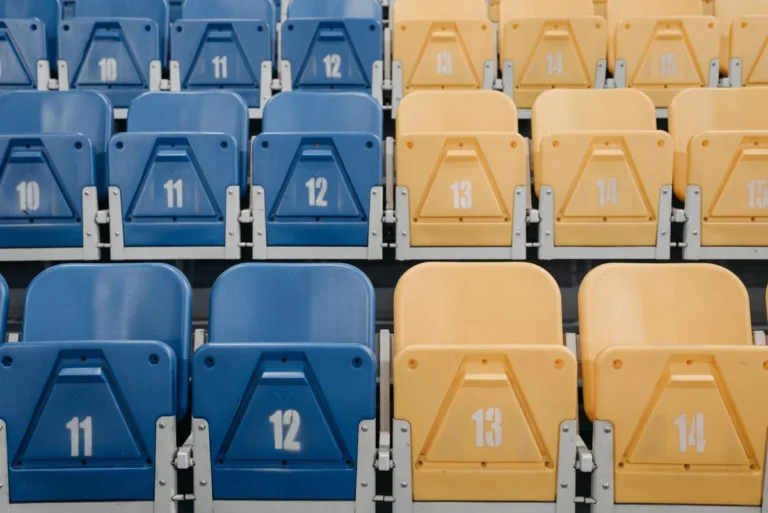
A blow-moulded or injection-moulded polymer shell, with or without a backrest, on a riser-mounted or tread-mounted bracket, folding by gravity or counterweight. Variants run from backless bench pads on economy tiers to half-back and full-back seats, and to armrest or cupholder versions in the box tiers. The bracket and fixing detail are as much of the engineering as the shell, because the seat transfers crowd loads into the structure.
Bleacher and grandstand bench seating
Aluminium or steel plank seating on a fabricated substructure, used for sports fields, training grounds and secondary stands. The plank is an extruded or roll-formed section; the value and risk sit in the substructure, guardrails and walking surfaces, which belong with the project’s structural steel scope, covered in our guide to metalwork manufacturers in China for commercial projects.
Telescopic, retractable and demountable stands
Banks of seating that fold into a fraction of their depth so a hall can convert between a match configuration and a flat floor. EN 13200-5:2006 specifies product characteristics for telescopic stands at entertainment venues including sports stadiums, sport halls and indoor and outdoor facilities, excluding fairground and amusement park stands; stands erected for an event or a season and taken down afterwards fall instead under EN 13200-6:2020. Both are mechanical systems rather than seats: the understructure, drive, interlocks and deck are the product, and they are procured as engineered systems with erection documentation, not as furniture.
Which standards actually govern spectator seating?
The EN 13200 series is the family to specify against. The table lists the parts and their status as published in a European national standards body catalogue, checked in September 2026. Editions matter: three parts changed edition in the last eight years, and a quotation against a superseded edition is one against a withdrawn document.
| Standard | What it covers | Status as checked |
|---|---|---|
| EN 13200-1:2019 | General characteristics for the spectator viewing area | Valid from 15 March 2019, replacing 2012 |
| EN 13200-3:2018 | Separating elements – requirements | Valid from 3 October 2018, replacing 2006 |
| EN 13200-4:2023 | Seats – product characteristics | Valid from 15 February 2023; 2006 edition withdrawn that day |
| EN 13200-5:2006 | Telescopic stands | Valid from 6 October 2006 |
| EN 13200-6:2020 | Demountable stands | Valid from 2 October 2020, replacing 2012 |
| EN 13200-7:2014 | Entry and exit elements and routes | Valid from 6 May 2014 |
| EN 13200-8:2017 | Safety management | Valid from 16 May 2017 |
EN 13200-4:2023 is the part to write into a seating specification. Its scope covers the mechanical, physical and chemical product characteristics of fixed seating used in sports venues, indoor and outdoor, in the spectator viewing area, and the criteria for fixing it to the structure. Those characteristics are set to ensure adequate resistance to static and dynamic stresses and to atmospheric agents — which is why this part, and not EN 12727, is the right reference for an open bowl.
EN 13200-3:2018 is the part most often forgotten: it covers the barriers in front of a row of fixed seats, adjacent to an end row, behind a rear row, and at the foot of a gangway or stairway — regularly left out of a seating package and discovered late. Where the venue takes upholstered seating, ignitability is assessed under EN 1021-1:2014 and EN 1021-2:2014, both of which state that the test measures a combination of materials, not the finished item of furniture incorporating them.
Weathering and fire: tests that mean nothing without their parameters
EN ISO 4892-2:2013, Plastics – Methods of exposure to laboratory light sources – Part 2: Xenon-arc lamps, specifies methods for exposing specimens to xenon-arc light in the presence of moisture, reproducing weathering effects such as temperature, humidity and wetting. It is an exposure method, so a claim of testing to it says nothing on its own: the duration, irradiance, cycle and acceptance criteria for colour change and retained impact strength all have to come from the specification.
EN ISO 9227:2022, Corrosion tests in artificial atmospheres – Salt spray tests, is explicit about this in its own scope. It specifies the apparatus, reagents and procedure for neutral, acetic acid and copper-accelerated acetic acid salt spray tests, then states that it does not specify the exposure period for a particular product or the interpretation of results — those come from the product specification. A salt spray pass reported without hours and acceptance criteria has reported nothing, so coastal venues should fix those numbers before quotations go out.
For fire, ask which laboratory issued the report, whether it is accredited for that method, and whether it covers the model and material combination being supplied: a report issued for another project, naming that project’s client and architect, is not transferable evidence for yours.
Pricing a stadium or arena seating package from China?
Send us the seating schedule or BOQ and we will match it to factories holding the right EN 13200 evidence for each product family, from bowl seats to telescopic stands.
Which Chinese manufacturers can be named, and what about the rest?
We name a company only where its exchange, ticker and current listed status have been checked against the exchange or national disclosure system, and its own official record states a role in this category. On that basis there are two, not ranked or scored against one another.
Jiangsu Jinling Sports Equipment Co., Ltd. Listed on the Shenzhen Stock Exchange ChiNext board under 300651 since 9 May 2017, registered in Zhangjiagang, Jiangsu. Its registered business scope names venue seating and grandstands alongside sports and stage equipment, and its stated main business covers sports equipment, venue construction, public fitness and event support. Its published project material includes electrically operated retractable grandstand seating and spectator seating supplied with competition equipment on sports centre projects. Evidence to request: the EN 13200-4 report for the seat model and bracket, the fixing detail drawing with the substrate tested, and the weathering record for the shell polymer.
Zhejiang Dafeng Industry Co., Ltd. Listed on the Shanghai Stock Exchange under 603081 since 20 April 2017, registered in Yuyao, Zhejiang, and classified under special-purpose equipment manufacturing. Its stated main business is culture and sports equipment, digital art technology and rail transit equipment, and its registered scope includes sports equipment manufacturing, sports venue facility construction and furniture manufacturing. Its published project material is organised under categories including public seating and movable grandstands. Evidence to request: for a telescopic stand, the EN 13200-5 documentation, the drive and interlock specification, the deck loading calculation, and the maintenance regime the warranty depends on.
The manufacturer types behind the rest of the market
Venue-equipment integrators supply seating with competition equipment, scoreboards and stage systems, and are the natural home for a package including telescopic stands. Evidence to request: a project reference list with venue capacity and completion year, plus EN 13200 documentation per system.
Polymer moulding plants own the tooling and material formulation, where ultraviolet and colour performance is decided, but not the bracket engineering. Evidence to request: resin grade and ultraviolet stabiliser package by name, the exposure report with its parameters, and whether the shell is moulded in-house.
Steel and aluminium fabricators supply bleacher planks, substructures, guardrails and brackets, and their finishing decides how the assembly survives outdoors; our comparison of powder coating and anodised aluminium for commercial projects sets out the trade-off. Evidence to request: coating datasheet, film thickness records, pre-treatment and salt spray parameters.
Ranked-seating factories crossing over from indoor work can be excellent on the seat body and weak on outdoor durability, with a test file that is often EN 12727 only. Evidence to request: whether an EN 13200-4 report exists for the outdoor model, and if not, what outdoor evidence exists.
Assemblers and trading operations buy shells from one source and brackets from another. Nothing is wrong with that, but responsibility for a system-level test report must sit somewhere, and if nobody in the chain holds one the project carries the risk. Evidence to request: which plant holds each report, and where each component is made.
Accessible seating: what a seat supplier can and cannot deliver
On projects in the United States, the 2010 ADA Standards for Accessible Design set the scoping in section 221: assembly areas must provide wheelchair spaces, companion seats and designated aisle seats. Table 221.2.1.1 scales the count with capacity, from one wheelchair space for 4 to 25 seats to 36 plus one for each 200 or fraction thereof above 5,000.
Three provisions catch venue projects. Section 221.2.1.2 requires wheelchair spaces in each luxury box, club box and suite within arenas, stadiums and grandstands, calculated box by box and suite by suite rather than across the venue. Section 221.2.1.4 requires at least one wheelchair space in team or player seating areas serving areas of sport activity. Section 221.3 requires a companion seat for each required wheelchair space, and section 221.4 requires at least five percent of aisle seats to be designated, chosen as those closest to accessible routes.
Most of this is a layout obligation, not a product obligation: a factory can supply removable seats, transfer-type armrests and companion seats, but the space count, dispersion and sightlines are settled in the seating plan, and the order has to be placed against the approved plan.
How the seating package sits with the rest of the venue scope
Seating cannot be set out until the risers are poured and surveyed, and premium areas follow the main bowl, so the package is sequenced against the two categories it most often shares a programme with: sports flooring and artificial turf manufacturers in China and commercial gym and fitness equipment manufacturers in China.
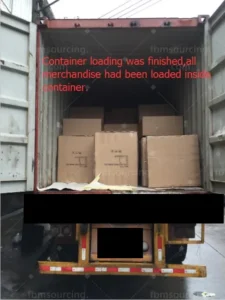
As a sourcing partner on venue packages, FBM Sourcing takes the seating schedule or BOQ, matches it to factories holding the right evidence for the product family, runs sampling and approvals against the drawings, and carries out inspection by our own team at the factory before shipment, with photo and video records. Sometimes, on a large project, the seats alone fill full containers; sometimes the seats share containers with the other product categories of the same project; and sometimes, in one batch, we combine a dozen or more product categories from several projects of the same client into a few containers — always full containers, and for us this is routine, well-practised work.
Pricing a stadium or arena seating package from China?
Send us the seating schedule or BOQ and we will match it to factories holding the right EN 13200 evidence for each product family, from bowl seats to telescopic stands.
Frequently Asked Questions
Which standard should a stadium seating specification reference?
EN 13200-4:2023, Spectator facilities – Part 4: Seats – Product characteristics, valid since 15 February 2023, the day the 2006 edition was withdrawn. It covers the mechanical, physical and chemical product characteristics of fixed seating in the spectator viewing area of indoor and outdoor sports venues, and the criteria for fixing it to the structure. Cite the year, because a report against the withdrawn edition is against a superseded document.
Is an EN 12727 report enough for outdoor stadium seats?
No. EN 12727:2016 covers the safety, structural strength and durability of seating permanently fastened to the floor or wall, but its own scope states that it does not include requirements for resistance to ageing, degradation, flammability, the effect of ambient temperature or the durability of upholstery materials. On an open bowl it should sit alongside EN 13200-4 evidence and explicit weathering parameters, not replace them.
Can one factory supply both telescopic stands and fixed bowl seating?
Some can, but they are different products behind different standards. A telescopic stand is a mechanical system under EN 13200-5:2006 with a drive, interlocks and a moving deck; fixed bowl seating is a building component under EN 13200-4:2023. Ask for documentation on each separately, and confirm which parts are made in-house.
How does stadium seating differ from auditorium and lecture theatre seating?
The standards treat them as separate categories: EN 13200-1:2019 covers sport stadia and sport halls, and states it is not applicable to venues such as theatres, cinemas, opera houses, auditoriums and lecture halls. In practice stadium seating is an unupholstered, weather-exposed shell judged on durability and crowd loading, while auditorium seating is an indoor upholstered product judged on comfort and acoustics, so the two are best sourced separately.
What weathering evidence should be requested for polymer stadium seats?
Ask for the resin grade and ultraviolet stabiliser package by name, and for an exposure report under EN ISO 4892-2:2013 stating the duration, irradiance and cycle used, with acceptance criteria for colour change and retained impact strength. For coastal venues add salt spray evidence for the metal components under EN ISO 9227:2022, which itself states it does not fix the exposure period or interpretation of results, so the specification must set them.
About FBM Sourcing
FBM Sourcing manages the entire China procurement package for overseas construction projects. Since 2014 we have worked with developers, general contractors, builders, commercial project owners, interior design and construction companies and FF&E solution providers across more than 20 countries and over 1,000 containers, as their sourcing partner in China — from the schedule or BOQ through factory selection, sampling, inspection by our own team before shipment, consolidation and shipping. All quotations, invoices and shipping documents are issued by FBM Sourcing, and sea freight is quoted to you before shipment. If you have a stadium and arena seating package to price, start at China building materials and FF&E procurement.