The natural stone manufacturers in China that matter for commercial projects fall into a handful of types: slab processors of imported blocks in Shuitou (Nan’an, Fujian) and Yunfu (Guangdong), quarry-linked granite producers in regions such as Laizhou in Shandong and Macheng in Hubei, cut-to-size fabrication plants, thin and composite panel makers, and dry-hang cladding fabricators. The only listed company named here is Xiamen Wanli Stone Stock Co., Ltd. (Shenzhen Stock Exchange 002785), which describes itself as the first stone company listed on China’s A-share market. Whichever type you use, the installed result depends on tracing every piece back to its block and testing that stone to the destination standard.
This guide is written for developers, general contractors, builders, commercial project owners, interior design and construction companies and FF&E solution providers carrying marble, granite and other natural stone on hotels, offices, residential towers and public buildings. It follows the stone from block to slab to finished piece. For species selection and layout drawings, see our guide to sourcing marble and natural stone from China; for manufactured alternatives, see quartz and engineered stone slab manufacturers in China.
How Does Natural Stone Move from Quarry Block to Finished Piece in China?
Each handover in the chain is a point where the link between a finished piece and its block can be lost:
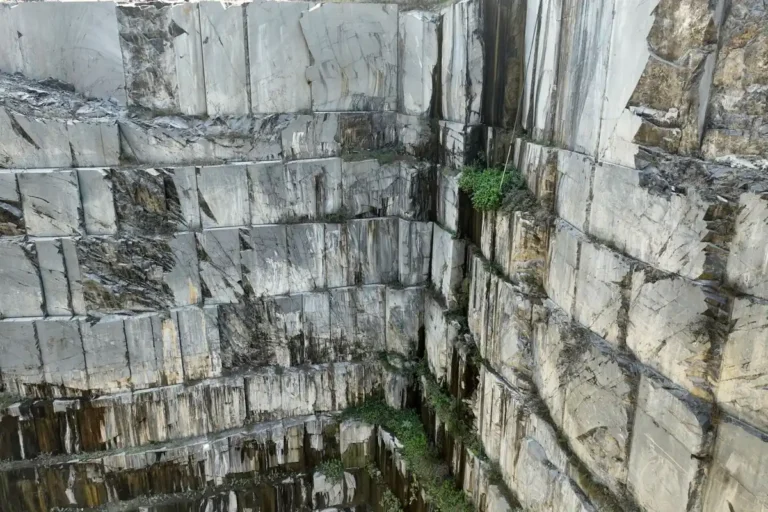
- Block: quarried in China or abroad, graded and numbered. The block is the real unit of colour and veining.
- Sawing: blocks are cut into slabs on gangsaws or wire saws; Nan’an in Fujian has adopted measures promoting wire saws.
- Treatment and finishing: many marbles are resin-filled to close natural fissures, and fragile stones are mesh-backed before polishing, honing or flaming.
- Slab bundles: slabs from one block, kept in sawing sequence and numbered.
- Cut-to-size fabrication: tiles, panels, treads, tops and bookmatched feature panels cut to shop drawings.
A plant buying slabs from a stone yard may not know which block they came from, so traceability has to be asked for.
Which Stones Are Imported Blocks, and Which Are Quarried in China?
China processes a large volume of stone it does not quarry. China Stone Material Association figures cited in Wanli Stone’s 2025 annual report put China’s 2025 stone imports at about 11.05 million tonnes and exports at about 7.99 million tonnes. Published sources on the clusters are specific:
- Nan’an, Fujian: a Fujian Daily report republished on the Fujian provincial government portal in June 2023 describes Nan’an, centred on Shuitou town, as producing almost no stone of its own, and puts its imported stone volume at 60% of the national total.
- Yunfu, Guangdong: an export base profile published by the China Chamber of Commerce for Import and Export of Metals, Minerals and Chemicals states that Yunfu imports marble mainly from Spain, Greece, Turkey and other Mediterranean countries, and granite from Brazil and India.
- Laizhou, Shandong: the city’s 2021–2030 stone industry plan describes more than 20 local varieties, mainly granite, and names Laizhou, Shuitou and Yunfu as China’s three traditional stone bases.
- Macheng, Hubei: the same plan describes a granite cluster built beside the Baiyashan quarry area.
So a named Mediterranean marble on a finish schedule is an imported block, and its lead time depends on whether suitable blocks are already in a Chinese yard. Trade names are not reliable identifiers either. EN 12440:2017 sets criteria for designating natural stone from raw material to finished product, and a purchase order should record petrographic name, country and region of origin and trade name together.
How This List Is Organised
We name only a company whose listing we have checked and that remains listed, describing its role from its own reports. Every other entry is a manufacturer type with industry facts and evidence to request. There is no scoring and no ranking.
Natural Stone, Marble and Granite Slab Manufacturers in China, by Type
Xiamen Wanli Stone Stock Co., Ltd. (Wanli Stone)
- Listing: Shenzhen Stock Exchange, stock code 002785, listed since December 2015.
- Role in the category: its 2025 annual report describes design, processing, sale and installation of architectural decorative stone made from natural granite and marble, plus landscape and memorial stone, including design-supply-install work on overseas projects. Stone processing made up almost all 2025 revenue; the report also records block trading and partly imported raw stone.
- Footprint disclosed: processing in Xiamen; its Tianjin stone subsidiary halted production from 12 March 2026; an associate plant in Vietnam and a Cambodian base described in the 2026 interim report as in production. It is also developing lithium and uranium resources.
- Evidence to request: the processing plant and block origin for each stone, and test reports for the exact stone and finish.
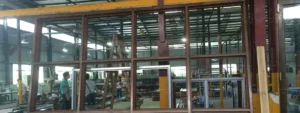
Imported-block slab processors in Shuitou, Nan’an (Fujian)
- What they make: slab bundles and cut-to-size pieces from imported blocks; some also produce ultra-thin stone.
- Industry facts: a cluster built on processing and trade rather than local quarries, now also investing in stone machinery and creative stone products.
- Evidence to request: block number and origin for every bundle, photographs of every slab in sequence, declared resin and mesh treatment, and test reports for that stone rather than a generic sheet.
Marble and mixed stone processors in Yunfu (Guangdong)
- What they make: marble and granite decorative slabs, stone furniture and stone craft products, alongside reconstituted stone slabs.
- Industry facts: the 2020 chamber profile counts nearly 4,000 stone businesses in Yunfu’s Yuncheng district, about 1,600 of them processors. Reconstituted stone is not natural stone: ASTM C503/C503M-23 excludes moulded, cast and artificially aggregated units.
- Evidence to request: written confirmation that each line is natural stone, petrographic examination to EN 12407:2019 where the stone type is uncertain, and results to EN 16306:2022 for exterior marble.
Quarry-linked granite producers (Laizhou, Shandong; Macheng, Hubei)
- What they make: granite slabs, paving, kerbs, stair treads and cladding in polished, honed and flamed finishes.
- Industry facts: Laizhou’s plan records that environmental rectification in 2016–2020 shut its quarrying companies and left processors working through stockpiled blocks, so quarry supply can be interrupted.
- Evidence to request: confirmation that the full quantity can come from one quarry and block lot, test reports to ASTM C615/C615M-23 or the relevant EN standard, and slip results for external finishes.
Cut-to-size and project fabrication plants
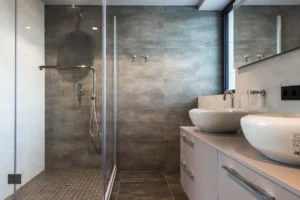
- What they make: calibrated tiles, wall panels, treads and risers, skirting, vanity tops, waterjet inlays and bookmatched feature walls.
- Industry facts: many do not saw blocks, so traceability depends on slab records received. See our guide to stone countertops sourced from China.
- Evidence to request: shop drawings with piece numbers, a slab-to-piece cutting map, tolerances and edge samples.
Thin stone and composite panel makers
- What they make: stone veneers on backings such as aluminium honeycomb, and ultra-thin sheets; Fujian reporting describes a Nan’an company making 0.5 mm stone sheets.
- Where they fit: lift interiors, ceilings and walls that cannot carry solid stone.
- Evidence to request: test results and reaction-to-fire evidence for the complete panel as supplied, where the building code requires them, plus fixing details.
Dry-hang cladding fabricators
- What they make: facade and interior panels with factory-cut kerfs, dowel holes or undercut anchor holes, sometimes with the anchors.
- Industry facts: China has national standards for dry-hang facing stone (GB/T 32834-2016) and for metal anchors for dry-hang stone (GB/T 32839-2016).
- Evidence to request: anchorage results for the exact stone, thickness and anchor, hole position drawings and anchor material certificates.
Pricing a marble, granite or natural stone package from China?
Send your finish schedule, drawings and destination market, and our team will match each stone to block-traceable supply and the test evidence your specification calls for.
Full Slabs, Cut-to-Size Pieces or Thin Panels: Which Format Suits Which Work?
| Format | What arrives | Suits | Watch for |
|---|---|---|---|
| Full slabs in bundles | Finished slabs in sawing sequence | Feature walls and tops cut locally | Transit breakage, local cutting capacity, offcut waste |
| Cut-to-size pieces | Numbered panels, treads and tops | Lobbies, corridors, stairs, bathrooms, facades | Needs final drawings and site dimensions |
| Calibrated modular tiles | Standard sizes gauged to thickness | Large repeated floor and wall areas | Colour banding between batches |
| Thin or composite panels | Stone veneer on a light backing | Lifts, ceilings, weight-limited walls | Evidence must cover the whole panel |
Breakage and cutting allowances differ by format, as set out in our guide to tile and stone flooring wastage allowances.
Dry-Hang or Adhesive Fixing: What Changes in the Stone Order?
- Adhesive fixing: thinner pieces bedded on a prepared substrate; confirm that mesh-backed or resin-treated backs suit the adhesive.
- Mechanical dry-hang fixing: thicker panels with kerfs or anchor holes cut in the factory to the facade engineer’s drawings, with anchorage tested on the actual stone. ASTM C1242-26 guides attachment system design for US projects.
- Exterior marble: EN 16306:2022 sets a laboratory method for resistance of marble to thermal and moisture cycling for external facade cladding, noting that bowing and rapid strength loss are known to occur in some marbles used this way.
Facade systems and anchors are covered in our guide to marble and stone cladding sourcing.
Which Standards Apply to Marble and Granite for Export Projects?
| Requirement | United States projects | European projects | China domestic reference |
|---|---|---|---|
| Marble dimension stone | ASTM C503/C503M-23 | Product standards by use, below | GB/T 19766-2016 |
| Granite dimension stone | ASTM C615/C615M-23 | Product standards by use, below | GB/T 18601-2024 |
| Cladding slabs | ASTM C1242-26 (attachment) | EN 1469:2015 | GB/T 32834-2016 (dry-hang) |
| Floor and stair slabs; modular tiles | Within C503 and C615 | EN 12058:2015; EN 12057:2015 | Not covered here |
| External paving slabs | Not covered here | EN 1341:2012 | Not covered here |
| Water absorption and density | ASTM C97/C97M-25 | EN 13755:2008; EN 1936:2006 | Not covered here |
| Flexural strength | ASTM C880/C880M-25; ASTM C99/C99M-25 (modulus of rupture) | EN 12372:2022 | Not covered here |
| Anchorage strength | ASTM C1354/C1354M-22 | EN 13364:2001 | GB/T 32839-2016 (anchors) |
| Frost; slip | Not covered here | EN 12371:2010; EN 14231:2003 | Not covered here |
| Radioactivity | Not covered here | National rules under Directive 2013/59/Euratom | GB 6566-2010 |
ASTM C503/C503M-23 classifies marble as calcite or dolomite and sets requirements for absorption, density, compressive strength, modulus of rupture, abrasion resistance and flexural strength; ASTM C615/C615M-23 covers the same properties for granite. A Chinese report to GB/T 19766-2016 or GB/T 18601-2024 does not demonstrate compliance with an ASTM or EN specification. China’s mandatory standard GB 46028-2025, safety technical requirements for building decorative stone, took effect in China on 1 August 2026.
Is Radioactivity a Real Issue for Granite and Other Natural Stone?
It is regulated in both China and the European Union, and the EU’s indicative list includes igneous stone such as granite.
- China: GB 6566-2010, in force since 1 July 2011, grades decorative materials by internal and external exposure indices. Class A (up to 1.0 and 1.3) may be used for all interiors; Class B (up to 1.3 and 1.9) is restricted indoors by building type; Class C (external index up to 2.8) is for exterior surfaces and outdoor use only.
- European Union: Article 75 of Council Directive 2013/59/Euratom sets a reference level of 1 mSv per year for indoor external exposure to gamma radiation emitted by building materials, in addition to outdoor exposure. Member States identify materials of concern taking into account Annex XIII, which lists granitoids such as granites, syenite and orthogneiss, and for those materials ensure that radium-226, thorium-232 and potassium-40 activity concentrations are determined before they are placed on the market.
For granite used indoors, request a gamma spectrometry report on material from the block lot being supplied, not from another quarry selling under the same name.
Keeping Colour Consistent from Block to Building
- Reserve by block lot: allocate enough blocks from one quarry for the whole project, including later phases and attic stock.
- Approve bundles, not chips: review photographs of every slab in sequence and a physical range showing the accepted light-to-dark band.
- Map slabs to pieces: cutting maps keep adjacent panels on one slab sequence; the factory dry lays continuous areas and packs in piece-number order.
Packing and Container Planning for Stone
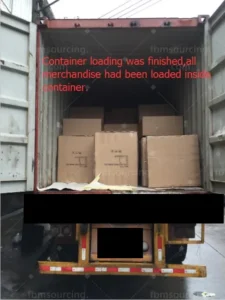
Stone fills a container by weight long before volume. Slabs travel upright on A-frames or in strapped crates; cut pieces travel dry, with non-staining separators and crate lists matching piece numbers.
Sometimes, on a large project, the stone slabs and tiles alone fill full containers; sometimes the stone slabs and tiles share containers with the other product categories of the same project; and sometimes, in one batch, we combine a dozen or more product categories from several projects of the same client into a few containers — always full containers, and for us this is routine, well-practised work.
Evidence to Request Before Releasing a Natural Stone Order
- Stone identity: petrographic name, origin, trade name and block numbers for each stone.
- Slab records: photographs of every slab in sequence, with resin and mesh treatment declared.
- Test reports to the standards in your specification, for the stone and finish ordered.
- Application evidence: anchorage, slip, frost and, for exterior marble, thermal-moisture results as the application requires.
- Radioactivity report for granite and other igneous stone used indoors.
- Shop drawings and cutting maps with piece numbers matching crate lists.
As a sourcing partner, FBM Sourcing collects this evidence against the finish schedule, keeps block, slab and piece records connected, and carries out inspection by our own team at the factory before shipment, with photo and video records. The sampling logic is explained in pre-shipment inspection and AQL sampling.
Pricing a marble, granite or natural stone package from China?
Send your finish schedule, drawings and destination market, and our team will match each stone to block-traceable supply and the test evidence your specification calls for.
Frequently Asked Questions
Is marble processed in China quarried in China or imported?
Both. China quarries its own marbles and granites but imported about 11.05 million tonnes of stone in 2025, according to China Stone Material Association figures, and Yunfu imports marble mainly from Spain, Greece and Turkey.
Which standards should Chinese granite be tested to for a US project?
The specification is ASTM C615/C615M-23, with test methods including ASTM C97/C97M-25 for absorption and bulk specific gravity, ASTM C880/C880M-25 for flexural strength, ASTM C170/C170M-24a for compressive strength and ASTM C1354/C1354M-22 for anchorages.
Do granite tiles from China need a radioactivity test?
For interior use a report should be requested. China grades decorative materials into Classes A, B and C under GB 6566-2010, and Directive 2013/59/Euratom lists granites among materials considered for gamma radiation, so the report should cover the block lot actually supplied.
What is the difference between full slabs and cut-to-size stone from China?
Full slabs arrive whole for a local fabricator to cut, which suits feature walls and tops but moves waste and cutting risk to site; cut-to-size stone arrives as numbered pieces made to shop drawings, which suits floors, walls, stairs and facades but needs final dimensions first.
Why does exterior marble cladding need extra testing?
Bowing and rapid strength loss are known to occur in some marbles used as exterior cladding. EN 16306:2022 provides a laboratory method for resistance of marble to thermal and moisture cycling, and dry-hang panels also need anchorage tests on the actual stone.
About FBM Sourcing
FBM Sourcing manages the entire China procurement package for overseas construction projects. Since 2014 we have worked with developers, general contractors, builders, commercial project owners, interior design and construction companies and FF&E solution providers across more than 20 countries and over 1,000 containers, as their sourcing partner in China — from the schedule or BOQ through factory selection, sampling, inspection by our own team before shipment, consolidation and shipping. All quotations, invoices and shipping documents are issued by FBM Sourcing, and sea freight is quoted to you before shipment. If you have a natural stone, marble and granite package to price, start at China building materials and FF&E procurement.