Sourcing chinese marble and natural stone for a commercial project means buying processing capacity as much as material: China is the world’s largest stone processing base, cutting both domestic quarry species and imported blocks (Italian, Greek, Turkish, Brazilian) into slabs, tiles, countertops, stair treads and cladding panels in one coordinated package. A project stone order runs on a 25–40 day processing cycle after layout drawings are approved, ships at 25–28 tonnes per container, and succeeds or fails on three documents: the cutting-list drawings, the factory dry-lay record, and the piece-numbering that tells installers where every slab goes. This guide covers the full stone scope for project buyers — what to source, which species logic to use, and how to control veining, water marks and breakage. FBM Sourcing works as your sourcing agent and sourcing partner throughout this process.
One scope note: this is the category-wide guide. If your package is specifically exterior or lobby wall cladding on mechanical fixings, our china marble and stone cladding guide covers dry-hang systems, anchors and facade engineering in detail; if it is kitchen and vanity tops, see stone countertops sourcing from China.
What Stone Applications Can One China Package Cover?
The efficiency of sourcing stone from China comes from consolidating every stone trade in the building into one processing programme:
- Flooring: calibrated tiles (600×600mm, 800×800mm) or pattern-cut slab flooring for lobbies, typically 18–20mm thick
- Wall cladding: interior panels at 18–20mm adhesive-fixed, or 25–30mm for mechanically fixed dry-hang systems
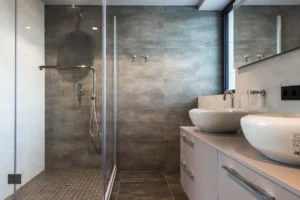
- Countertops and vanity tops: kitchen, bathroom and bar tops at 18–20mm with laminated edges, cut to templates with sink and tap cutouts done in the factory
- Stairs: treads and risers, treads commonly 30mm with anti-slip grooving cut in-line
- Feature elements: reception desk faces, columns, table tops, window sills and skirtings from the same blocks, so the lobby reads as one material
The single-package logic has a quality dividend: when the flooring, cladding and desk face are cut from the same block sequence, colour and veining stay consistent across the space — something impossible to guarantee when three trades buy stone separately. A typical hotel lobby package runs 800–2,500m² of stone across these applications, processed by one factory under one drawing set.
Chinese Quarry Species or Imported Blocks Processed in China — Which Should You Specify?
China’s stone industry runs two supply logics, and most projects use both:
Domestic species — Chinese quarries produce a deep range of commercial-grade marbles (whites, greys, beiges, blacks), granites and travertine-type stones. The structural advantage is supply-chain depth: quarry, block yard and processing factory sit inside one domestic chain, so lead times are shorter, replacement material for future phases is easier to secure, and the cost structure carries no international block freight. For large-area flooring and cladding where the design intent is “calm grey marble” rather than a named famous stone, domestic species usually win on every axis.
Imported blocks processed in China — when the design specifies Carrara, Calacatta-type whites, or other named international stones, the blocks are imported into China and processed there. You get the specified stone with China’s processing scale and labour economics; the trade-offs are longer lead time (add 4–8 weeks for block supply if not already in a Chinese block yard) and a cost structure dominated by the block itself rather than processing. The decision discipline: send the design intent and let equivalent domestic species be dry-laid next to the imported reference — on many projects a domestic alternative passes the designer’s review for large-area use, with the imported stone held for the one feature wall where it earns its cost. For countertop applications, also weigh engineered alternatives — see our comparison of sintered stone vs quartz vs granite for hotel countertops.
Sourcing this for a commercial project?
FBM Sourcing works with project owners, developers, main contractors and FF&E contractors on hotel, apartment, school, office and other commercial building projects. Send us your BOQ, drawings or product list — our team will review it and get back to you.
How Do Layout Drawings and Dry-Lay Control Veining and Colour?
Natural stone is the one building material where every unit is different, so project stone is bought against drawings, not against a sample chip. The control sequence:
- Cutting-list (layout) drawings — the factory converts your architectural drawings into a slab-by-slab cutting plan: every floor panel, wall panel and tread gets a piece number keyed to an installation location. Book-matching and vein-direction decisions (veins running with the corridor, mirrored across a feature wall) are made here, on paper, before a single slab is cut. Allow 1–2 weeks plus a revision round.
- Control-sample approval — a range of samples showing the accepted light-to-dark band for the lot, because a single chip cannot represent a natural material. This range becomes the inspection standard, following the same sign-off discipline as any custom item — see how sample approval works when sourcing from China.
- Factory dry-lay — the cut material for each visually continuous area is laid out flat at the factory in installation sequence and photographed panel by panel. This is where colour drift, vein clashes and out-of-range pieces are caught and re-cut — at the cost of days, not the weeks and claims the same discovery costs on site. On FBM Sourcing projects the dry-lay is reviewed by our own inspection team and delivered to the design team as a photo and video record for remote sign-off, alongside dimensional checks to ±1mm on calibrated pieces.
The piece numbers then follow the stone through crating to site, so installers lay panel 14 in position 14 — the dry-lay is worthless if the sequence dies in packing.
How Do You Manage Water Marks, Colour Variation and Breakage?
Three defect classes account for most stone disputes, and each has a known prevention:
- Water marks and staining. Stone is processed wet; crated damp, moisture migrates and leaves shadowy marks, and light marbles can pick up staining from packing materials. Prevention: drying time before packing, six-side sealing on moisture-sensitive light stones, and non-staining separators (clean foam or plastic film, never dyed materials or raw timber against a polished face).
- Colour variation beyond the approved range. Prevention is the control-sample range plus dry-lay above — and for multi-phase projects, reserving matched material from the same block sequence at order time, because returning to a quarry a year later for “the same stone” is a lottery.
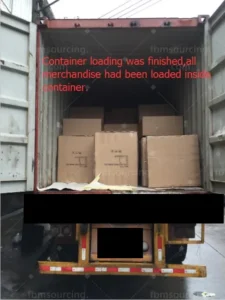
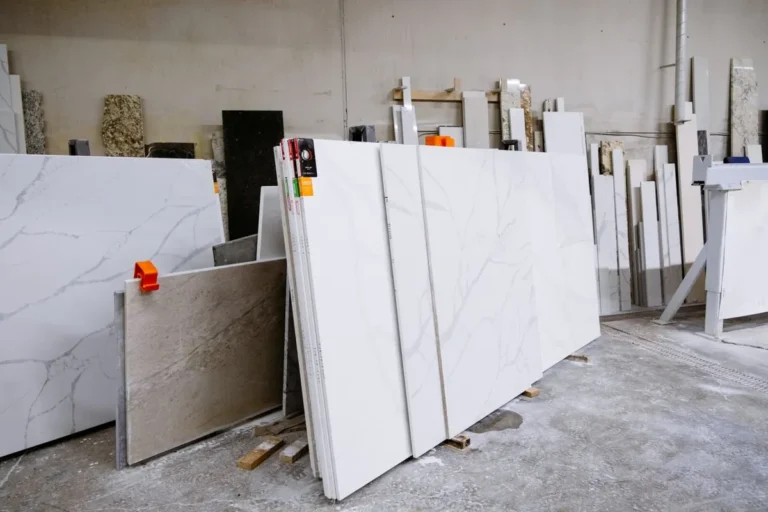
- Transit breakage. Stone ships on A-frames or in reinforced wooden crates, vertical for slabs, flat for calibrated tiles, and hits container weight limits fast: at 18–20mm thickness roughly 50–55kg/m², a 20ft container’s 25–28 tonne payload carries only about 450–550m² — stone budgets are weight-driven, not volume-driven. Order 3–5% overage on field material and 5–7% on delicate pieces; some breakage and cutting waste is a certainty, and overage ordered with the batch matches; replacement ordered later may not.
Final inspection before loading — face checks, edge checks, moisture, crate count against the cutting list — is carried out by FBM Sourcing’s own team and documented in photos and video, the same regime described in our factory QC and inspection guide.
What Does the Stone Programme Timeline Look Like?
Working backwards from the stone trades’ site dates: 1–2 weeks quotation from your drawings and BOQ, 1–2 weeks layout drawings, 1–2 weeks control-sample approval, 25–40 days processing including dry-lay, then loading and 18–35 days ocean freight by destination. That is roughly 3–4.5 months door to door for domestic species — add 4–8 weeks if imported blocks must be bought in. The scheduling trap is templating: countertop and stair pieces cut to site templates cannot start until site dimensions exist, so most projects split the order — field flooring and cladding released early from drawings, template-dependent pieces released in a second wave — rather than holding the whole package for the slowest measurement.
Frequently Asked Questions
Is Chinese marble good quality for commercial projects?
Yes — China is the world’s largest stone processing base, and commercial-grade domestic marbles, granites and travertine-type stones are specified on hotel and apartment projects worldwide. Quality is controlled by process, not origin: an approved control-sample range, slab-by-slab cutting drawings, a photographed factory dry-lay and final inspection to ±1mm on calibrated pieces are what determine the installed result.
Should I use Chinese stone species or imported stone processed in China?
Use domestic species for large-area flooring and cladding where the intent is a colour family rather than a named stone — shorter lead times, deeper supply for future phases, no international block freight in the cost structure. Import named stones (Carrara, Calacatta types) as blocks processed in China where the design demands them, typically holding them for feature areas; dry-laying a domestic equivalent next to the imported reference often settles the question.
How much stone fits in a shipping container?
Stone is weight-limited, not volume-limited: at 18–20mm thickness it weighs roughly 50–55kg/m², so a container’s 25–28 tonne payload carries only about 450–550m² of slab or tile. Slabs ship vertically on A-frames, calibrated tiles flat in reinforced crates, and field material should include 3–5% overage ordered with the batch so replacements match.
How long does a project stone order from China take?
Roughly 3–4.5 months door to door for domestic species: 1–2 weeks quotation, 1–2 weeks layout drawings, 1–2 weeks control-sample approval, 25–40 days processing including the factory dry-lay, then 18–35 days ocean freight. Add 4–8 weeks if imported blocks must be bought in, and split template-dependent pieces (countertops, stairs) into a second release so they do not hold the field material.
Where a finish schedule names an imported marble or a Chinese granite, it helps to know which natural stone manufacturers in China saw blocks into slabs, which only cut to size, and what test evidence each type can provide.
Get a Stone Package Quote for Your Project
If your project carries a stone scope — lobby flooring, cladding, countertops, stairs or all of them — send us the architectural drawings, finish schedule and destination port. As a building material sourcing agent, we will propose species options against your design intent, run the layout drawings, dry-lay and inspection sequence with our own team, and deliver the whole package numbered for installation — on a 5% commission for suppliers you nominate (products we source for you are quoted at a direct price), as part of a complete China building materials and FF&E procurement programme.