
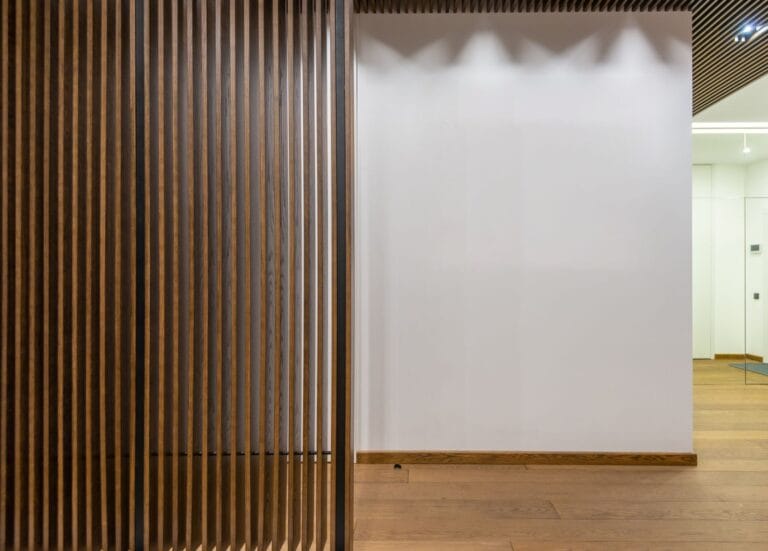
Acoustic panels look like a single product category and are not. A fabric-wrapped absorber, a PET felt baffle, a perforated wood slat panel, a perforated gypsum board and a mineral fibre ceiling tile solve overlapping problems using entirely different manufacturing processes, and in China they are made by different types of company in different provinces. A commercial interiors package that lists “acoustic panels” as one line will come back with quotations that are not comparable to each other.
This is a shortlisting guide for project buyers, not a ranking. There are no scores, and we do not publish which factories we work with. The last field under each supplier type is the evidence to request — because on a category where almost every supplier claims the same NRC figure, what separates them is what they can produce on paper.
Why We Have Not Published a List of Named Factories Here
The acoustic panel trade in China is dominated by private, mid-sized converters rather than by publicly listed manufacturers, which means there is no filing, annual report or exchange disclosure against which a claimed capacity or revenue figure can be checked from outside. We would rather tell you what type of company to approach and what to demand from them than publish a Top 10 of names we cannot verify independently. Where you do want a named shortlist, the way to build one is to take the supplier types below to a sourcing conversation and let the evidence requests do the filtering.
Which Acoustic Product Are You Actually Specifying?
- PET / polyester fibre panels and baffles: thermally bonded recycled polyester, self-finished, cut and shaped by CNC. No separate fabric, no frame, low VOC, and the reason this format took over open-plan offices and schools. See PET, fabric-wrapped and wood slat acoustic panels compared.
- Fabric-wrapped absorbers: a glass wool or mineral wool core in a frame, wrapped in acoustically transparent fabric. Highest absorption per millimetre of thickness, and the format that dominates auditoria, cinemas and conference rooms. Two suppliers matter here, not one: the panel converter and the fabric mill.
- Perforated or slatted wood panels: MDF or plywood carriers with a veneer, melamine or lacquer face, perforated or grooved and backed with an acoustic fleece. Made by joinery and panel factories rather than by acoustic specialists, which is why lead time and finish quality track the millwork trade. See modular standard vs fully custom millwork.
- Mineral fibre and metal acoustic ceilings: a ceiling system, not a wall product, sold by the square metre with a grid. See mineral fibre vs gypsum vs metal ceilings and acoustic ceilings sourcing.
- Acoustic wall systems as a package: where absorption, fire rating and a finished architectural appearance have to be delivered together. See acoustic wall panels sourcing from China.
Where Is Acoustic Panel Production Concentrated in China?
- Jiangsu and Zhejiang — the PET and polyester fibre base, sitting alongside the same non-woven and synthetic fibre industry that supplies filtration and automotive interiors. Most self-finished felt panels and baffles trace back here.
- Guangdong (Foshan, Guangzhou, Dongguan) — panel conversion, wood slat and perforated MDF production, metal ceilings and the fabrication capacity to carry a finished architectural face. This is also where a mixed interiors package is easiest to consolidate.
- Shandong and Hebei — mineral wool and glass wool core material, feeding fabric-wrapped absorber makers rather than selling to projects directly.
- Shanghai and surrounding Yangtze Delta — the concentration of international-standard testing laboratories and the trading houses that serve specification-driven export work.
The practical consequence for a package mixing ceiling tiles, wall absorbers and slatted feature walls is that it spans at least two clusters and usually three suppliers. That is a consolidation exercise. See consolidating multiple factories into one container.
Pricing an acoustic or interiors package?
FBM Sourcing works with project owners, developers, main contractors and FF&E contractors on commercial building projects. Send your finishes schedule or drawings and our team will review it and get back to you.
Supplier Types Worth Shortlisting
1. PET felt panel converters
- Characteristics: non-woven fibre plants running thermal bonding lines, with CNC cutting and often in-house colour matching. Typically 100–300 staff, export-oriented, and comfortable with bespoke shapes because cutting is digital.
- Best fit: offices, schools, libraries and any project where the panel is the finish and the installation must be fast.
- Evidence to request: a reverberation-room absorption test report to ISO 354 (not an impedance tube figure quoted as if it were an NRC), the fire test report against your destination standard, recycled content percentage with the supporting declaration, and colour batch consistency policy across phases.
2. Fabric-wrapped absorber manufacturers
- Characteristics: assembly operations combining a bought-in mineral or glass wool core, a frame and a fabric. Because two of the three inputs are purchased, the supplier’s own quality control on incoming material matters more than its own line.
- Best fit: cinemas, auditoria, lecture theatres, conference and broadcast rooms where high absorption at low frequency is required.
- Evidence to request: the core density and thickness actually used in the tested build-up, the fabric’s own fire certificate as a separate document from the panel’s, whether the tested assembly matches the assembly being quoted, and the tolerance on panel dimensions since these are almost always installed as a butt-jointed grid.
3. Wood slat and perforated panel joinery factories
- Characteristics: panel furniture and millwork factories with CNC perforation, edge banding and finishing. They are woodworkers who make an acoustic product, not acousticians who work in wood, and their strengths and risks follow from that.
- Best fit: hotel lobbies, restaurants, reception areas and feature walls where appearance leads and absorption is a secondary requirement.
- Evidence to request: the board emissions class (CARB Phase 2, E0 or E1) with the mill certificate, the surface spread of flame class for the finished panel rather than the raw board, whether the acoustic fleece is factory-applied, and physical samples in the actual veneer or decor before the run.
4. Ceiling system manufacturers
- Characteristics: volume producers of mineral fibre tiles, metal pans and grid, selling systems rather than panels, and quoting by the square metre including suspension components.
- Best fit: repeatable ceiling areas across many rooms or floors where the grid module and tile size are fixed.
- Evidence to request: whether the grid is included and to what load class, humidity and sag performance for the destination climate, and the accessory schedule, since the perimeter trims and hangers are where ceiling packages are routinely under-quoted.
5. Trading houses and system integrators
- Characteristics: companies that assemble a mixed acoustic package from several factories and present one quotation. Sometimes exactly what a project needs; sometimes an unnecessary margin over a single-factory purchase.
- Best fit: packages genuinely spanning three or more manufacturing types where a single point of accountability is worth paying for.
- Evidence to request: which lines are made in-house and which are bought, who holds the test reports, and who carries the replacement obligation if one component of the package fails at destination. See manufacturer, trading company or sourcing agent.
What Does an Acoustic Panel Test Report Actually Have to Say?
This is the single field where acoustic quotations diverge most and buyers check least.
- Absorption: a reverberation room test to ISO 354, reported as absorption coefficients across the octave bands and reduced to a single NRC or αw figure. A number quoted with no test method behind it means nothing. The mounting condition matters as much as the panel — the same panel direct-fixed and on a 50mm cavity give different results.
- Fire: the destination standard, not a Chinese equivalent. EN 13501-1 for Europe and the UK, ASTM E84 Class A for most US commercial work, AS/NZS ISO 9705 or AS 5637 in Australia. See Class A flame spread wall panels for US projects and the wider fire rating standards map for building materials and finishes.
- Emissions: for anything wood-based, CARB Phase 2 or TSCA Title VI for the US and E0/E1 elsewhere. For PET, a VOC declaration.
- The test has to match the product: the most common problem is a genuine report for a 25mm panel supplied against a quotation for 9mm, or a report for the supplier’s standard colour supplied against a custom one. Ask which specific build-up was tested and compare it line by line with what is being priced.
What Moves the Price on an Acoustic Package?
- Thickness and density — the actual acoustic performance driver, and the easiest place for a cheaper quotation to hide.
- Shape and cutting — rectangular panels nest efficiently on a sheet; complex profiles and curves produce offcut waste that shows up as a unit price increase.
- Fixing system — adhesive, magnetic, clip or track. Track systems can cost more than the panels on a large wall and are frequently left out of an initial quotation.
- Fabric on wrapped panels — a specified fabric can exceed the cost of the panel it wraps, and a buyer-supplied fabric changes the arrangement entirely. See how COM and COL work on China orders.
- Volume and packing — acoustic panels are light and bulky, so they fill a container by volume long before they reach a weight limit. See 40ft container loading, CBM and weight limits.
How Should a Buyer Run the Shortlist?
- Split the package by manufacturing type before asking for prices — PET, wrapped, wood and ceiling as separate schedules.
- State the destination fire and emissions standard on the enquiry rather than asking what the supplier holds.
- Ask for the test reports first and the price second; suppliers who cannot produce a matching ISO 354 report drop out at no cost to you.
- Get physical samples in the actual specification, and for wrapped panels in the actual fabric.
- Price the fixing system and the perimeter details explicitly, since these are the standard omissions.
- Plan the consolidation, because a full acoustic package will not come from one factory.
Acoustic treatment and seating are set out on the same wall and the same riser, so the two packages are usually coordinated together. If your project also has to price the seats themselves, our companion guide to cinema seating manufacturers in China for commercial cinema projects covers the plant types that build powered recliners, fixed rocker-back seats and VIP hall seating, and the evidence to request from each.
About FBM Sourcing
FBM Sourcing manages the entire China procurement package for commercial building projects — furniture, FF&E and building materials — for project owners, developers, main contractors and FF&E contractors. We work from your drawings and schedules, shortlist against the evidence rather than the sales claim, and consolidate multi-factory packages into planned shipments. If you have an acoustic or interiors package to price, start at https://fbmsourcing.com/china-building-materials-ffe-procurement/.





