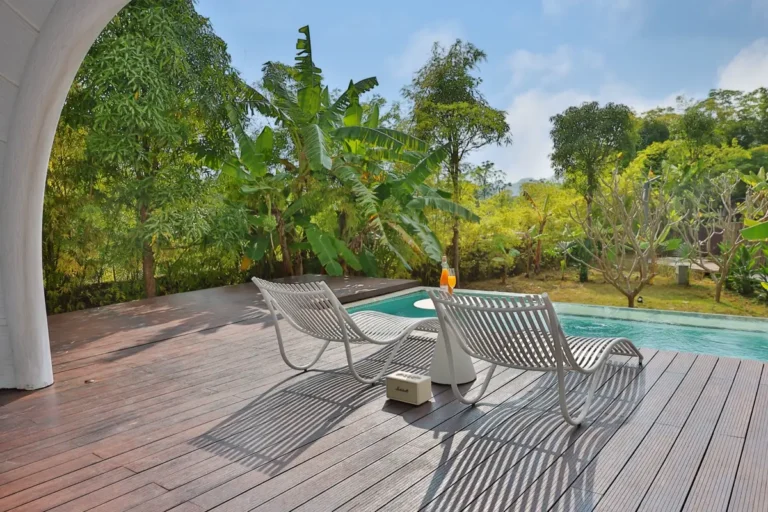
For most resort projects the practical answer is a mix: powder-coated aluminum for pool decks and high-turnover dining terraces, Grade A teak for beachfront dining and feature areas where guests touch and photograph the furniture, and rope-woven pieces on aluminum frames for design-led lounge and cabana zones. Which way the mix tilts depends on salt exposure, UV intensity, wind, and how much maintenance your operations team can realistically sustain. This guide compares aluminum vs teak outdoor furniture — with rope as the third contender — across the eight factors that decide resort specifications, from the perspective of a China sourcing partner that procures all three from dedicated production lines.
Quick Summary: Which Material Fits Which Resort Zone?
| Material | Best-fit resort zones | Key watch-out |
|---|---|---|
| Powder-coated aluminum | Pool decks, sun loungers, casual dining terraces, high-turnover F&B | Coating quality decides coastal lifespan — specify salt-spray-tested finishes |
| Grade A teak | Signature restaurants, beachfront dining, spa courtyards, feature terraces | Highest cost and weight; decide patina-or-maintenance policy up front |
| Rope on aluminum frame | Lounge areas, cabanas, guest-room balconies, lobby-adjacent outdoor seating | Rope grade varies widely — commercial projects need UV-stabilized olefin or HDPE |
Key facts that anchor the comparison:
- Grade A teak heartwood carries natural oils and silica that resist rot, fungus and insects with no applied coating, and weathers to a silver-grey patina rather than degrading.
- Aluminum outdoor frames are typically extruded from 6061 or 6063 alloy; corrosion protection comes from the pre-treatment plus powder coat, verified by salt-spray testing to ASTM B117 — premium outdoor specifications commonly require 500–1,000 hours.
- Commercial rope furniture uses UV-stabilized olefin (polypropylene/polyethylene) or HDPE rope, which retains tensile strength through thousands of hours of direct tropical sun.
- Production for containerized resort orders generally runs 30–60 days, with custom teak at the longer end; one 40HQ container holds roughly 68 m³, a 20GP roughly 28 m³.
Aluminum vs Teak Outdoor Furniture: Weathering and Lifespan
Aluminum wins on predictability. It cannot rust — the metal forms its own protective oxide layer — so lifespan is really a question of coating integrity. A properly pre-treated, powder-coated frame keeps its finish for many years even in humid tropical climates, and the coating system can be verified before shipment through standardized salt-spray testing rather than taken on faith.
Teak wins on sheer longevity. The heartwood of mature teak is loaded with natural oils and silica, which is why it was the classic decking material for ocean-going ships: it resists rot, fungal attack and insects with no treatment at all. Left alone outdoors it turns silver-grey but stays structurally sound for decades. The distinction that matters at specification stage is grade — Grade A heartwood carries the full oil content, while cheaper Grade B/C stock with sapwood does not weather the same way.
Rope furniture’s weathering story is really two stories: the aluminum frame behaves like any powder-coated aluminum piece, while the rope itself depends entirely on polymer grade. UV-stabilized olefin and HDPE ropes fade only marginally over years of sun and do not turn brittle or snap the way cheap plastic wicker does.
| At a glance | Expected service life in resort use |
|---|---|
| Aluminum | Long, coating-dependent; verifiable by ASTM B117 salt-spray reports |
| Grade A teak | Decades; surface patina changes, structure does not |
| Rope + aluminum | Long with commercial-grade olefin/HDPE rope; re-weavable at end of life |
Maintenance Cost and Frequency: What Will Your Team Actually Do?
Aluminum is the low-maintenance baseline: a periodic wash with mild soap and water, plus prompt touch-up of any deep scratches near the coast. There is no seasonal ritual, which is why high-turnover pool and F&B zones default to it.
Teak forces a policy decision before the first container ships. Option one: let it silver naturally and simply clean it — the lowest-cost path and increasingly the design intent at high-end resorts. Option two: keep the golden honey tone, which means scheduled cleaning and light sanding roughly every one to two years across hundreds of pieces. Budget labor for whichever policy you choose; the expensive mistake is buying teak for the golden look without budgeting the upkeep, then resenting the grey.
Rope pieces need little more than hosing down and an occasional mild-soap clean; the quick-drying synthetic fiber resists mold. The maintenance item to plan is spot damage — a cut or burned rope strand is not field-repairable the way wood is, so order spare rope spools or attrition units with the main batch.
| At a glance | Routine maintenance burden |
|---|---|
| Aluminum | Lowest — wash-downs only |
| Grade A teak | Low if patina accepted; scheduled sanding/cleaning if golden tone required |
| Rope + aluminum | Low — rinse and dry; keep spare rope stock for spot damage |
How Do Aluminum, Teak and Rope Furniture Perform in Salt Air and High UV?
Beachfront is where specification discipline pays. For aluminum, the frame alloy is rarely the failure point — the coating system and the fasteners are. A marine-grade specification means chromate-free or equivalent pre-treatment, a powder coat with documented salt-spray performance under ASTM B117 (500 hours minimum, 1,000 hours for premium beachfront packages), and stainless fasteners rather than plated steel that streaks rust down the frame.
Teak is essentially salt-proof — its shipboard history is the proof — and UV affects only color, accelerating the shift to grey. The practical coastal issues are joinery hardware, which should be stainless, and sand abrasion on feet, solved with replaceable glides.
Rope furniture in high-UV climates lives or dies by fiber choice. Olefin rope is the poolside and tropical benchmark precisely because high-grade versions withstand thousands of hours of unshaded sun without losing tensile strength. The commercial risk is substitution: visually identical low-grade PP rope can chalk and loosen within a couple of seasons, which is why rope specification and pre-shipment inspection matter more for this category than for either solid material.
| At a glance | Beachfront verdict |
|---|---|
| Aluminum | Excellent with marine-grade coating spec; ordinary coatings underperform |
| Grade A teak | Excellent by nature; only color changes |
| Rope + aluminum | Excellent with certified olefin/HDPE rope; verify fiber grade before shipment |
For a worked example of how these material choices play out across a full outdoor package — furniture, shade structures and hard landscaping bought together and shipped as one program — see our outdoor FF&E and building materials procurement case study.
Sourcing this for a commercial project?
FBM Sourcing works with project owners, developers, main contractors and FF&E contractors on hotel, apartment, school, office and other commercial building projects. Send us your BOQ, drawings or product list — our team will review it and get back to you.
Weight, Wind and Stacking on Pool Decks
Weight cuts both ways. Aluminum’s lightness is an operational gift — staff rearrange loungers daily, and many aluminum dining chairs stack for events and storm prep — but in exposed rooftop bars or windy coastal sites, lightweight pieces become projectiles, so exposed zones need heavier-gauge frames, cross-bracing or fixing points. Teak is among the denser furniture hardwoods; a teak dining set stays planted in wind that sends aluminum chairs across the deck, at the cost of two-person moves and no stacking. Rope pieces sit in between: the woven seat adds little weight, so wind behavior follows the frame gauge. For hurricane- or typhoon-zone resorts, write the storm plan into the FF&E spec — what stacks, what stores, what stays out.
Refinishing and Repair: Which Material Gets a Second Life?
Teak is the only one of the three that genuinely renews. Scratches, stains and grey patina sand out, and a weathered five-year-old teak table can be brought back close to new on site with abrasives and cleaner — one reason its high entry cost amortizes well for flagship zones. Powder-coated aluminum cannot be practically recoated at the resort; deep coastal damage usually means replacing the piece, so carry attrition stock — an allowance of roughly 2–5% spare units on commercial orders is common practice. Rope seats cannot be rewoven poolside, but frames are; the pragmatic route is spare rope stock, factory re-weaving for a batch at refurbishment time, or rotating damaged units to low-visibility zones.
| At a glance | Renewability |
|---|---|
| Aluminum | Low — replace rather than refinish; hold spare units |
| Grade A teak | High — sands and restores on site, repeatedly |
| Rope + aluminum | Medium — factory re-weave possible; plan spare rope |
Lead Times, Customization and Container Planning
All three categories are mature export industries in China, but they come from different specialist factories: aluminum outdoor furniture lines around Foshan and Zhejiang, teak workshops with kiln-drying and hardwood joinery, and rope-weaving factories that combine extrusion frames with hand weaving. For containerized resort orders, production typically runs 30–60 days — hand-woven rope collections and custom teak sit at the longer end — and sea freight adds roughly two to six weeks depending on destination. Customization runs deepest in aluminum (frame colors, sling and cushion fabrics, custom dimensions at modest tooling cost), while teak customization is mostly dimensional and rope collections offer frame-color and rope-color matrices.
Container math favors mixed loads: one 40HQ holds about 68 m³, and stacking aluminum loungers cube out far more efficiently than fixed-frame teak. Sometimes, on a large project, the outdoor furniture alone fill full containers; sometimes the outdoor furniture share containers with the other product categories of the same project; and sometimes, in one batch, we combine a dozen or more product categories from several projects of the same client into a few containers — always full containers, and for us this is routine, well-practised work. Shade structures deserve the same consolidated treatment — see our review of sunshade and louver manufacturers in China for the categories that ship alongside outdoor furniture.
Sustainability: FSC Teak and Recyclable Aluminum
Sustainability questions now appear in most resort FF&E tenders, and each material has a defensible answer when specified correctly. For teak, the credible route is FSC-certified plantation timber with chain-of-custody documentation — this is the line item to insist on, since old-growth teak is neither available legitimately nor acceptable to lenders and brands. Aluminum’s case rests on recyclability: frames are recyclable at end of life, and recycled-content billet is increasingly available from Chinese extruders. Rope furniture pairs that aluminum story with synthetic fiber whose durability is itself the sustainability argument — a woven piece that survives a decade beats one replaced every three years. Ask every factory for the specific certificate, not a brochure claim, and have the documents verified during procurement.
We Recommend: A Decision Framework for Resort Projects
Map material to zone, climate and operating reality rather than choosing one winner:
- High-salt beachfront with lean maintenance staffing: aluminum-led package with marine-grade coating specs (ASTM B117-tested), teak reserved for covered signature areas, rope accents under shade.
- Flagship F&B terraces and spa courtyards with a maintenance budget: Grade A teak dining and lounge pieces — the renewability and guest-facing warmth justify the premium.
- Design-led lounges, cabanas and guest-room balconies: rope collections on aluminum frames with certified olefin or HDPE fiber and quick-dry cushions.
- Wind-exposed rooftops: weight and fixing points first — heavier-gauge aluminum or teak, with a written storm-stowage plan.
Because the three materials come from three different production lines, a mixed package means managing several factories, inspection schedules and loading plans at once. FBM Sourcing manages the entire China procurement package for overseas construction projects. As a furniture sourcing agent for resort work, we match each zone of your FF&E list to the factory whose core line it is — aluminum, teak or rope — consolidate the quotations into one package, inspect at each factory with our own team, and load combined containers. Start with our guide to top outdoor furniture manufacturers in China for hotel and resort projects to see how the factory landscape maps to these materials, our outdoor and patio furniture procurement guide for the process end to end, and our overview of FF&E and building materials sourcing for resort and beach club projects for how outdoor furniture fits the wider package. For the full scope of what one contract can cover, see how a China furniture sourcing agent handles FF&E procurement on large projects.
Frequently Asked Questions
How long does teak outdoor furniture last in a resort environment?
Grade A teak, cut from the heartwood of mature trees, contains natural oils and silica that resist rot, fungus and insects without any coating. In constant outdoor use it routinely serves for decades: the surface weathers to a silver-grey patina, but the structure stays sound. Most resorts either embrace the patina or schedule a light sand and clean every one to two years to keep the golden tone.
Is rope furniture durable enough for commercial pool areas?
Yes, if the rope is a UV-stabilized synthetic such as olefin or HDPE on a powder-coated aluminum frame. High-grade olefin rope withstands thousands of hours of direct tropical sun without losing tensile strength, dries quickly and shrugs off pool chemicals on wet swimsuits. The main precaution is specifying commercial-grade weaving density, since loosely woven decorative rope wears faster under daily guest turnover.
Does powder-coated aluminum furniture rust near the ocean?
Aluminum cannot rust the way steel does, because it forms a protective oxide layer instead of iron oxide. For beachfront resorts the coating is what matters: specify a marine-grade pre-treatment and powder coat validated by salt-spray testing to ASTM B117, with premium outdoor furniture specifications typically requiring 500 to 1,000 hours of exposure. Uncoated scratches and low-grade fasteners, not the aluminum itself, are the usual failure points in salt air.
Can a resort order aluminum, teak and rope furniture together from China?
Yes, and mixed packages are the norm for resort projects, though each material usually comes from a different specialist factory. A furniture sourcing agent consolidates the aluminum, teak and rope lines into one procurement package with unified quality control and combined container loading, so the project deals with one contract instead of three or four factories.
Decking is one of the outdoor material choices that follows the same trade-offs — see WPC vs timber decking for resort and outdoor commercial projects for how the two compare on maintenance, moisture and heat underfoot.
For Gulf pool decks and seafront terraces, the manufacturer types that make each of these materials, and the coating, fabric and weathering evidence to ask them for, are set out in our shortlist of outdoor furniture manufacturers in China for Middle East and high-heat projects.
Get a China Procurement Quote for Your Project
If your resort, hotel or mixed-use project includes outdoor furniture — aluminum, teak, rope or all three — send us your drawings, quantities, destination port and timeline. Our team will review the package, match each category to the right production line, and come back with a consolidated proposal covering product options, inspection by our own QC team at each factory, and full-container shipping planning. Use the quote button above or message us on WhatsApp to get started.