UK developers, main contractors and FF&E contractors source building materials from China by running the order as a documented procurement package rather than as a series of factory purchases. The destination conformity marking and the Declaration of Performance (DoP) are written into the purchase contract before any deposit is paid, factory type-test reports are collected against the specific harmonised standards named in the specification, and a China-based sourcing agent and sourcing partner consolidates several factories into full container loads for arrival at Felixstowe, Southampton, London Gateway or Liverpool. Two things decide whether Chinese material can be used on a UK project at all: the conformity marking regime that applies at the destination, and the reaction-to-fire classification that the building’s height and use class demand. Price, lead time and container planning are negotiated around those two, not the other way round.
- Marking regime is geographic: UKCA applies in England, Wales and Scotland; Northern Ireland runs on CE, with UKNI alongside it in defined cases. The UK Government has extended recognition of CE marking for construction products more than once, so the correct step is to confirm the transitional arrangement in force at the time of order rather than assume a fixed cut-off.
- Every construction product covered by a harmonised standard needs a DoP — a Declaration of Performance issued by the manufacturer, referencing the standard and declaring performance for the essential characteristics.
- Typical UK standards in a fit-out package: BS EN 14351-1 (windows and external pedestrian doorsets), BS EN 12150 (thermally toughened soda lime silicate safety glass), BS EN 14449 (laminated glass), BS EN 1634-1 (fire resistance testing for door and shutter assemblies), BS EN 13501-1 (reaction to fire classification) and BS EN 13501-2 (fire resistance classification).
- Sea transit is the fixed cost in the programme: Far East to North Europe and UK mainline services typically run in the 30–40 day port-to-port band, before port handling, customs clearance and inland haulage.
- Container maths: one 40HQ holds roughly 67–68 m³ of loading volume, which is the unit UK buyers should be planning FF&E and material packages around from the first BOQ review.
What Do UK Projects Actually Buy from China?
The UK pipeline that pulls the most volume out of China is repeatable-room accommodation: build-to-rent (BTR) apartment blocks, purpose-built student accommodation (PBSA), hotels and aparthotels. These schemes have identical bedroom and bathroom modules repeated hundreds of times, which is exactly the condition that makes China procurement work — a single tooling and sampling cycle amortised over 200 to 900 keys.
The categories that recur on UK BOQs are:
- Bedroom and studio furniture packages for BTR and PBSA: bed frame, desk, desk chair, wardrobe, shelving, bedside unit, soft seating. A typical PBSA studio package runs 8–12 line items per room, and a 500-bed scheme usually lands in the 12–20 x 40HQ range depending on whether wardrobes ship flat-packed or pre-assembled. See our overview of student accommodation and BTR furniture manufacturers in China.
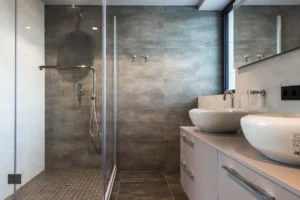
- Sanitaryware and bathroom pods components: WCs, basins, vanity units, shower trays, brassware, mirrors and shower enclosures.
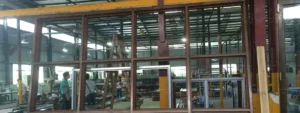
- Windows, external doorsets and curtain walling: aluminium and aluminium-timber composite systems, thermally broken profiles, double and triple glazed units.
- Internal doors and architectural ironmongery: fire-rated doorsets with matched frames, hinges, closers and intumescent seals supplied as a tested assembly.
- Floor and wall finishes: porcelain tile, SPC and LVT, carpet tile and broadloom for hotel corridors, engineered wall panelling.
- Hotel FF&E: casegoods, loose furniture, lighting, mirrors, soft furnishings and OS&E for hospitality operators.
What separates a UK package from a comparable US package is document density. UK projects, particularly residential above low rise, carry a heavier evidence burden per line item — classification reports, DoPs, test evidence traceable to the exact configuration supplied. A factory that has sold the same product into the US for years may never have produced a DoP. That gap is the most common cause of a UK order stalling after deposit.
What Compliance Documents Do UK Projects Require? (UKCA, CE and DoP)
For construction products covered by a designated or harmonised standard, the UK route requires a Declaration of Performance from the manufacturer plus the applicable conformity marking. The DoP is not a certificate and not a test report — it is the manufacturer’s own declared statement of performance against the essential characteristics of the named standard, and it is what the building control route, the client’s technical adviser and the eventual golden-thread record will ask for.
The geography matters more than most overseas factories realise. UKCA is the marking for Great Britain (England, Wales and Scotland). Northern Ireland continues to operate on the CE regime, with UKNI marking used alongside CE in the specific cases where a UK-based approved body has been involved. The UK Government has repeatedly extended the period during which CE-marked construction products remain acceptable in Great Britain, and the end dates have moved more than once. The practical conclusion for a buyer is therefore procedural, not calendar-based:
- Confirm the transitional arrangement currently in force for your product category and destination jurisdiction before you issue the PO.
- Write the required marking into the purchase contract as a named deliverable, alongside the DoP and the underlying test reports.
- Require that the DoP references the same product designation, configuration and factory production control reference as the goods actually being shipped — not a sister model.
- Treat the paperwork as a payment milestone. Documents that are chased after the container sails are documents you may never get.
Glass is the clearest worked example. A curtain wall or window package for a UK project will normally reference BS EN 12150 for thermally toughened safety glass and BS EN 14449 for laminated glass, with the window or doorset itself covered by BS EN 14351-1. The factory must be able to produce type-test evidence for the exact build-up specified — glass thickness, interlayer, coating, cavity and gas fill. We cover the standard-by-standard detail in our guide to glass safety standards for curtain wall and windows from China, and the UKCA-versus-CE decision itself in UKCA or CE marking for building materials imported from China.
Sourcing this for a commercial project?
FBM Sourcing works with project owners, developers, main contractors and FF&E contractors on hotel, apartment, school, office and other commercial building projects. Send us your BOQ, drawings or product list — our team will review it and get back to you.
How Do Fire Regulations Shape Material Choice on UK Projects?
Fire performance is the hardest filter on a UK project, and it operates before commercial selection rather than after it. Approved Document B places strict limits on the reaction-to-fire performance of external wall materials on residential buildings above a defined height, and the applicable threshold and use classes depend on the current edition in force in the project’s jurisdiction — England, Wales and Scotland maintain their own guidance documents. The correct sequence for a buyer is: confirm building height and use classification first, establish the permitted reaction-to-fire class for external wall construction, then open the material conversation with factories. Doing it in the other order produces expensive dead ends.
The classification language is BS EN 13501-1, which grades reaction to fire from A1 (non-combustible) through A2, B, C, D and below, with suffixes for smoke production (s1–s3) and flaming droplets (d0–d2). A2-s1,d0 is the class most frequently written into UK external wall specifications for higher-risk residential buildings. Insulation and decorative external elements are caught by the same logic.
Fire-resisting elements inside the building are a separate system. Doorsets are tested to BS EN 1634-1 and classified to BS EN 13501-2, producing designations such as EI₂30 or EI₂60 — integrity and insulation for a stated number of minutes. Three points routinely cost UK buyers time:
- A fire door is certified as a complete assembly. Leaf, frame, intumescent seals, hinges, closer and lock must match the tested configuration. Swapping ironmongery after test invalidates the evidence.
- Evidence must cover the exact leaf size supplied. Extending a doorset beyond its tested dimensional range requires a supporting assessment.
- Furniture and soft furnishings in UK hotels and student accommodation sit under a separate flammability regime from building materials, and the specification wording is different again.
Our reference article on fire rating standards for building materials and finishes sets out how the EN 13501 family compares with the ASTM and BS test routes buyers see on multi-market projects.
How Does Shipping from China to the UK Work?
Mainline services from South China ports — Yantian, Nansha, Shekou — to UK entry ports run in the 30–40 day port-to-port band. Add factory-to-port trucking, booking lead time, UK port handling, clearance and inland delivery, and a realistic factory-gate-to-site window for a full container is normally 45–60 days after production is complete. Production itself is the larger variable: custom casegoods and fire-rated doorsets commonly need 45–70 days after sample approval.
Practical points for UK-bound cargo:
- Ports: Felixstowe and London Gateway dominate deep-sea container volumes for the South East and Midlands; Southampton serves the South and South West; Liverpool gives the shortest inland leg for schemes in Manchester, Leeds and Glasgow.
- Import VAT: postponed VAT accounting lets a VAT-registered UK importer account for import VAT on the VAT return rather than paying it at the border and reclaiming later. For a developer importing several containers, this is a material cash-flow tool and should be set up with the customs agent before the first shipment, not after.
- Duty: rates are set by commodity code, and the code assigned to a mixed FF&E consignment can vary meaningfully by line. Get commodity codes confirmed against the actual product descriptions at quotation stage.
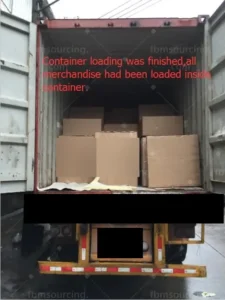
- Consolidation: a project buying doors, tile, sanitaryware and furniture from four factories should consolidate at one warehouse in China rather than accept four separate loose shipments, whose charges and repeated clearances erode the saving that justified the China route.
Programme sequencing by project type is set out in our guide to how long it takes to source and ship building materials from China.
What Does a UK Buyer Need to Get Right in the RFQ?
Most problems on UK-bound orders are traceable to what was left out of the enquiry. A UK RFQ should carry, per line item: the applicable harmonised or designated standard, the required conformity marking for the destination jurisdiction, the required reaction-to-fire or fire-resistance class, the DoP as a named contract deliverable, and quantities expressed by room type rather than as a single total.
Timber and timber-derived products carry an additional obligation. The UK timber regulation regime, carried over from EUTR after EU exit, places a due-diligence duty on the operator first placing timber or timber products on the UK market. That means the importer, not the Chinese factory, is the party carrying the duty. In practice the buyer needs species (botanical name), country of harvest, and chain-of-custody documentation such as FSC or PEFC where the specification calls for it — collected before shipment and retained as records. Engineered wood, plywood cores in casegoods, doorsets and flooring are all in scope.
Two further habits save the most rework: state the destination port and inland delivery town so quotations are comparable on a landed basis rather than ex-works, and set out the mock-up requirement explicitly. On BTR and PBSA schemes a signed-off sample bedroom set before bulk production is the cheapest insurance available.
How a China Sourcing Agent Works with UK Contractors
A China sourcing agent sits on the buyer’s side of the table in China. For UK projects the scope is: translate the specification and BOQ into an enquiry package Chinese factories can price accurately, compare factory options, manage sampling and mock-up rounds, hold the compliance documentation trail as a deliverable tied to payment milestones, supervise production, and consolidate multiple factories into full container loads for a single UK clearance.
FBM Sourcing is a building material and furniture sourcing agent based in Guangzhou, one hour from Foshan — the manufacturing cluster that produces most of China’s cabinetry, aluminium windows and doors, tile, sanitaryware and commercial furniture. We are not a manufacturer. The commercial model is an a 5% commission for suppliers you nominate (products we source for you are quoted at a direct price), so the buyer sees the factory pricing structure rather than a resold price. All inspection is carried out by FBM Sourcing’s own team at the factory before shipment, with photo and video records issued to the client. For UK contractors working to a fixed handover date, specification, documentation and container planning are handled in the factory’s own time zone rather than by email across an eight-hour gap.
On the conformity side, which mark a product needs depends on where in the UK it is installed — see UKCA vs CE marking for China-made products on UK projects for the GB and Northern Ireland position and the importer duties.
For the window and door line of a UK package, the manufacturer types that supply UK and European projects, and the CE, UKCA, Part L and PAS 24 evidence each must show, are set out in aluminum window manufacturers in China for UK projects.
For UK developers whose China package includes doors, windows and tile, doors, windows and tiles from China for property developers sets out what to send, what has to be specified before a factory can quote, and how the three packages sequence against the construction programme.
Get a China Procurement Quote for Your UK Project
FBM Sourcing works with project owners, developers, main contractors and FF&E contractors on hotel, BTR and student accommodation, school, healthcare, office and retail fit-out projects across the UK, Europe, USA, Australia, the Caribbean and the Middle East, covering both building materials and furniture from one point of contact. Send us your BOQ, drawings or product schedule together with quantities, destination port, required conformity marking and fire classification, and your programme dates, and our team will review it and come back to you. You can also read more about how we run full packages on our project procurement page.
If you are a developer rather than a contractor managing this relationship, see how a developer’s procurement priorities differ from a contractor’s.