Metal screens have moved from decorative afterthought to a core architectural element — facade veils on hotels and car parks, laser-cut privacy screens on apartment balconies, patterned dividers in lobbies and restaurants, and ventilation screens that hide plant while passing air. The category rewards factory-direct buying more than most, because the cost is dominated by CNC machine time and finishing rather than material, and Chinese fabricators run the largest fleets of fiber-laser and turret-punch capacity in the world. Metal screens sourcing from China turns a pattern file and a panel schedule into finished, project-labelled screens, and FBM Sourcing manages the scope as a building material sourcing agent and sourcing partner — pattern engineering, samples, finishing, fixings and container planning in one accountable package.
Types of Metal Screens and Specifications for Commercial Projects
Most project screens are flat panels cut or pressed from sheet, engineered into one of four families:
- Laser-cut decorative screens — custom patterns cut from 2–6 mm aluminum or 1.5–3 mm steel; balcony privacy, feature walls, partitions and gates
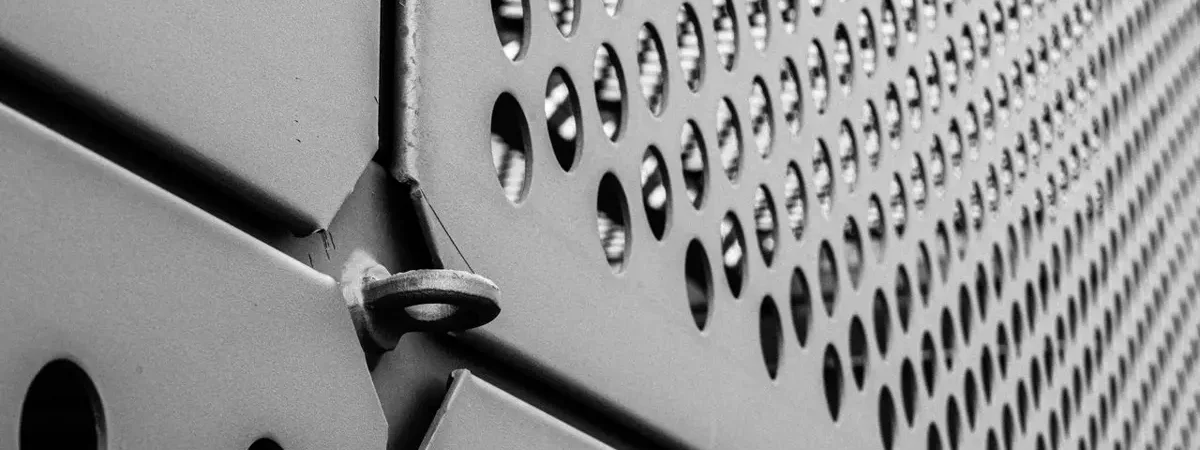
- Perforated metal panels — round, square or slotted perforations at controlled open areas; facade cladding, car park screening, acoustic backings and ceiling features
- Expanded and mesh screens — expanded aluminum, woven or welded mesh for large-area facade veils at low weight
- Framed screen assemblies — panels welded or riveted into aluminum or steel subframes, arriving as hang-ready units with concealed fixings
The controlling specifications are open area, thickness and finish. Open area — the percentage of the panel that is void — drives everything: privacy screens typically run 30–40% open, ventilation screens 50%+ to satisfy mechanical requirements, and facade veils are tuned panel by panel for solar shading and view. Panel thickness sets flatness and span — 3 mm aluminum is the practical floor for exterior panels above about a metre span, moving to 4–6 mm or stiffened backs for larger modules. Finishes follow exposure: architectural powder coating (Qualicoat-class) for most work, PVDF coil or spray systems for high-exposure facades, and anodizing at 15–25 µm where a metallic finish is wanted — the trade-offs are covered in our guide to powder coating vs anodized aluminum. Being non-combustible, metal screens are also one of the few decorative facade layers that sit comfortably inside post-cladding-crisis fire regimes — a genuine specification advantage over timber and composite alternatives.
How Does Metal Screen Sourcing from China Work?
Screens are pattern-driven, so the workflow starts with files rather than samples: the architect’s pattern artwork or DXF/DWG cutting files, a panel schedule with dimensions and quantities, and the fixing concept. The factory nests the patterns for cutting, engineers the subframes and returns shop drawings showing panel joints, fixing positions and edge details for approval — the same drawing-led sequence described in our CAD and shop drawings guide. Where no native files exist, factories redraw patterns from PDFs or photographs and return the vector file for sign-off.
A physical sample panel — typically a corner section around 500×500 mm in the specified thickness and finish — is produced before the run, because pattern scale and open area read very differently in metal than on screen. Production for a typical project package runs 25–40 days after sample approval. Screens ship flat-packed with foam interleaving in plywood cases, panels labelled to the installation drawings; framed assemblies crate individually. A full facade or balcony package for a mid-rise building commonly fits one to two 40ft containers.
Quality Standards and Inspection
Screen quality lives in three measurable things: pattern accuracy, flatness and finish. FBM Sourcing’s own inspection team checks all three in the factory before shipment — a full inspection of the finished panels against the approved cutting files and sample, covering deburring, flatness and weld quality on framed units, coating thickness readings, colour consistency across the batch and protective-film packing before cases close. Every stage is photographed and filmed for the client’s record, and coating system certificates ship with the documentation. Colour control is handled the same way as fabric dye lots in furniture: the whole project’s panels are finished in continuous batches so screen 200 matches screen 1.
Why Source Metal Screens Through FBM Sourcing
Screens rarely travel alone. The same project usually carries facade shading systems, aluminum sunshades, balustrades and gates that want the same finish, the same colour batch and the same container. As a building material sourcing agent we run those scopes as one metalwork package — one pattern-engineering dialogue, one inspection regime, one shipping plan — on a 5% commission for suppliers you nominate (products we source for you are quoted at a direct price), with the screens consolidated alongside the rest of the project’s building materials rather than shipped as an orphan order. Where the screen is a solid or folded sheet rather than a perforated pattern, the scope moves to decorative metal panels from China, produced on the same lines. Perimeter and entrance gates are usually bought with the same metalwork package; see metal gates from China.
Sourcing this for a commercial project?
FBM Sourcing works with project owners, developers, main contractors and FF&E contractors on hotel, apartment, school, office and other commercial building projects. Send us your BOQ, drawings or product list — our team will review it and get back to you.
Get a Quote for Your Project
Send us your pattern files or design references, panel schedule, finish intent, destination port and programme dates. FBM Sourcing will return pattern-engineering feedback, a sample plan, pricing by panel type and a container estimate — start on our project inquiry page.