
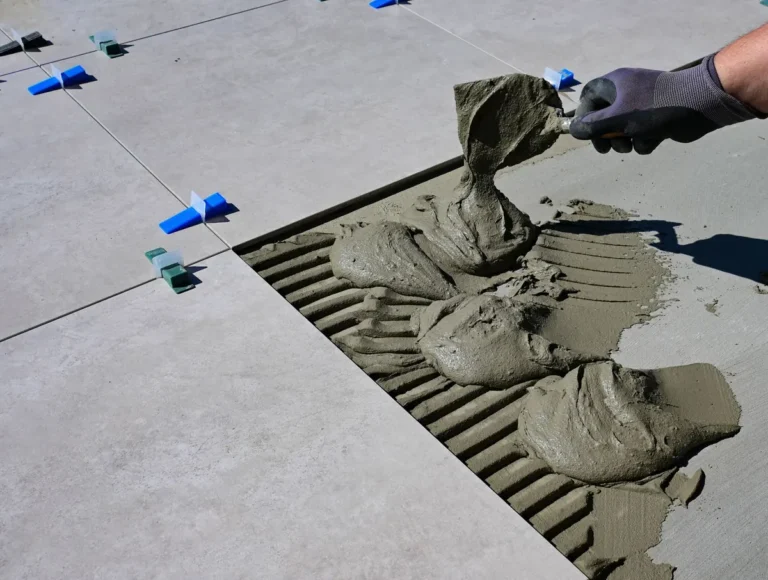
A tile schedule usually names the tile in detail and the adhesive and grout in a line or two: “thin-set”, “tile adhesive”, “grout, colour to match”. A factory can answer that line with a product name and still leave open which specification the product is made to. In the US, the American National Standards that name the mortar, grout and adhesive classes are the ANSI A118 series, and the standards for how those materials are used in an installation are the A108 series. The Tile Council of North America (TCNA) lists both and is the secretariat of the ANSI committee that periodically revises or reaffirms them. This article sets out what TCNA’s own pages list, why the edition year in a specification line matters, and what to ask a factory to show before you accept a class in a quotation.
Everything attributed to TCNA below was read on its website on 17 November 2026. The standards themselves are sold through TCNA and ANSI and we did not read them, so this article says nothing about test methods, performance limits or which class suits which tile or substrate.
Who Publishes the A108 and A118 Standards
TCNA’s Industry Organizations and Committees page says that ANSI standards for ceramic, glass, stone and other hard surface tiles and panels, tile installation materials and tile installation requirements are available from the TCNA, that the ANSI Accredited Standards Committee (ASC) A108 is the committee for which the TCNA is the secretariat, and that the committee periodically revises or reaffirms them. It describes them as voluntary standards intended to serve as a guide to the general public, manufacturers, distributors, contractors and others.
On its ANSI Standards page, TCNA groups its list under Installation Standards (the A108 numbers), Material Specifications (the A118 numbers, plus A136.1 for organic adhesives and A137.1 to A137.3 for tile), a Sustainability Standard and Test Method. For almost every entry the status line says that the publication available for purchase through TCNA and ANSI is current. Two entries, A137.2 for glass tile and A137.3 for gauged porcelain tile, are marked as not current, with TCNA saying a new version will be available soon. The one test method on the page that TCNA says is free on its website is A326.3, the dynamic coefficient of friction method; our article on tile test reports for US and Australian projects covers that method.
The Mortar, Adhesive and Grout Specifications TCNA Lists
As listed on 17 November 2026, with each edition year as TCNA gives it (a second year in brackets is a reaffirmation):
- A118.1, Dry-Set Cement Mortar (2023)
- A118.4, Modified Dry-Set Cement Mortar (2023)
- A118.15, Improved Modified Dry-Set Cement Mortar (2023)
- A118.11, EGP (Exterior Glue Plywood) Modified Dry-Set Mortar (2017, reaffirmed 2022)
- A136.1, Organic Adhesives for Installation of Ceramic Tile (2020, reaffirmed 2025)
- A118.3, Chemical Resistant, Water Cleanable Tile-Setting and -Grouting Epoxy and Water Cleanable Tile-Setting Epoxy Adhesive (2021, reaffirmed 2025)
- A118.6, Standard Cement Grouts (2019)
- A118.7, High Performance Cement Grouts (2019)
- A118.19, Organic Pre-mixed Grouts (2023)
- A118.8, Modified Epoxy Emulsion Mortar/Grout (1999, reaffirmed 2025)
- A118.5, Chemical Resistant Furan Mortars and Grouts (1999, reaffirmed 2025)
The same series also covers materials that sit under or around the tile rather than bond it: A118.9 cementitious backer units, A118.18 foam core backer boards, A118.10 load bearing, bonded, waterproof membranes, A118.12 crack isolation membranes, A118.13 bonded sound reduction membranes and A118.16 flowable hydraulic cement underlayment and self-leveling underlayment. TCNA also lists three standards as under development: A118.17 field fabricated shower kits, A118.20 uncoupling membranes and A108.23 interior installation of foam core backer boards. A tile schedule that includes a waterproofing membrane, backer board or underlayment line has its own specification to name.
Matching the Material to the Installation Standard
The A108 entries on the same page are titled by method and material, and several name the A118 class directly. A108.5 covers setting ceramic tile with dry-set, modified dry-set, EGP modified dry-set or improved modified dry-set cement mortar (2023). A108.4 covers installation with organic adhesive or water cleanable tile-setting epoxy adhesive (2023), and A108.6 covers installation with chemical resistant, water cleanable tile-setting and -grout epoxy (2023). Grout has its own entries: A108.10 for installation of grout in tilework (2026) and A108.22 for installation of pre-mixed grout (2023). For large-format porcelain, A108.19 covers interior installation of gauged porcelain tiles and tile panels or slabs by the thin-bed method bonded with modified dry-set or improved modified dry-set cement mortar (2025), and A108.20 covers exterior installation of gauged porcelain (2025).
Read together, those titles show why a schedule that names only the adhesive product is incomplete. The material specification says what the product is; the installation standard says how the method is carried out. They are separate documents, and they carry their own edition years. Which combination a project needs is for the tile manufacturer’s instructions, the specifier and the local authority to settle, not for this article.
Why the Edition Year and Status Matter in a Schedule
The years on TCNA’s page run from 2026 (A108.01, A108.1A, A108.10, A108.14, A108.18) back to 1999 (A118.5 and A118.8, reaffirmed 2025). TCNA also uses the term “open PINS”: it explains that this means TCNA has notified ANSI of its intent to revise or create a standard, using the Project Initiation Notification System form. As read on 17 November, A118.6 and A118.7 grouts and A108.5, the installation standard for dry-set and modified mortars, each carried an open PINS, with TCNA noting that a group of technical experts is working on possible revisions and that balloted changes may pass or fail.
So a specification line that says only “to ANSI A118” or “A118.4” leaves open which edition is meant and whether the standard is mid-revision. Writing the number with its year, and recording the date you checked TCNA’s list, avoids an argument at the quotation stage and again at delivery.
Sourcing this for a commercial project?
FBM Sourcing manages the entire China procurement package for overseas construction projects. We work with Developers · General Contractors · Builders · Commercial Project Owners · Interior Design & Construction Companies · FF&E Solution Providers. Send your BOQ, drawings or product schedule for review.
What to Put in the Schedule and What to Ask a Factory to Show
Turning TCNA’s list into steps you can apply to a quotation:
- In the specification line for each material, write the standard number with its edition year, for example “ANSI A118.4-2023”, not only the product name or the word “thin-set”.
- Name a separate line, with its own standard, for grout, for any waterproofing or crack isolation membrane, and for any backer board or underlayment.
- Ask the factory which A118 or A136.1 class its product is made to, and ask for the data sheet that states it. The class and edition on the data sheet should match the line in your schedule.
- Ask for the test report for that product against that standard, and check that the product name or code on the report is the product on the quotation. Our article on factory test reports and accredited lab testing sets out what different kinds of report prove.
- If the answer is a general quality certificate, a report for a different product or a data sheet that says a product is “similar to” a class, treat the claim as not yet shown.
- Keep the installation method in view: ask which A108 standard or manufacturer instruction the product is meant to be used with, and put it in the schedule beside the material.
Our article on test reports and certificates before a China quotation covers what to tell a sourcing agent at the start. Joint sealants are a separate material with their own specifications; ASTM C920 vs C1193 compares two of them, and slip resistance ratings for commercial tiles covers the tile-side slip results.
What FBM Sourcing’s Guide Says About Certifications, Quotations and Inspection
FBM Sourcing’s client guide says that in its main markets of North America and Australia every product must meet local codes, so the first step in choosing a factory is checking that it holds the test reports or certifications for that specific product, “confirmed before we quote”. Its examples cover aluminium windows and doors, sanitary ware, fire-rated doors and solar systems; it does not mention tile adhesives or grout, so this article claims nothing about FBM Sourcing sourcing products made to any A118 class.
On quotations, the guide says each line gives the item, specification, materials and finish, dimensions, unit price, quantity, packing and lead time, quoted like-for-like against your specification, with any substitution flagged on the line. On inspection, it says FBM Sourcing’s own QC team checks quantities, dimensions, finish, hardware and packing against the signed-off specification before shipment, and that your own project team is welcome to attend. That inspection compares the goods with the specification you signed off; it is not a test of the product to an ANSI standard, so the class and edition belong in the specification before it is signed.
What This Article Does Not Cover
- The content of any A108 or A118 standard, including test methods, performance limits and classes within a standard. We did not read the standards.
- Which mortar, adhesive or grout class a given tile, substrate or project needs.
- Standards used outside North America. TCNA says ISO/TC 189 develops standards for ceramic tiles and related installation materials, including grouts, adhesives and membranes; we did not read any ISO standard.
- Any specific brand, product or factory, and the cost or coverage of any material.
- Everything attributed to TCNA is as read on 17 November 2026 and can change; several standards on its list were marked as open for revision.
Questions About ANSI A118 Tile Adhesive and Grout
What is the ANSI A118 series?
In TCNA’s list, the A118 numbers are the Material Specifications: American National Standard specifications for tile-setting mortars, grouts, membranes, backer units and underlayments, such as A118.1 for dry-set cement mortar and A118.4 for modified dry-set cement mortar.
What is the difference between A108 and A118?
On TCNA’s page, the A108 numbers are the Installation Standards, which cover how tile is installed with a given method and material, and the A118 numbers are the Material Specifications, which cover the materials themselves. A108.5, for example, covers setting tile with dry-set, modified dry-set, EGP modified dry-set or improved modified dry-set mortar.
Which edition of an A118 standard should a schedule name?
TCNA lists each standard with an edition year, for example A118.4 (2023) and A118.6 (2019), and says some are open for revision. Name the number with the year and record the date you checked the list. Which class a project needs is for the specifier and the tile manufacturer to decide.
What does “open PINS” mean on TCNA’s list?
TCNA explains that an open PINS means it has notified ANSI of its intent to revise or create a standard, using the Project Initiation Notification System form. For some entries TCNA adds that experts are working on possible revisions and that balloted changes may pass or fail.
Where can I get the standards?
TCNA’s page says the publications are available for purchase through TCNA and ANSI, apart from A326.3, which it says is free on the TCNA website.
What should I ask a factory that quotes tile adhesive or grout?
Ask which A118 or A136.1 class the product is made to, and for the data sheet and the test report for that product against that class, with the product name on the report matching the product quoted. Treat a general certificate or a “similar to” claim as not yet shown.
How does FBM Sourcing charge for this?
For suppliers you nominate, we charge a 5% commission; for products we source for you, we quote a direct price. Our own team performs one inspection after bulk production is complete and before shipment, and the client’s project team is welcome to attend.
FBM Sourcing manages the entire China procurement package for overseas construction projects. We work with Developers · General Contractors · Builders · Commercial Project Owners · Interior Design & Construction Companies · FF&E Solution Providers.





