As of 21 September 2026, imports into the United States of certain upholstered wooden products and of kitchen cabinets and vanities (including their parts) carry an additional Section 232 duty of 25 percent ad valorem under Proclamation 10976, which has applied to goods entered for consumption on or after 14 October 2025. Under Proclamation 11000, which amended it, that rate is scheduled to rise on 1 January 2027 to 30 percent for the upholstered wooden products and to 50 percent for kitchen cabinets and vanities, except for countries that reach an agreement with the United States. The Section 232 duty is charged in addition to other applicable duties, so the published rate is one input to a landed cost, not the landed cost itself.
This article is written for companies that carry the import budget on a US project: developers, general contractors, builders, commercial project owners, interior design and construction companies and FF&E solution providers. It sets out what the two proclamations say, in their own words, and where the dates fall. It is not customs advice: the tariff provision and the orders that apply to a specific product must be confirmed by your licensed customs broker.
What Does Section 232 Currently Impose on Upholstered Wooden Seating, Kitchen Cabinets and Vanities?
Section 232 of the Trade Expansion Act of 1962 (19 U.S.C. 1862) allows the President to adjust imports of an article that the Secretary of Commerce finds is being imported in quantities or under circumstances that threaten to impair national security. Proclamation 10976 of 29 September 2025, titled “Adjusting Imports of Timber, Lumber, and Their Derivative Products Into the United States”, was published in the Federal Register on 6 October 2025 at 90 FR 48127 (FR Doc. 2025-19482).
The operative clauses set three rates:
- Softwood timber and lumber, as set out in Annex I to the proclamation: a 10 percent ad valorem duty rate.
- Certain upholstered wooden products, as listed in Annex I: a 25 percent ad valorem duty rate. The Annex describes these as upholstered wooden furniture products, “such as couches, sofas and chairs”.
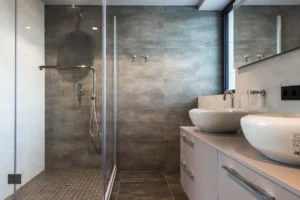
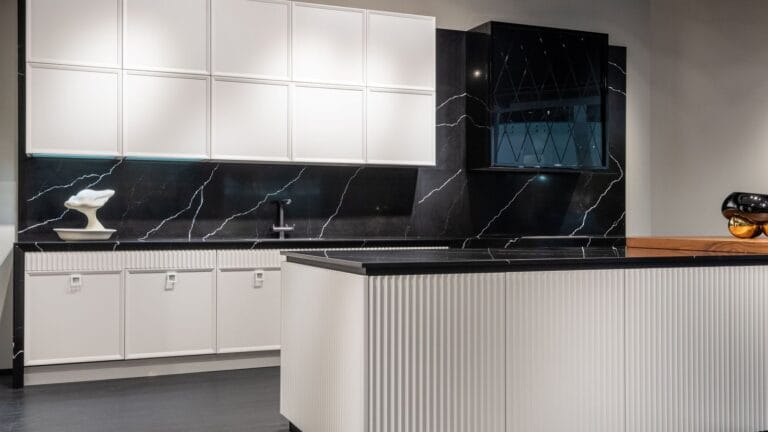
- Kitchen cabinets and vanities, as listed in Annex I: a 25 percent ad valorem duty rate. The proclamation states that “This duty shall apply to completed kitchen cabinets and vanities as well as parts imported for use in kitchen cabinets and vanities.”
The rates apply “with respect to goods entered for consumption, or withdrawn from warehouse for consumption, on or after 12:01 a.m. eastern daylight time on October 14, 2025”. The trigger is the date of entry for consumption in the United States, not the order date, the production date or the sailing date.
The Annex implements the duty through new headings in Chapter 99 of the Harmonized Tariff Schedule of the United States (HTSUS) and a new U.S. note 37, which lists the statistical provisions under headings 9401 and 9403 to which each duty applies. When we checked the USITC’s online HTSUS on 21 September 2026, heading 9903.76.02 (upholstered wooden furniture products) and heading 9903.76.03 (completed kitchen cabinets and vanities and parts) both still showed “The duty provided in the applicable subheading + 25%”. Whether a particular chair, cabinet or vanity falls in a listed provision is a classification decision for your licensed customs broker.
What Changes on 1 January 2027?
The original clause 5 of Proclamation 10976 scheduled an increase for 1 January 2026: clause 2 (upholstered wooden products) to 30 percent and clause 3 (kitchen cabinets and vanities) to 50 percent.
That increase did not take place on that date. Proclamation 11000 of 31 December 2025, published on 9 January 2026 at 91 FR 1039 (FR Doc. 2026-00327), states that the President determined it necessary and appropriate “to delay for an additional year the increase in the duty rates for upholstered furniture, kitchen cabinets, and vanities” while negotiations continue. It revised clause 5 so that it now reads: “Effective January 1, 2027, the duty rate in clause 2 shall increase to 30 percent and the duty rate in clause 3 shall increase to 50 percent, and shall continue in effect, except for countries with which the United States reaches an agreement that addresses the threatened impairment of the national security posed by imports of wood products.”
| Product group in Proclamation 10976 | Rate for entries on or after 14 October 2025 | Rate scheduled from 1 January 2027 (as amended by Proclamation 11000) |
|---|---|---|
| Certain upholstered wooden products (clause 2) | 25 percent ad valorem | 30 percent |
| Kitchen cabinets and vanities, and parts (clause 3) | 25 percent ad valorem | 50 percent |
The 2027 increase is already written into the law as it stands; no further document is needed for it to take effect. The same sentence carries an exception for countries that reach an agreement, and the first increase date was moved once, by a proclamation signed on the last day of the year before it was due. Treat 1 January 2027 as the current legal position and recheck it before each commitment.
We searched the Federal Register on 21 September 2026 and found no presidential document amending Proclamation 10976 after Proclamation 11000.
Which Countries Have a Different Ceiling?
Proclamation 10976 sets separate limits for three trading partners. Clause 7 states that the Section 232 tariff on imports of wood products from the United Kingdom “shall not exceed 10 percent”, and that the tariff on imports of wood products from the European Union and Japan “shall not result in a tariff that, when added to the applicable Column 1 Duty Rate in the HTSUS, exceeds 15 percent”.
Two later Federal Register notices extend a similar approach to two more partners:
- Republic of Korea. The notice at 90 FR 55964 (published 4 December 2025) states that for timber, lumber and their derivative products of Korea with a column 1 duty rate below 15 percent, the sum of the column 1 rate and the Proclamation 10976 duty “will be 15 percent ad valorem”, effective for entries on or after 14 November 2025.
- Taiwan. The notice at 91 FR 31818 (published 28 May 2026) states that the United States committed to limit Section 232 duties on timber, lumber and wood derivative products of Taiwan “to no more than 15 percent”, effective for entries on or after 1 May 2026.
The USITC’s online HTSUS, checked on 21 September 2026, shows country-specific headings 9903.76.20 to 9903.76.24 for wood products of the United Kingdom, Japan, the European Union, South Korea and Taiwan. We found no equivalent provision for products of China, so for Chinese-origin goods in the listed provisions the general rates in clauses 2 and 3 are the ones the text applies.
Pricing a cabinet, vanity or seating package for a US project?
Send FBM Sourcing your schedule or BOQ. We quote the goods line by line so your team and your customs broker can build the landed cost assessment on the real composition of the order.
Does the Section 232 Duty Stack with Other US Duties?
It is added to the ordinary duty and to other charges
Clause 5 of Proclamation 10976, in both its original and amended form, ends with the same sentence: “Except as otherwise provided in this proclamation, the tariffs imposed in this proclamation are in addition to any other duties, taxes, fees, exactions, and charges applicable to such imported wood products.”
Antidumping and countervailing duties continue on top
For kitchen cabinets and vanities, U.S. note 37 in the Annex states: “All antidumping, countervailing, or other duties and charges applicable to such goods shall continue to be imposed in addition to the duty provided in heading 9903.76.03.” The same sentence appears for heading 9903.76.02. AD/CVD orders are a separate legal regime with their own scopes and rates; we cover the orders that matter to project packages in US anti-dumping duties on Chinese cabinets, quartz and flooring and do not repeat those figures here.
It replaced, and did not add to, the IEEPA reciprocal tariff
Clause 4 of Proclamation 10976 states that products tariffed under it “shall not be subject to any tariffs imposed by Executive Order 14257 of April 2, 2025”, the reciprocal tariff order issued under the International Emergency Economic Powers Act (IEEPA). Executive Order 14389 of 20 February 2026, “Ending Certain Tariff Actions” (91 FR 9437), provides that the additional ad valorem duties imposed under IEEPA by the listed orders “shall no longer be in effect and, as soon as practicable, shall no longer be collected”. It adds: “This order does not affect any other duties, including duties imposed under section 232 of the Trade Expansion Act of 1962 … and section 301 of the Trade Act of 1974”.
On the same day, Proclamation 11012 (91 FR 9339) imposed a temporary import surcharge of 10 percent ad valorem under Section 122 of the Trade Act of 1974 “for a period of 150 days”, continuing “through 12:01 a.m. eastern daylight time on July 24, 2026”. Its clause 4 states: “The surcharge imposed in this proclamation shall not apply in addition to tariffs imposed under section 232.” We did not find a Federal Register document extending that surcharge when we searched on 21 September 2026; ask your broker what applies on the date of your entry.
Section 301 remains a separate layer
Section 301 duties on Chinese-origin goods are imposed under a different statute and, as Executive Order 14389 confirms, were not ended by it. Proclamation 10976 makes the Section 232 duty additional to “any other duties”, so the two are separate lines on an entry. Current Section 301 rates are outside this article. The way the layers fit together is set out in how US import duty is structured for furniture and building materials from China.
What Else in the Proclamation Can Move?
Two clauses leave room for the scope to change:
- More products can be added. Clause 16 directs the Secretary of Commerce to “establish a process for including additional wood products within the scope of the tariffs described in this proclamation”.
- Hardwood is under review. Clause 9 requires the Secretary to give the President an update on imports of hardwood timber and lumber “By October 1, 2026”, so that the President may determine whether an additional duty on those products, “as well as any additional duties on derivatives of such products, is warranted”.
Published Rate Is Not Landed Cost: How to Use These Dates in a Project Budget
A Section 232 rate is an ad valorem percentage on the goods that fall in the listed provisions. A project package is rarely made only of such goods: cabinets and vanities travel with countertops, sinks, hardware and lighting, and seating with tables and casegoods. Each line has its own tariff provision and its own applicable orders. The only reliable way to see the effect on the whole package is a line-by-line landed cost assessment for that project, prepared with your broker’s classifications, which is the approach we describe in what has changed in sourcing from China: tariffs and lead times.
For a programme that spans the turn of the year, one fact from the text matters more than the headline rate:
- The rate is fixed by the date of entry for consumption. Deliveries for the same project that enter before and after 1 January 2027 fall under different rates as the law now stands. Production and shipping durations are confirmed per order by the factory and the freight forwarder.
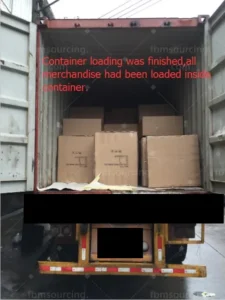
Logistics are a separate line. Sometimes, on a large project, the cabinets and vanities alone fill full containers; sometimes the cabinets and vanities share containers with the other product categories of the same project; and sometimes, in one batch, we combine a dozen or more product categories from several projects of the same client into a few containers — always full containers, and for us this is routine, well-practised work.
Cabinets and vanities for US multifamily work still need the formaldehyde emission evidence discussed in our guides to kitchen cabinet manufacturers in China for US multifamily projects and bathroom vanity manufacturers in China for US multifamily projects. Upholstered seating still needs the federal flammability label covered in the SOFFA label under 16 CFR 1640 for contract upholstered seating. Tariffs sit beside those requirements.
What FBM Sourcing Does, and Does Not Do, on This Subject
FBM Sourcing works as the client’s sourcing partner in China. For a cabinet, vanity or seating package we quote against the project’s schedule or BOQ, arrange samples for approval, carry out one inspection by our own team at the factory after bulk production is finished, before shipment, with photo and video records, and ship in full containers. The quotation covers the goods; sea freight is quoted to you before shipment. Most of our clients handle import duties in the destination country through their own licensed customs broker, which is the right place for the questions raised here.
What we contribute to the landed cost assessment is the supply side: complete product descriptions, materials, dimensions, quantities and values for every line, so that your broker classifies from accurate information.
Every rule quoted above was read in the Federal Register full text on 21 September 2026. Tariff law in this area has changed several times within twelve months, so read the current documents, or ask your broker to, before relying on any summary.
Pricing a cabinet, vanity or seating package for a US project?
Send FBM Sourcing your schedule or BOQ. We quote the goods line by line so your team and your customs broker can build the landed cost assessment on the real composition of the order.
Frequently Asked Questions
What is the Section 232 tariff on kitchen cabinets and vanities right now?
As of 21 September 2026, Proclamation 10976 imposes an additional 25 percent ad valorem duty on kitchen cabinets and vanities listed in its Annex I, including parts imported for use in them, for goods entered for consumption on or after 14 October 2025. Different ceilings apply to products of the United Kingdom, the European Union, Japan, Korea and Taiwan.
What happens to these tariffs on 1 January 2027?
Under clause 5 of Proclamation 10976 as amended by Proclamation 11000 (91 FR 1039), the rate for the listed upholstered wooden products is scheduled to increase to 30 percent and the rate for kitchen cabinets and vanities to 50 percent, effective 1 January 2027, except for countries with which the United States reaches an agreement.
Does the Section 232 duty apply on top of antidumping and countervailing duties?
Yes. The Annex to Proclamation 10976 states that all antidumping, countervailing or other duties and charges applicable to the goods continue to be imposed in addition to the Section 232 duty. Your customs broker needs to check both regimes for each product line.
Are all upholstered chairs and sofas covered?
No. The proclamation covers “certain upholstered wooden products” as listed in its Annex, which identifies specific HTSUS provisions for upholstered wooden furniture such as couches, sofas and chairs. Whether a given seat falls within them is a classification question for your licensed customs broker.
Can FBM Sourcing tell us what duty our project will pay?
No. FBM Sourcing quotes the goods, quotes sea freight before shipment and supplies accurate descriptions, materials, quantities and values for every line; tariff classification and the duties that apply are for your licensed customs broker. A line-by-line landed cost assessment comes first, because the published rate is only one part of it.
About FBM Sourcing
FBM Sourcing manages the entire China procurement package for overseas construction projects. Since 2014 we have worked with developers, general contractors, builders, commercial project owners, interior design and construction companies and FF&E solution providers across more than 20 countries and over 1,000 containers, as their sourcing partner in China — from the schedule or BOQ through factory selection, sampling, inspection by our own team before shipment, consolidation and shipping. All quotations, invoices and shipping documents are issued by FBM Sourcing, and sea freight is quoted to you before shipment. If you have a cabinet, vanity or upholstered seating package to price, start at China building materials and FF&E procurement.