16 CFR 1640 makes California Technical Bulletin 117-2013, a smolder (lit cigarette) resistance standard, the federal flammability standard for upholstered furniture in the United States, and requires each manufacturer to put a permanent label on the product reading “Complies with U.S. CPSC requirements for upholstered furniture flammability”. The standard applies to upholstered furniture manufactured, imported or reupholstered on or after June 25, 2021, and the label requirement from June 25, 2022. The regulation does not separate residential from contract furniture: coverage depends on whether a piece meets the definition in 16 CFR 1640.3(e), and in this article “contract upholstered seating” means seating made for hotels, apartments, restaurants and offices, read against that definition piece by piece.
This guide is for developers, general contractors, builders, commercial project owners, interior design and construction companies and FF&E solution providers having upholstered seating made in China for projects in the United States. It sets out what the federal text says, which items on a hotel or apartment seating schedule fall inside and outside the definition, and what has to be built into each piece at the factory so the label is true when it is sewn on.
What Does 16 CFR 1640 Require?
Congress enacted the requirement on December 27, 2020, as section 2101 of Public Law 116-260 (Division FF, Title XXI), the COVID-19 Regulatory Relief and Work From Home Safety Act. The SOFFA name comes from H.R. 2647 of the 116th Congress, the Safer Occupancy Furniture Flammability Act, a bill “to adopt a certain California flammability standard as a Federal flammability standard”. The Consumer Product Safety Commission codified the text as Part 1640 in a direct final rule on April 9, 2021 (86 FR 18440).
- The standard. Under 1640.5(a), all upholstered furniture must comply with TB 117-2013, “Requirements, Test Procedure and Apparatus for Testing the Smolder Resistance of Materials Used in Upholstered Furniture”, June 2013, incorporated by reference in 1640.6.
- The effective date. Under 1640.2(a), the standard is effective June 25, 2021 and applies to upholstered furniture manufactured, imported, or reupholstered on or after that date, which the statute set at 180 days after enactment.
- The label. Under 1640.4(b), each manufacturer of a product subject to the California standard “shall include the statement ‘Complies with U.S. CPSC requirements for upholstered furniture flammability’ on a permanent label located on the product”, and that label “shall be considered to be a certification that the product complies with that standard”.
- The label compliance date. Under 1640.2(b), the labeling requirement applies from June 25, 2022.
- Certification route. Under 1640.4(a), a product to which the California standard applies “shall not be subject to section 14(a) of the Consumer Product Safety Act” with respect to that standard; the permanent label is what the statute treats as the certification.
Does 16 CFR 1640 Cover Contract and Hospitality Seating?
The regulation does not draw the line where the furniture trade draws it. The words “residential”, “commercial” and “contract” do not appear anywhere in Part 1640. Coverage is decided by the definition in 1640.3(e), which repeats the statutory definition. Under it, “upholstered furniture” means an article of seating furniture that:
- is intended for indoor use;
- is movable or stationary;
- is constructed with an upholstered seat, back, or arm;
- is made or sold with a cushion or pillow, attached or detached, or is stuffed or filled, or able to be stuffed or filled, in whole or in part, with any material; and
- together with its structural units, filling and covering, can be used as a support for the body of an individual, or the limbs and feet of an individual, when the individual sits in an upright or reclining position.
The definition “includes an article of furniture that is intended for use by a child” and “does not include” a mattress, a foundation, any bedding product, or “furniture that is used exclusively for the purpose of physical fitness and exercise”. Nothing excludes furniture sold to businesses or described as contract grade.
Two more points of text matter. The standard is adopted under section 4 of the Flammable Fabrics Act, and that Act (15 U.S.C. 1191) defines “interior furnishing” as a furnishing made of fabric or related material “intended for use or which may reasonably be expected to be used, in homes, offices, or other places of assembly or accommodation”. And the earlier CPSC rulemaking that Part 1640 superseded was titled “Standard for the Flammability of Residential Upholstered Furniture”; the Commission withdrew that 2008 proposed rule as of September 16, 2021, stating it had been superseded by the COVID-19 Act. The rule in force is titled “Standard for the Flammability of Upholstered Furniture”.
So each seating item is read against the five elements, not against the market it was designed for. Borderline items are a question for the project’s compliance adviser or counsel; this article describes the text and is not a legal opinion.
How typical hotel and apartment seating reads against the definition
| Item on the schedule | What the definition text points to |
|---|---|
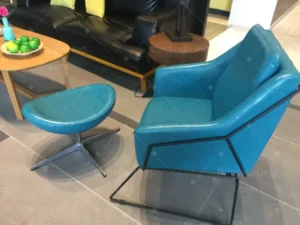
| Lobby sofas, lounge chairs, guestroom armchairs | Indoor seating with an upholstered seat, back or arm and filled cushions: meets the elements on the face of the text. |
| Dining chairs and bar stools with padded seats | An upholstered, filled seat meets the elements; a hard seat with no upholstery does not meet element 3. |
| Built-in banquettes and booths | The definition covers seating that is “movable or stationary”, so fixing it to the floor or wall does not take it outside. |
| Ottomans and footstools | The definition refers to support for “the limbs and feet of an individual” when seated; do not assume these are out of scope, and confirm per design. |
| Pool loungers and terrace seating | Furniture intended for outdoor use does not meet element 1, “intended for indoor use”. |
| Sofa beds | The seating unit is read against 1640.3(e); the mattress inside is excluded as a mattress, and 16 CFR 1633.2(a)(1) lists “convertible sofa bed mattresses” by name. |
| Upholstered headboards and wall panels | Not articles of seating furniture on the plain wording of the definition. |
Mattresses sit under 16 CFR Part 1632 and Part 1633 instead, so a hotel package with beds and seating carries two separate compliance tracks.
Need US-compliant upholstered seating made in China?
Send us the seating schedule and specification for your US project, and we will map each item to the component test reports and label it needs.
What Does the TB 117-2013 Smolder Test Check?
TB 117-2013 is a component test, not a test of the finished chair. It “provides methods for smolder resistance of cover fabrics, barrier materials, resilient filling materials, and decking materials for use in upholstered furniture”. Each test exposes a miniature assembly on a plywood mock-up “that resembles a small chair seat and back” to a lit, non-filtered cigarette, following ASTM E1353-08aε1.
- Section 1, cover fabric: a mock-up fails if it still smolders after the 45-minute test duration, if a vertical char length of more than 1.8 inches (45 mm) develops on the cover fabric, or if it transitions to open flaming.
- Section 2, barrier (interliner) materials: same criteria, with a char limit of 2 inches (51 mm).
- Section 3, resilient filling (foams, fibre batting, pads): same criteria, with a char limit of 1.5 inches (38 mm).
- Section 4, decking under loose seat cushions: same criteria, with a char limit of 1.5 inches (38 mm).
Three mock-ups are tested per material; if one fails, three more are tested and all must pass, and if more than one of the first three fails, the material fails.
Two limits matter on contract projects. Section E.2 states the methods “are not intended to measure the performance of upholstered furniture under conditions of open flame exposure”, and E.3 states that mock-up results “do not necessarily indicate the performance of the same material component in other geometrical configurations, such as in full size furniture”. If a project specification or brand standard calls for an open-flame or full-scale test as well, that is a separate contract requirement with its own report; the federal label does not cover it.
How Is Compliance Built Into a Piece Made in China?
Because TB 117-2013 tests components, compliance is decided when the bill of materials is fixed, not when the chair is finished. The standard sets out the construction routes:
- Cover fabric passes Section 1: “the first layer of filling materials located below the cover fabric shall also meet the test requirements of section 3”.
- Cover fabric fails Section 1: it can still be used with a barrier that passes Section 2. The barrier “must cover all sides and top of the seating cushion(s)”, except that non-reversible and non-detachable seating cushions do not need it on the underside.
- Filling fails Section 3: it can be used if a passing barrier sits between the cover fabric and the filling.
- Loose-cushion seats: the deck is tested under Section 4, and the first filling layer below a passing deck must also meet Section 3.
Each in-scope seating item therefore needs a small evidence file. The evidence to request per item:
- The TB 117-2013 report for the actual cover fabric, identified by the mill’s article number and colourway, or confirmation that the construction relies on a tested barrier.
- The Section 2 report for the barrier, where one is used.
- The Section 3 report for each filling directly under the cover fabric or barrier, identified by foam grade or fibre type.
- The Section 4 report for decking on loose-cushion seats.
- An accredited laboratory’s report whose sample description matches the approved material.
The main risk to this chain is substitution: a fabric or foam change after sample approval breaks the link between report and piece. Customer’s own material is one such case (see our guide to supplying your own fabric for contract upholstery in China); the smolder report must belong to the fabric actually on the frame. Abrasion, colourfastness and other fabric performance points are covered in our article on contract-grade upholstery fabric for hotel furniture.
What Should the Label Say, and Where Does It Go?
The wording is fixed and should be reproduced exactly: “Complies with U.S. CPSC requirements for upholstered furniture flammability”, on “a permanent label located on the product”. The regulation gives no position, so the practical choice is a sewn-in or securely fixed label on a part that is not removed in use or cut away at installation.
Because the label is itself the certification, it belongs only on a piece whose components are covered by the evidence file. California’s own labeling section, 4 CCR 1374.3, is one of the state provisions the statute expressly preserves, so it is a separate matter. Reupholstery is also in scope: the standard and label apply to furniture “manufactured, imported, or reupholstered” on or after the relevant dates. As the label has to be on the product, the sensible place to fix it is at the factory, before packing.
What Happens to State Flammability Rules for Upholstered Furniture?
Section 1640.5(b) carries a broad preemption clause: with stated exceptions, “no State or any political subdivision of a State may establish or continue in effect any provision of a flammability law, regulation, code, standard, or requirement that is designed to protect against the risk of occurrence of fire, or to slow or prevent the spread of fire, with respect to upholstered furniture”.
Section 1640.5(c) preserves state or local requirements that concern health risks and are not designed to protect against fire, sections 1374, 1374.2 and 1374.3 of Title 4 of the California Code of Regulations (except subsections (b) and (c) of section 1374), and the California standard itself. How the clause interacts with fire codes for particular occupancies is a legal question we do not interpret here; on the sourcing side, whatever flammability tests the project specification lists are the tests the factory must meet, each with its own report.
What Does This Mean for a Seating Package Sourced from China?
The smolder requirement is a property of the materials chosen at the start, not a document requested afterwards. For FBM Sourcing, acting as the client’s sourcing partner, the order that follows from the text is:
- Classify the schedule against 1640.3(e): in scope, out of scope (outdoor, fitness-only, bedding) or to be confirmed; mattresses go to the mattress track.
- Fix the bill of materials for each in-scope item and match every component to a TB 117-2013 report.
- Close gaps before bulk production by testing the material or adding a tested barrier.
- Lock substitutions: any change of fabric, foam or barrier after sample approval is checked against the evidence file before cutting.
- Specify the label wording, material and position in the production approval for each item.
- Inspect before shipment: labels and construction are checked against the approved sample at inspection by our own team at the factory before shipment, with photo and video records.
Sometimes, on a large project, the upholstered seating items alone fill full containers; sometimes the upholstered seating items share containers with the other product categories of the same project; and sometimes, in one batch, we combine a dozen or more product categories from several projects of the same client into a few containers — always full containers, and for us this is routine, well-practised work.
For the factory side of this category, see our lists of commercial upholstered furniture manufacturers in China for hospitality projects and restaurant booth and banquette seating manufacturers in China. A TB 117-2013 report does not substitute for another market’s seating standard; our overview of hotel FF&E fire safety certificates from China covers the main standards by destination.
Need US-compliant upholstered seating made in China?
Send us the seating schedule and specification for your US project, and we will map each item to the component test reports and label it needs.
Frequently Asked Questions
What exact wording does the 16 CFR 1640 label need?
The statement “Complies with U.S. CPSC requirements for upholstered furniture flammability” on a permanent label located on the product, under 16 CFR 1640.4(b); the regulation fixes the wording but not the label size, font or position.
Does 16 CFR 1640 apply to hotel and restaurant seating, or only to residential furniture?
Part 1640 has no residential-only limitation and no exclusion for contract or commercial furniture; coverage depends on whether each item meets the definition in 1640.3(e), and borderline items should be confirmed with the project’s compliance adviser.
When did the federal standard and label take effect?
The standard applies to upholstered furniture manufactured, imported or reupholstered on or after June 25, 2021, and the labeling requirement to furniture manufactured, imported or reupholstered on or after June 25, 2022.
Are mattresses, outdoor furniture and gym equipment covered?
Mattresses, foundations and bedding products are excluded and fall under 16 CFR Parts 1632 and 1633, fitness-only furniture is excluded, and outdoor furniture fails the definition’s first element, intended for indoor use.
Does a TB 117-2013 report cover open-flame requirements in a specification?
No; TB 117-2013 is a smolder test on component mock-ups, and its own text says the methods are not intended to measure performance under open flame exposure, so an open-flame or full-scale test in a specification needs its own report.
About FBM Sourcing
FBM Sourcing manages the entire China procurement package for overseas construction projects. Since 2014 we have worked with developers, general contractors, builders, commercial project owners, interior design and construction companies and FF&E solution providers across more than 20 countries and over 1,000 containers, as their sourcing partner in China — from the schedule or BOQ through factory selection, sampling, inspection by our own team before shipment, consolidation and shipping. All quotations, invoices and shipping documents are issued by FBM Sourcing, and sea freight is quoted to you before shipment. If you have a contract upholstered seating package to price, start at China building materials and FF&E procurement.