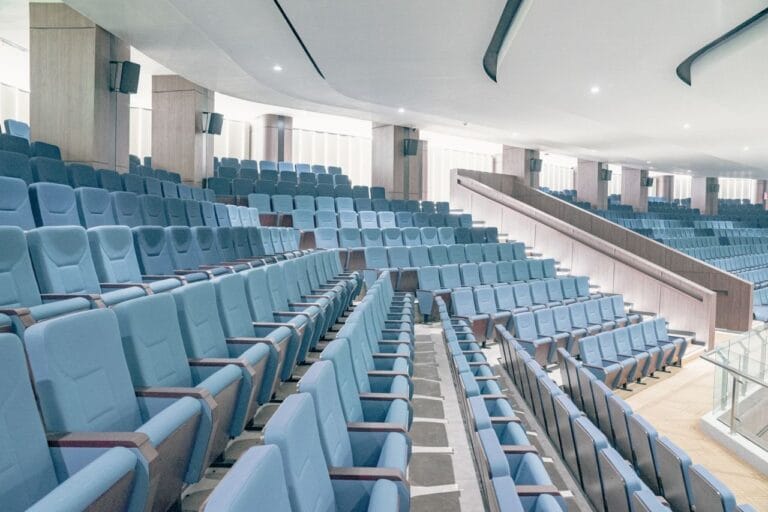
Auditorium seating is the only furniture category on a campus project that is simultaneously a building element, a life-safety element and a piece of furniture. It is bolted to the structure, it defines the egress path, and it is specified by row spacing and sightline before anyone considers how it looks. That is why a lecture theatre seating package cannot be procured the way the rest of a campus furniture package is procured — and why the supplier selection question is different from every other FF&E category.
This guide is for universities, school districts, developers and main contractors buying fixed or retractable seating for auditoriums, lecture theatres, multipurpose halls and assembly spaces. It sets out how the Chinese supply base for this category is structured, what actually has to be verified before an order, and where the category’s real risks sit in a construction programme.
Why this article does not publish a ranked list of company names
Ranked seating is a project-order business with almost no public visibility. The plants that build it work through contractors, consultants and dealers; they do not sell to consumers, they rarely carry a brand a buyer would recognise, and their reference projects are frequently covered by client confidentiality. Any list purporting to rank them is ranking marketing output, not manufacturing capability.
There is a second reason specific to this category. Ranked seating capability is not a single thing that can be ranked — a plant that excels at fixed tiered theatre seating may have no retractable telescopic capability at all, and the two are different engineering disciplines with different verification requirements. A list would flatten exactly the distinction the buyer needs. What follows is that distinction, written out.
The product families, and why they are not interchangeable
Fixed ranked seating
Chairs mounted to a stepped or raked floor, usually in continuous rows on a shared standard or beam. This is the default for lecture theatres and auditoriums with a permanent function. The engineering questions are anchorage to the substrate, row-to-row spacing against the governing building code, and the self-rising mechanism that returns the seat to the upright position to maintain clear aisle width.
Retractable and telescopic seating
Tiered banks that fold into a wall pocket to release the floor. This is a mechanical system with a structural frame, a drive mechanism and a deployment cycle — closer to a piece of building plant than a piece of furniture. It is specified for sports halls and multipurpose spaces, and it should never be procured from a supplier whose only evidence is fixed-seating experience.
Loose and link-together assembly seating
Stackable or interlocking chairs for flat-floor halls that need reconfiguration. Mechanically simple, but governed by the same egress logic when set out in rows: many jurisdictions require chairs in assembly occupancy to be linked together above a certain row count, which is a specification item that is routinely missed until inspection.
Tablet-arm and writing-surface variants
Any of the above with a fold-away writing surface. The tablet arm is the highest-failure component in the entire category, because it is the only part subject to repeated user-applied load at a long lever arm. It deserves separate verification from the chair it is attached to.
Sourcing this for a commercial project?
FBM Sourcing works with project owners, developers, main contractors and FF&E contractors on hotel, apartment, school, office and other commercial building projects. Send us your BOQ, drawings or product list — our team will review it and get back to you.
What actually has to be verified before an order
Four verification items carry almost all of the risk in this category, and none of them is answered by a catalogue.
Strength and durability evidence on the seating itself. Ranked seating has its own test regime distinct from office or lounge furniture — EN 12727 is the European reference for ranked seating strength and durability, and North American projects generally work to the applicable ANSI/BIFMA method for the chair type. What matters for a buyer is not which standard is quoted but whether the evidence covers the model being supplied, in the configuration being supplied. Test evidence is issued against a specific construction; a report for a similar model from the same plant does not transfer.
Anchorage and the structural interface. Fixed seating transfers load into the floor, and the fixing detail has to be agreed against the actual substrate — cast-in-place concrete, a stepped screed, or a raised platform each behave differently. This is the item most likely to cause a site problem, because it is the one item the furniture supplier cannot resolve alone. It needs to be closed between the seating supplier, the structural engineer and the main contractor before production, not during installation.
Fire performance of the upholstered components. Ranked seating in an assembly occupancy is subject to the flame performance rules of the project’s jurisdiction, applied to the assembled seat and back construction rather than to the face fabric alone. The applicable test differs by market, and evidence generated for one market does not automatically satisfy another. Our guide to fire safety certificates on FF&E from China sets out how this evidence chain should be assembled and checked.
Row spacing, aisle width and the egress calculation. These come from the project’s building code and the approved drawings, not from the furniture supplier. The supplier’s obligation is to build to the setting-out they are given; the buyer’s obligation is to make sure the setting-out handed over has been checked against code. Where this goes wrong is almost always a late seat-count increase that quietly erodes clear width.
How do you tell a real ranked-seating plant from a general furniture factory?
Three requests separate them quickly, and all three can be made remotely:
- Ask for a setting-out drawing for your actual room. A ranked-seating manufacturer works from a floor plan and returns a seat layout with row spacing, seat numbering, aisle positions and fixing points. A general furniture factory returns a product datasheet. This single request is the most reliable filter in the category.
- Ask which component of the chair they make in-house and which they buy. The self-rising mechanism, the standards or beams, the injection-moulded shells and the upholstery are frequently different sources. There is nothing wrong with a bought-in mechanism — but a supplier who cannot tell you where it comes from cannot support it in five years.
- Ask for the test evidence to be matched to the model code on your quotation. Requesting the report is routine; checking that the model number on the report is the model number on the quotation is the step that gets skipped, and it is where mismatches are found.
For the broader education furniture package that usually accompanies this category, our overview of school furniture manufacturers in China for education projects covers classroom and common-area items, and dormitory and classroom furniture sourcing covers residential campus scope.
Where this category sits in the construction programme
Ranked seating is the FF&E item most tightly coupled to the building programme, and treating it as furniture is the single most common programme error. Three consequences follow.
First, it is installed against a finished floor, not a furnished room. The seating installation sits after the floor finish and before the room is handed over, which puts it on the critical path in a way that loose furniture never is. A delay in the seating delivery is a delay in the room.
Second, it requires site dimensional verification before production. Row spacing is calculated from the built dimension, not the drawn one, and on a stepped floor the riser heights as built determine the standard lengths. Releasing production before that verification is how a bank of seating arrives that does not fit the room it was made for.
Third, installation is a trade, not a delivery. Someone has to set out, drill, anchor, align and commission. Whether that is a local contractor, a supplier-provided supervisor, or a full supplier install crew is a commercial decision that has to be made at the time of order, because it changes what is being quoted. Our guidance on FF&E installation drawings and assembly documents covers what a supplier should be handing over for this.
Cost drivers a buyer can actually control
Within any given quality level, the variables that move the number most are seat width, the presence and type of tablet arm, the upholstery specification, and the degree of customisation in the standards and end panels. Seat width is the largest and the least negotiable, because it is usually set by the room capacity requirement. Tablet arms carry a disproportionate cost for their apparent simplicity, because they add a mechanism and a load case.
The variables buyers commonly try to control and should not are the mechanism and the frame gauge. These are the components that determine whether the seating is still serviceable in year ten, and they are invisible in the sample. For a broader treatment of the same trade-off in institutional furniture, see our comparison of steel versus wood frame furniture for school and university projects.
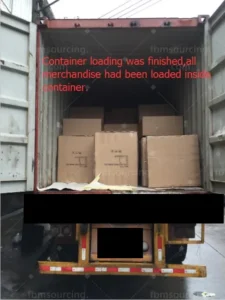
Shipping economics also differ from the rest of an FF&E package. Ranked seating ships as components — shells, standards, mechanisms, upholstered parts — and consolidates densely, which makes it comparatively efficient per seat. A campus package combining seating with other categories is usually best planned as a consolidated programme; our note on mixed container consolidation applies directly.
Sourcing this for a commercial project?
FBM Sourcing works with project owners, developers, main contractors and FF&E contractors on hotel, apartment, school, office and other commercial building projects. Send us your BOQ, drawings or product list — our team will review it and get back to you.
Frequently asked questions
What is the lead time for auditorium seating from China?
Longer than loose furniture, because production cannot start until the room dimensions are verified and the setting-out is approved. The sequence — layout approval, site dimensional check, prototype, production, shipping, installation — is what determines the date, not the manufacturing time alone. Treat it as a building element on the programme and work backwards from the room handover date.
Do Chinese factories supply installation for fixed seating?
Some will supply a supervisor to direct a local crew; full overseas installation crews are less common and change the commercial basis of the order. The practical arrangement on most international projects is a local installation contractor working to the supplier’s setting-out drawings and fixing details, with the supplier answering technical queries during the install window. This should be settled at order stage.
Can retractable seating be procured from the same supplier as fixed seating?
Sometimes, but it should not be assumed. Retractable systems are mechanical plant with a deployment cycle and a maintenance regime; fixed seating is not. Ask specifically for retractable reference installations and for the maintenance documentation that accompanies them. A supplier with no retractable evidence should be evaluated as a new capability, not an extension of an existing one.
How do row spacing requirements affect the seat count I can fit?
Directly, and the calculation belongs to the project’s code consultant rather than the furniture supplier. Minimum clear width between rows, maximum seats per row before an aisle is required, and aisle width all come from the governing building code for the project’s jurisdiction. The supplier builds to the approved layout; confirming the layout complies is the design team’s responsibility.
Is tablet-arm seating worth the additional cost on a lecture theatre?
It depends on whether the room has fixed writing surfaces or continuous desking. Where the tablet arm is the only writing surface it is not optional, and it should then be specified with attention to the mechanism and the load case, because it is the component most likely to fail in service. Where continuous desking is provided, tablet arms add cost and a failure point for little benefit.
Fixed seating is only one part of an education package, and the rules change again once the destination is Australia. For the plant types behind classroom tables, chairs and storage, and for the state emission, timber and biosecurity requirements that govern the import, see our guide to school furniture manufacturers in China for Australian school projects.
Working with FBM Sourcing on an auditorium seating package
FBM Sourcing has been sourcing building materials and FF&E from China since 2014, and has shipped more than 1,000 containers for project buyers in over 20 countries. On ranked seating our role is to identify suppliers whose capability actually matches the seating type specified, verify that test evidence covers the model being quoted, hold the setting-out and fixing interface between the supplier and the site, and inspect before shipment rather than on arrival.
If you have an auditorium, lecture theatre or assembly hall package coming up, send the floor plan, the seat count and the specification through our project procurement enquiry page and we will review it and come back to you.