
The moment a deposit leaves a project account, one question becomes concrete: if something goes wrong, who is the buyer’s counterparty? On a China project order that answer is decided long before anything ships, by whose name appears on the quotation, the invoice and the shipping documents. It is a structural question, not a question of goodwill, and it is worth settling in writing before the first payment rather than discovering it afterwards.
This page sets out how FBM Sourcing is structured, what that means in practice, and what it deliberately does not cover.
Three structures, three different answers
Almost every China procurement arrangement resolves into one of three shapes. They look similar in a proposal and behave very differently once an order is running.
- Buying direct from factories. The buyer contracts with each manufacturer separately. On a multi-category package that means several counterparties, several sets of terms, several sets of documents, and coordination work that lands on the buyer’s own project team. It gives the most direct commercial relationship and the least consolidated accountability — when a package is late or wrong, the question of which factory owns the problem is the buyer’s to resolve.
- Buying through an introducer. Some intermediaries connect a buyer to factories and take a fee for doing so, but the contract, the invoice and the payment still run to the factory. This is a legitimate model and it is cheap, but the buyer should be clear that the counterparty is the factory. The introducer’s name is not on the document the buyer would rely on.
- Buying through a company that takes the order in its own name. The buyer contracts with one company, which contracts with the factories. There is one counterparty, one set of documents and one place the responsibility sits. This is how FBM Sourcing works.
None of these is inherently right. A single-category order of a familiar product from a factory a contractor has used before does not need the third structure. A multi-category package for a commercial building, running across a dozen factories on a programme with a fixed handover, generally does. The distinction between the kinds of company involved is covered separately in manufacturer, trading company or sourcing agent; this page is about a narrower question — whose name is on the paperwork.
What “you deal with us” means on the documents
All quotations, invoices and shipping documents are issued by FBM Sourcing — you deal with us, and we carry the responsibility. That sentence has practical content, and it is worth unpacking rather than treating as a slogan.
It means the purchase order is placed with one company. It means the commercial invoice and packing list a buyer’s customs broker works from carry one name. It means the bill of lading names one shipper. And it means that when a buyer needs to raise something — a shortfall against the packing list, a finish that does not match the approved sample, a carton damaged in transit — the conversation is with the company they contracted with, not with a factory in a province they have never visited and have no contract with.
It also means something less comfortable that is worth stating plainly: consolidating accountability does not eliminate risk, it relocates it. A buyer who contracts with one company is relying on that company. That is precisely why the structure only makes sense alongside the operational controls below, and why the honest version of this argument includes the parts we do not do.
Placing a multi-category order from China?
FBM Sourcing works with project owners, developers, main contractors and FF&E contractors on hotel, apartment, school, office and other commercial building projects. Send us your BOQ, drawings or product list — our team will review it and get back to you.
What sits behind the name on the invoice
Taking an order in your own name is a claim about accountability. These are the things that have to be true for it to mean anything.
- The specification is fixed against an approved sample before production is released. Most disputes on a China project order are not fraud; they are an unfrozen specification. A finish signed off in an email thread and a finish signed off against a physical sample are different objects, and only one of them is arguable later.
- Inspection is carried out by our own team on the factory floor, with a full inspection before shipment. Dimensions, colours, finishes, quantities and function are checked against the approved specification, and the record is photographic and video. This is work our own people do, not something delegated to an outside inspection company.
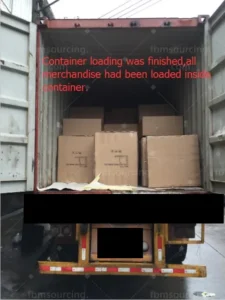
- Goods ship as complete container loads. Sometimes, on a large project, one product category alone fill full containers; sometimes that category share containers with the other product categories of the same project; and sometimes, in one batch, we combine a dozen or more product categories from several projects of the same client into a few containers — always full containers, and for us this is routine, well-practised work.
- The commercial terms are stated before the deposit, not after. For suppliers you nominate, we charge a 5% commission; for products we source for you, we quote a direct price. A deposit of 30–50% applies, with custom-made items typically at the upper end of that range, and the balance before shipment. We work on telegraphic transfer terms and do not use trade credit insurance.
The deposit-and-balance mechanics, including how they behave across several factories on one package, are set out in more detail in deposit and balance payment terms on China orders and payment terms with Chinese factories. Where a buyer’s own financing requires a letter of credit, the trade-offs are in letters of credit on China factory project orders.
What we do not do, and why saying so matters
An accountability claim is only as good as its boundaries, so here are ours.
We do not sell to individual homeowners. We work mainly on commercial construction projects, with developers, general contractors, builders, commercial project owners, interior design and construction companies, and FF&E solution providers. A private buyer furnishing their own house is not a project we are set up to run, and taking it on would serve neither side.
We do not quote against a deadline we have not seen the drawings for. Reviewing a bill of quantities or a set of shop drawings for a commercial package is substantial work, and a number produced quickly enough to satisfy a same-week request is a number that will move. Send us the specification and our team will review it and get back to you.
We do not take on packages we cannot run as full containers. Loose freight and shared depot arrangements introduce handling that a project package does not survive well, and the minimum unit of work is a complete container load.
We do not act as a purchasing department the buyer directs supplier by supplier. Where a client selects the factory, pays the factory directly and expects us to carry the consequences, the structure on this page has been dismantled while the expectation attached to it remains. That is not an arrangement we take on, and it is better said at enquiry stage than discovered at shipment.
How this looks across a whole package
On a commercial building the practical benefit of a single counterparty is not legal, it is administrative, and it compounds. A hotel package might involve a window and door factory, a cabinet plant, a tile supplier, a sanitaryware works, a lighting manufacturer, a loose furniture producer and a casegoods maker. Bought direct, that is seven contracts, seven deposit schedules, seven sets of export documents, seven quality standards to agree and seven production calendars to hold against one site programme, all of it landing on a project team that already has a building to run.
Bought as one order, it is one contract, one document set arriving in the form a customs broker expects, and one production calendar reconciled before it reaches the buyer. The categories still have to be managed individually — that work does not disappear, it moves. What changes is who does it, and who answers for it. The way that sequence runs on a hospitality package is set out in hotel FF&E procurement from China, and the developer and contractor variants in developer and contractor procurement paths.
What to settle before the deposit
Four things are worth having in writing before any money moves, whichever structure a buyer chooses.
- Whose name is on the invoice and the bill of lading, and whether that is the same company the purchase order was placed with.
- What the approved specification is, and whether it is a physical sample, a drawing, a written schedule or an email — and where that record is kept.
- What inspection happens, by whom, and at what point, and what form the record takes.
- How the goods are shipped, and whether the shipping arrangement matches what was priced.
These are not a test to run against a supplier. They are the four facts that determine what a buyer can actually rely on if a package goes wrong, and a serious counterparty of any of the three structures above should be able to answer them in a sentence each.
Where FBM Sourcing Fits
FBM Sourcing manages the entire China procurement package for overseas construction projects. That means we take the order in our own name, fix the specification against an approved sample before production, inspect on the factory floor with a full inspection before shipment, consolidate into full containers and issue the document set the buyer’s side needs — so the buyer’s counterparty is one company from purchase order to arrival.
About FBM Sourcing
Sourcing since 2014, FBM Sourcing has shipped 1,000+ containers of building materials and FF&E to more than 20 countries for hotels, apartment buildings, schools, offices and other commercial buildings. All quotations, invoices and shipping documents are issued by FBM Sourcing — you deal with us, and we carry the responsibility. For suppliers you nominate, we charge a 5% commission; for products we source for you, we quote a direct price.
If you have a package to price, send us the bill of quantities, drawings or product list and our team will review it and get back to you at https://fbmsourcing.com/china-building-materials-ffe-procurement/.
Frequently asked questions
Who is the counterparty when FBM Sourcing places an order with a Chinese factory?
FBM Sourcing. All quotations, invoices and shipping documents are issued by FBM Sourcing, and the buyer’s purchase order is placed with FBM Sourcing rather than with each manufacturer. FBM Sourcing contracts with the factories separately. The practical effect is that a buyer raising a shortfall, a finish that does not match the approved sample or transit damage deals with the company they contracted with, rather than with a factory they have no contract with.
Is it better to buy direct from Chinese factories or through one counterparty?
It depends on the shape of the order. A single-category order of a familiar product from a factory a contractor has used before does not need an intermediary. A multi-category package for a commercial building, running across a dozen factories against a fixed site programme, means several contracts, several deposit schedules, several document sets and several production calendars to reconcile, and that coordination lands on the buyer’s project team. Consolidating it does not remove the work or the risk, it relocates both.
What deposit is normal on a China project order?
A deposit of 30–50% is normal, with custom-made items typically at the upper end of that range, and the balance before shipment. FBM Sourcing works on telegraphic transfer terms and does not use trade credit insurance. Where a buyer’s own financing requires a letter of credit, that is a different arrangement with its own costs and document requirements.
Who carries out quality inspection?
Our own team, on the factory floor, with a full inspection before shipment. Dimensions, colours, finishes, quantities and function are checked against the approved specification, and the record is photographic and video. It is not delegated to an outside inspection company.
What does FBM Sourcing charge?
For suppliers you nominate, a 5% commission on the ex-factory value. For products we source for you, we quote a direct price. The terms are stated before the deposit.
Will FBM Sourcing work with a buyer who has already chosen the factories?
Where a client selects the factory, pays the factory directly and expects FBM Sourcing to carry the consequences, the structure that makes single-counterparty accountability meaningful has been dismantled while the expectation attached to it remains. That is not an arrangement we take on. Where a buyer has factories in mind but wants the order placed, controlled and shipped as one package, that is straightforward.