
At FBM Sourcing the fee depends on who found the supplier: for suppliers you nominate we charge a 5% commission, and for products we source for you, we quote a direct price with our work inside it. Either way it buys the entire procurement workload on the China side: factory sourcing and price benchmarking, sample coordination, production follow-up, pre-shipment inspection by the agent’s own team with photo and video records, multi-factory container consolidation, export documentation, and after-sales coordination. Sea freight and documents are arranged by FBM Sourcing, normally with our own forwarder, and no forwarder or other third party invoices you separately; import duties are assessed by your own customs authority. This article breaks the china sourcing agent fee down line by line so you can see exactly what you are paying for, and what you are not. FBM Sourcing is a sourcing agent working on your side.
How Do Sourcing Agents Charge? The Standard Model
At FBM Sourcing there are two models. For suppliers you nominate, we charge a 5% commission, agreed in writing before any order is placed and applied to the FOB value of each purchase order; for products we source for you, we quote a direct price. All quotations, invoices, packing lists and shipping documents are issued under FBM Sourcing’s own name, and sea freight is quoted to you before shipment.
What the Fee Covers: The Full Scope of Work
Here is the work a china sourcing agent fee actually pays for on a commercial building project. Each item below would otherwise be your own team’s job, executed remotely, in another language and legal system.
Factory sourcing and price benchmarking
The agent identifies candidate factories for each product category, screens them for export experience and production capability, and collects comparable quotations against the same drawings and specifications. Benchmarking three or more factories per category is standard practice, because first quotes from Chinese factories routinely leave negotiating room that only a comparable second and third quote will expose.
Sampling and pre-production follow-up
Before bulk production, the agent coordinates samples: material cuttings, finish panels, prototype units for custom furniture, or first-article pieces for architectural products. The agent checks samples against your specification, documents deviations, and manages revision rounds until the sample is signed off as the production reference.
Quality inspection by the agent’s own team
Goods are inspected before shipment by our own team, with photo and video records shared with the buyer, checking quantities, dimensions, finishes, and packing against the approved sample and packing list. On project orders this is the single highest-leverage line in the scope: a defect caught at the factory costs a rework cycle, while the same defect discovered at a job site on another continent costs an ocean crossing each way. See how factory QC inspection in China sourcing works in practice.
Multi-factory container consolidation
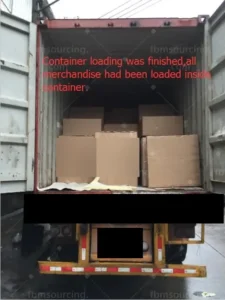
Commercial packages rarely fill containers neatly factory by factory. The agent books consolidated loads so goods from several factories ship together: filling a 40ft high-cube container from four or five factories instead of shipping four or five part-loads is one of the most concrete ways the fee earns its keep. The mechanics are covered in our guide to consolidating multiple factories into one container.
Export documentation and compliance paperwork
Commercial invoices, packing lists, certificates of origin, fumigation certificates for wood packaging, and the test reports your destination market requires are prepared and checked before the container gates in. Documentation errors are a leading cause of customs holds, and they are entirely preventable at this stage.
After-sales and claim coordination
If goods arrive damaged or short, the agent pursues the claim with the factory on your behalf: evidence packages, replacement production, and compensation negotiation. Without a local party holding the relationship, a claim against a factory you will never visit is difficult to enforce in practice.
How the Fee Is Calculated and When You Pay
For suppliers you nominate, the base for the 5% commission is the FOB value of the goods: the factory price including export packing, delivery to the Chinese port, and export clearance, as defined under Incoterms 2020. Using FOB as the base keeps the calculation clean, because it captures the value the agent actually procures and excludes freight and destination costs the agent does not control.
Payment follows the order’s own milestones rather than a separate schedule. Common practice on project orders looks like this:
- Deposit and balance milestones are agreed per order, and the service fee follows those same milestones rather than a separate schedule.
- All quotations, invoices and shipping documents are issued by FBM Sourcing — you deal with us, and we carry the responsibility.
- Fee terms, inspection scope, and claim procedures are written into the service agreement before the first purchase order.
Buyers placing six-figure project orders should also make sure the underlying purchase contracts protect them, not just the fee agreement. Our breakdown of contract terms that protect project buyers in China covers the clauses that matter most.
Want to see how this applies to your BOQ?
Send your drawings, product list, quantities, destination port and project timeline. FBM Sourcing will review the package category by category and come back with a sourcing plan. See what the full China procurement package covers.
What the Fee Does Not Cover
A clear fee is as clear about what sits outside it as what sits inside it. This is how the other costs on a project order are handled:
- Ocean and inland freight — sea freight transit time is confirmed by the carrier at booking; FBM Sourcing arranges container loading, sea freight and documents, normally with our own forwarder, and no forwarder invoices you separately.
- Import duties, tariffs, and destination taxes — assessed by your customs authority on arrival.
- Marine cargo insurance — arranged through FBM Sourcing together with the shipment; no insurer invoices you separately.
- Destination handling — port charges, customs brokerage, and last-mile delivery at your end.
- Third-party testing and certification fees — where your market requires product test reports from accredited laboratories, the lab fee goes on the FBM Sourcing quotation rather than being invoiced to you separately.
Carriers and forwarders still move the cargo, but the booking, the documents and the invoice run through FBM Sourcing. If the division of labour between those parties is unclear to you, our comparison of 3PL vs freight forwarder vs sourcing agent maps who does what from factory floor to job site.
Is a Sourcing Agent Worth It for a Commercial Project?
For a commercial building project, the honest way to evaluate the fee is against total project risk, not against the sticker price of the goods. Three points anchor the calculation:
Coordination load is the hidden cost. A mid-sized hotel or apartment fit-out package routinely draws on well over a dozen factories across doors, windows, tiles, stone, sanitary ware, kitchen and wardrobe joinery, lighting, and loose furniture. Every one of those factories needs specification review, order follow-up, inspection, and shipping alignment. Handled from your own office across time zones, that is a full-time workload for the duration of procurement; the fee is what transfers it to a team already on the ground.
Defects and shortages cost more than the fee. Custom commercial furniture runs a full production cycle after deposit, and tile and stone orders normally carry an overage allowance for cutting waste and breakage. If a defective batch ships uninspected, the replacement cycle is that production window plus an ocean crossing — on a fit-out schedule, that is the difference between opening on time and paying delay penalties. Pre-shipment inspection with photo and video records exists precisely to keep that scenario off your critical path.
Benchmarked pricing offsets the fee structurally. Because the agent collects competing factory quotations against identical specifications, the buyer enters negotiation with real market data instead of a single reseller’s number. We deliberately make no blanket savings promise — outcomes depend on category and specification.
For project owners, developers, main contractors, and FF&E contractors weighing the decision, the practical test is this: if your package spans multiple categories, multiple factories, and a fixed opening date, a china sourcing agent for building materials and FF&E procurement converts an opaque, fragmented buying exercise into a managed, documented supply chain.
Get a China Procurement Quote for Your Project
If you are budgeting a hotel, apartment, school, office, or other commercial building project and want to see how the fee model applies to your actual bill of quantities, send us your drawings, product list, quantities, destination port, and project timeline. Our team will review the package, benchmark factory pricing category by category, and come back with a sourcing plan built around your fit-out schedule — with the fee stated up front, the way it should be.
For how a sourcing agent and a showroom’s packaged price differ, see our companion breakdown of one-stop showroom supplier vs owner-side procurement agent.
Not sure what separates a sourcing agent, agency and company? See our comparison of sourcing agent vs sourcing agency vs sourcing company in China.