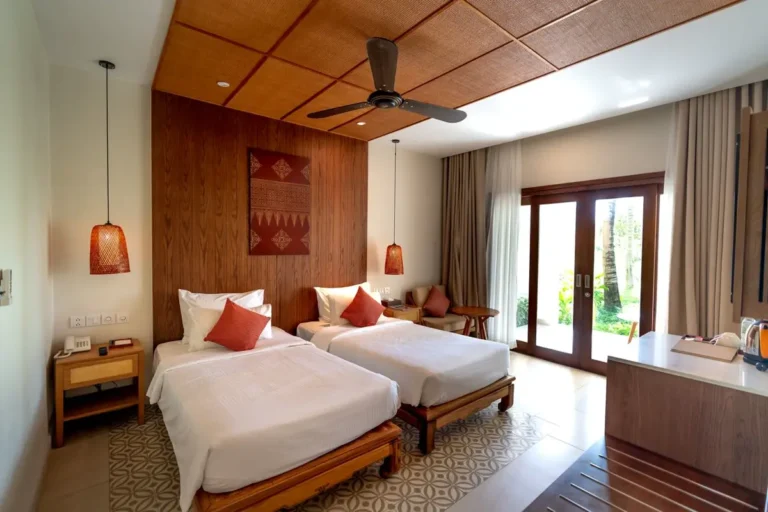
For a 30-80 room property, boutique hotel FF&E procurement from China works by treating many small-quantity, design-led items as one coordinated order: MOQs are negotiated per design, goods from multiple specialised factories are consolidated into shared containers, and a single cost-controlled mock-up room replaces the model-room floor a chain brand would build. The structural difference from chain hotel purchasing is not the product — it is that no single line item is large enough to run on its own, so consolidation, not volume, is what makes the numbers work. FBM Sourcing acts as your sourcing partner from specification through to shipment.
This guide is written for boutique hotel owners, developers and design-and-build contractors who are weighing a China FF&E package for a property that does not follow chain brand standards.
Why Boutique Hotel FF&E Procurement Differs from Chain Hotel Programs
A chain hotel program orders 150-300 identical keys against a brand standard, so every factory involved gets a deep production run of one specification. A boutique project inverts that: a 30-80 room property generates per-design quantities of only 30-80 pieces for anything used once per room, and quantities of one to ten for lobby, restaurant and corridor pieces. The order is wide and shallow instead of narrow and deep.
That shape has three practical consequences. First, you will be negotiating minimums on almost every custom line, because a designer-led scheme can easily carry 15-25 distinct furniture designs across guest rooms and public areas. Second, no single factory can make the whole package well — casegoods, upholstery, metalwork, lighting, stone and bathroom fittings come from different production clusters — so the project only holds together if one party manages all of them against one delivery date. Third, freight has to be planned as mixed loads from day one, since almost nothing in the order fills a container by itself.
None of this makes China uneconomic for small room counts. It means the procurement method matters more than it does for a chain, and a hotel furniture sourcing agent earns its fee (for suppliers you nominate, a 5% commission; for products we source for you, a direct price) mostly on exactly these three problems: MOQ negotiation, multi-factory coordination and consolidation.
What MOQs Can You Realistically Expect for Custom Hotel Furniture?
MOQs in China are set per design, not per purchase order, and they vary by how much dedicated setup a design requires. The workable reference points for a boutique order:
- Custom casegoods (headboard walls, wardrobes, minibar units, desks): 30-50 sets per design is a common factory floor — a 50-room property clears this on once-per-room items without negotiation.
- Upholstered seating: 20-30 pieces per model is typical for custom frames; smaller counts are usually accepted when the frame is an existing model with your fabric.
- Fabrics and finishes: stock fabric and standard finish colours carry no mill minimum; a custom-woven fabric can require several hundred linear meters, which a small property cannot absorb.
- Decorative lighting: custom designs often start at 50-100 pieces, while modified stock designs can run from 10-20.
The negotiating pattern that works for small room counts is bundling: a factory that would refuse 40 pieces of one custom desk will often accept it as part of a casegoods package covering six or seven designs for the same project, because the combined order justifies the setup. This is also why splitting a boutique package across many independently-contracted factories is the most expensive way to buy it — each factory sees only a fragment, and every fragment is below its comfort level.
For public-area pieces needed in quantities of one to five, the realistic route is semi-custom (covered below) or China’s contract-grade stock programs, not full customisation. Insisting on fully bespoke one-off pieces is where small projects burn budget fastest.
Order attic stock with the main run — you cannot come back for six chairs
Hotel projects conventionally add a small allowance of attic stock — spare fabric, extra chairs, replacement casegoods components — on top of installed quantities, and for a boutique property this habit is close to mandatory. A chain can reorder against a live brand program; a 45-room independent cannot place a repeat order for six lounge chairs in year three, because six pieces is below every custom MOQ and a new fabric dye lot will not match the original anyway. The attic stock rides in the same containers at marginal freight cost, and it is the only insurance policy against damage and wear that a small room count can actually buy.
How Do You Fill Containers When Every Item Is Low Quantity?
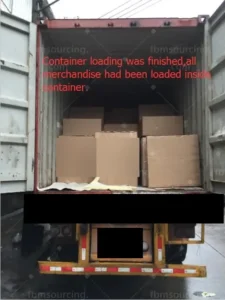
Mixed-category consolidation. Instead of shipping each factory’s goods separately, everything is collected at one consolidation warehouse near the port, inspected, load-planned and shipped together. A 40ft high-cube container holds less packed hotel cargo than its nominal capacity once crate shapes and loading clearances are accounted for — and a competent load plan closes that gap by pairing dense casegoods crates with light, bulky items like mattresses and lampshades.
Run this way, even a boutique project produces full containers of FF&E, so you are buying full containers, not paying loose-freight rates. Getting the count and the sequence right (which rooms’ goods travel together, what must arrive first for install) is its own discipline; see our guide to hotel FF&E container planning for how loads are estimated from a room count.
Loading order matters as much as volume on a boutique job. Install crews want casegoods and beds first and decorative layers last, so containers should be packed in reverse install sequence and cartons labelled by room number and floor at the factory, not sorted on a live construction site. Loose OS&E-adjacent items — lamps, mirrors, artwork crates — are the natural void-fillers between large casegoods crates, which is another reason mixed loading beats shipping category by category.
The consolidation warehouse is also where the last quality gate sits: goods from every factory are inspected before shipment by our own team, with photo and video records, so a problem from one of a dozen factories is caught before it is buried in the middle of a sealed container on the water.
Sourcing this for a commercial project?
FBM Sourcing works with project owners, developers, main contractors and FF&E contractors on hotel, apartment, school, office and other commercial building projects. Send us your BOQ, drawings or product list — our team will review it and get back to you.
Get a Project Quote
WhatsApp +86 135 6007 5057
For the wider picture of how a full FF&E procurement China package is structured — who holds the specification, how categories are grouped across factories, and where the sequencing risk sits — our main guide covers the whole process end to end.
How Do You Run a Mock-Up Room on a Boutique Budget?
Chain brands build a full model-room floor — sometimes several complete rooms plus corridor — and hold it against brand-standard sign-off. A boutique project needs the function, not the ceremony. The cost-controlled version is one physical mock-up room, built from the approved shop drawings before bulk production is released, and it adds time ahead of the bulk order.
What the single mock-up must do
It has to settle the questions that are expensive to reopen at 50-room scale: real finish colours under the actual lighting scheme, drawer and door hardware feel, upholstery comfort against the specified foam densities, and whether the casegoods dimensions actually work in the room footprint with the curtain and joinery lines. Everything signed off on the mock-up becomes the quality benchmark the bulk production is inspected against — the process is detailed in our hotel mock-up room guide.
Where the savings come from
Three habits keep the mock-up cheap without weakening it. Build it in China at the consolidation stage and review it by live video plus a recorded walkthrough, rather than air-freighting a whole room to site — air freight for one room’s furniture routinely costs more than the furniture. Limit it to the guest room, and cover public-area pieces with finish samples and first-article photos instead. And ship the approved mock-up itself in the first container as saleable stock for one real room, so the money is not spent twice.
Custom vs Semi-Custom: Where the Cost Boundary Sits
The single most useful cost lever on a small room count is knowing which changes are free-ish and which trigger tooling. Casegoods are usually the largest single line of a hotel FF&E package, so this boundary matters most there, but the logic applies across categories:
| Change level | Examples | MOQ / cost impact |
|---|---|---|
| Surface only | Your fabric on an existing frame; different veneer, stain or laminate; hardware swap | No tooling; minimums drop to near stock levels — the boutique sweet spot |
| Dimensional | Resized wardrobe or desk from an existing construction; reconfigured headboard wall | New shop drawings and CNC programs, no new molds; standard custom MOQs apply |
| New tooling | Cast-metal bases, moulded shells, custom extrusions, custom-woven fabric | Mold and setup charges spread over a small run — usually uneconomic below roughly 100 pieces |
A pragmatic boutique scheme puts the fully custom money where guests touch and photograph — headboard wall, one signature lobby piece — and runs everything else as surface-level or dimensional customisation of proven contract models. Designers do not lose the scheme by working this way; they lose the tooling invoices.
Multi-Factory Consolidation: One Contract, One Program
The categories in a hotel package map onto distinct production geographies: Foshan is China’s dominant furniture and sanitary-ware manufacturing cluster, while Zhongshan’s Guzhen town is the country’s recognised lighting production capital — and stone, drapery and hardware each have their own concentrations again. A boutique FF&E package therefore commonly draws on eight to fifteen specialised factories across casegoods, seating, lighting, stone, mirrors, drapery and bathroom fittings. Managed individually, that is eight to fifteen production schedules, deposit payments, inspection visits and shipping arrangements — for an owner’s team that usually has no one on the ground in China. Run through one china sourcing agent, it is one contract, one consolidated payment schedule and one delivery program aligned to your opening date.
Sequencing is the quiet risk. For custom casegoods, allow around four months from deposit to shipment (around two months for drawings and around two months for production); upholstery, stone and lighting run on their own curves, each confirmed by its factory in writing, and main-leg sea transit is confirmed by the carrier at booking. Work backwards from the opening date to per-factory order-release dates; what should be inside the package is itemised in the hotel FF&E package breakdown.
For a small property, the consolidation model is not a convenience — it is the mechanism that makes a 40-room custom scheme priceable at all.
Get a China Procurement Quote for Your Project
If you are developing a boutique hotel and want to know what your scheme costs to produce and ship from China, send us the basics: drawings or a design brief, room count and key quantities, destination port and your target opening timeline. We will come back with a structured view of MOQ fit, consolidation plan and production sequence for your project — see our China building materials and FF&E procurement service page, or use the buttons above to reach the team directly.