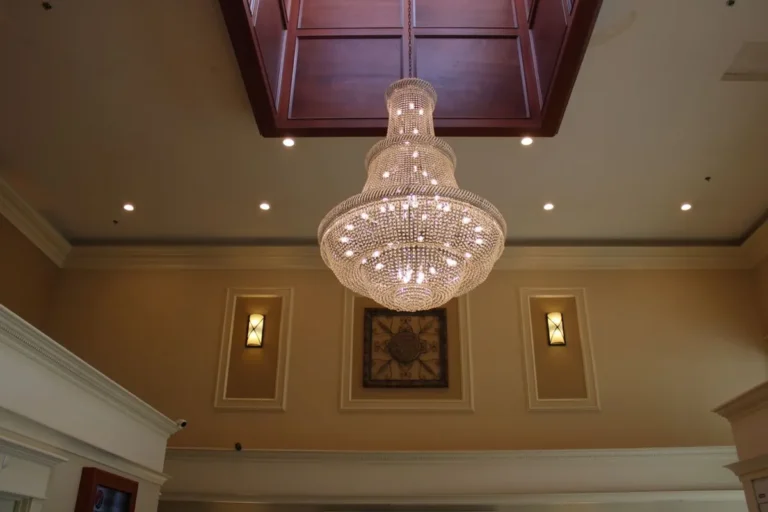
Sourcing a china chandelier or custom statement light for a hotel lobby is an engineering project, not a catalogue purchase: the piece is designed to your atrium’s dimensions, engineered around your ceiling’s structural hanging points, certified to your destination market (UL for North America, CE for Europe, SAA/RCM for Australia), and delivered with installation drawings your electrical contractor works from. Chinese custom lighting workshops routinely build bespoke light fittings from 1.5m decorative pendant pieces up to 6–8m multi-tier installations weighing 300–800kg, on a 45–75 day production cycle after sample approval. The buyer’s job is to control four things — scale, structure, certification and the drawing sequence — and this guide covers each in order. FBM Sourcing works as your sourcing agent and sourcing partner throughout this process.
It sits alongside our broader indoor lighting sourcing guide for hotel and apartment projects, which covers the full decorative lighting package; here the focus is the one-off statement pieces that anchor a lobby, atrium or ballroom.
What Scale of Custom Made Light Fixtures Can China Produce?
China’s custom lighting workshops are set up for exactly the work hotel projects need: one-off or short-run pieces in crystal, blown glass, brass, stainless steel, alabaster-effect resin and LED-integrated acrylic. Practical scale brackets for planning:
- Lobby feature pendants: 1.2–2.5m diameter, 30–120kg — standard ceiling mounting usually suffices
- Atrium and stairwell cascades: 3–12m drop, built as stacked modules of glass rods, globes or crystal strands, 150–500kg
- Ballroom and grand lobby chandeliers: 3–8m diameter, 300–800kg, requiring engineered structural connections and often a winch system for lamp maintenance
A useful sizing convention for a lobby piece: add the room’s length and width in metres, and read the sum in inches-per-foot terms — in practice, a chandelier diameter of roughly 1/10 to 1/12 of the room diagonal reads correctly at lobby scale, and the bottom of the piece should hold at least 2.4m clear height over circulation areas. Your interior designer sets the aesthetic; the factory’s engineers confirm what those dimensions weigh. Smaller repeated decorative pieces for corridors and restaurants are a different, catalogue-based exercise — see our pendant lights sourcing guide for those.
How Do You Engineer Suspension Points, Weight and Safety?
Structure is the part of statement lighting that cannot be fixed after shipment, so it is resolved on paper before production. Four numbers must be agreed between the factory and your structural engineer:
- Total suspended weight, stated on the shop drawings and re-weighed at final inspection — large pieces are commonly specified with a safety factor of 4:1 or better on every suspension component
- Number and position of hanging points — a 400kg cascade might load 6–12 points into the slab or a dedicated steel frame above the ceiling, and those points must exist in the builder’s programme before the ceiling closes
- Secondary retention — independent safety cables rated for the full load, standard practice for public-area suspended fittings
- Maintenance access — above roughly 6m mounting height, specify an integrated electric winch or demountable modules, because lamp replacement from scaffolding in a working lobby is a cost the operator pays for 20 years
The coordination point project buyers miss most often: the hanging-point layout must be issued to the main contractor while the slab or ceiling steel is still open. On a typical programme that means the lighting factory’s first engineering drawing is needed 3–5 months before the fitting itself ships.
UL or CE — Which Certification Does Your Hotel Project Need?
Certification is destination-driven, and it must be written into the purchase order before production because it changes the components inside the fitting, not just the paperwork:
- North America: UL 1598 (or cUL/CSA for Canada) listing for luminaires; many US jurisdictions’ inspectors will not sign off unlisted custom fittings, so confirm whether your project requires a listed fitting or field evaluation at destination
- Europe and the UK: CE (or UKCA) marking against EN 60598, with LED drivers and wiring components individually compliant
- Australia and New Zealand: SAA-approved components and RCM marking, with AS/NZS 60598 as the reference standard
The practical difference is real: a UL-bound chandelier uses listed sockets, listed drivers and specific wire gauges and grounding details that differ from a CE build. Asking a factory to “add the certificate later” is asking for a rebuild. On FBM Sourcing projects the certification route is fixed at quotation stage, and component certificates travel with the shipping documents — the same discipline we apply across commercial lighting packages.
Sourcing this for a commercial project?
FBM Sourcing works with project owners, developers, main contractors and FF&E contractors on hotel, apartment, school, office and other commercial building projects. Send us your BOQ, drawings or product list — our team will review it and get back to you.
What Does the Custom Process Look Like, Concept to Installation Drawings?
Bespoke light fittings run through a four-drawing sequence, and each stage exists to catch a different class of error:
- Concept design — the designer’s render or reference image with target dimensions and finishes. The factory responds with feasibility comments and a budget-level quotation, typically within 7–10 days.
- Deepening (engineering) drawings — the factory’s own construction drawings: frame structure, module breakdown, wiring routes, driver locations, total weight and hanging-point loads. This is where the piece becomes buildable; allow 2–3 weeks and at least one revision round.
- Sample stage — for a one-off statement piece, a full prototype is rarely economic; standard practice is a 1:1 section sample (one tier, one module, or a 500–800mm segment) plus finish plates and a lit test of the actual LED source at the specified colour temperature (2700K and 3000K read very differently in crystal). Allow 15–25 days. The approval mechanics follow the same rules as any custom item — see how sample approval works when sourcing from China.
- Installation drawings — issued with the finished piece: hanging-point template, module assembly sequence, wiring diagram and torque/fixing specifications, which your electrical contractor works from on site.
Production itself runs 45–75 days after sample sign-off for a large piece. End to end, concept to delivered crate is realistically 4.5–6 months — which is why the statement lighting order belongs in the first wave of an FF&E programme, not the last.
How Are Statement Pieces Packed, Shipped and Installed?
Large chandeliers ship disassembled into numbered modules: frame sections in foam-lined plywood crates, crystal strands or glass elements individually wrapped and boxed by position number, drivers and hardware bagged per hanging point. A 4m chandelier typically ships as 8–20 crates, and the numbering matters more than the wrapping — an unnumbered crystal shipment can add days of sorting on site. Specify 3–5% spare crystal or glass elements in the order; breakage of small elements in transit is normal and spares turn it into a non-event.
Before crating, the assembled piece is test-hung and lit at the factory. On FBM Sourcing orders that test is witnessed by our own inspection team and documented in photos and video — full assembly, lit operation, weight check and crate-by-crate packing record — so the project team overseas signs off the piece before it ships, not after it is hanging. Installation is then the electrical contractor’s scope, working from the factory’s drawings, with the factory available on video call during assembly; for complex cascades, agree that support in the purchase order. How the lighting scope coordinates with the rest of the lobby package is covered in our hotel lobby furniture sourcing guide.
Frequently Asked Questions
How long does a custom chandelier from China take for a hotel project?
Realistically 4.5–6 months from concept to delivered crates: 7–10 days for feasibility and quotation, 2–3 weeks of engineering drawings, 15–25 days for a section sample and finish approval, 45–75 days production, then test-hang, crating and 3–5 weeks of ocean freight. The hanging-point drawing is needed by the main contractor months earlier, while the ceiling structure is still open.
Can Chinese factories build UL-listed custom light fixtures?
Yes — established custom lighting workshops build to UL 1598 with listed sockets, drivers and wiring, but the certification route must be fixed in the purchase order before production because a UL build uses different internal components from a CE or SAA build. Confirm with your local authority whether a listed fitting or a field evaluation is required, and have all component certificates travel with the shipping documents.
How heavy is a hotel lobby chandelier and what structure does it need?
Lobby feature pendants run 30–120kg; large atrium and ballroom pieces run 300–800kg across 6–12 engineered hanging points with independent safety cables and a 4:1 or better safety factor on suspension components. The factory states total weight on the deepening drawings and your structural engineer signs off the connections; pieces mounted above roughly 6m should include a winch or demountable modules for maintenance.
How are large chandeliers shipped without damage?
Disassembled into numbered modules: frames in foam-lined plywood crates, crystal and glass elements individually wrapped and boxed by position, hardware bagged per hanging point — a 4m piece ships as 8–20 crates. The piece is test-hung, lit and documented at the factory before crating, and ordering 3–5% spare crystals turns normal transit breakage of small elements into a non-event.
Get a Quote for Your Lobby’s Statement Lighting
If your hotel or mixed-use project has a lobby, atrium or ballroom piece on the drawings, send us the concept render, ceiling heights and destination country. As a china procurement agent for hotel and apartment developments, we will confirm feasibility, fix the certification route, manage the drawing and sample sequence, and deliver the piece crated, documented and ready for your electrical contractor to hang — on a 5% commission for suppliers you nominate (products we source for you are quoted at a direct price).