The top ceramic tile manufacturers in China for Australian commercial projects are best read as five manufacturer types rather than a ranked list: listed building-ceramics groups in Foshan and Dongguan, private porcelain plants in Foshan, Zhaoqing and Qingyuan, high-capacity plants in Gao’an, Jinjiang and Zibo, large-format porcelain slab lines, and specialists in extruded tiles, pavers and trim. Four of the groups can be checked from exchange filings — Monalisa Group (SZSE 002918), Guangdong Dongpeng Holdings (SZSE 003012), MarcoPolo Holdings (SZSE 001386) and Guangdong Tianan New Material (SSE 603725), the parent of Eagle Ceramics. What puts any of them on an Australian apartment, hotel or office project is evidence tied to the exact tile: an AS 4586 slip classification for the finish supplied, a water absorption group under AS 13006:2020, and shade and calibre control that holds across phased deliveries.
This guide is written for developers, general contractors, builders, commercial project owners, interior design and construction companies and FF&E solution providers delivering apartments, build-to-rent, hotels, offices, aged care and education projects in Australia. General manufacturer profiles are in our master list of top ceramic tile manufacturers in China; this page narrows the field to the manufacturer types an Australian tile package actually uses, and the Australian evidence each must produce before its tile goes into a tender.
What Does an Australian Specification Ask a Tile Manufacturer to Prove?
Australian tile schedules are written around a handful of standards and code clauses. Only some are the manufacturer’s to meet; the rest belong to the installer or the builder, and it helps to know which is which before any factory is shortlisted.
- AS 4586-2013 slip resistance classification. Specifications call up slip resistance as a P classification from the wet pendulum test or an R classification from the oil-wet inclined ramp test. In some locations the NCC makes it mandatory: NCC 2022 Volume One Table D3D15 sets minimum classifications, tested to AS 4586, for ramps, stair treads, landings and nosing strips — for a tread or landing surface, P3 or R10 in dry conditions and P4 or R11 where it may be wet. Elsewhere the specifier sets the rating area by area. The classification belongs to a product in one surface finish, so a matt and a textured version of the same series are separate results. How the two scales compare is covered in AS 4586 slip ratings for Australian projects.
- AS 13006:2020 classification. The Australian adoption of ISO 13006:2018 with Australian variations, superseding AS ISO 13006—2013. It classifies ceramic tiles by forming method — Group A extruded, Group B dry-pressed — and by water absorption, from group BIa (not more than 0.5 per cent) through BIb, BIIa and BIIb to BIII (above 10 per cent), and sets the characteristics and marking of first-quality tiles. The test report for a quoted series should state its group. The standard does not apply to trim and accessory pieces such as skirting, steps, coves and corners, or to small mosaic pieces.
- AS 3958:2023, installation of ceramic and stone tiles. It replaced AS 3958.1:2007 and AS 3958.2-1992 and covers background preparation, bonded fixing and grouting. It is the tiler’s standard: no manufacturer can certify a tile to AS 3958, but the tile’s format and flatness have to suit the bedding method the installer will use.
- Wet-area waterproofing. Under NCC 2022 Volume One F2D2, wet areas in Class 2 and 3 buildings must be impervious to water in accordance with AS 3740, in the locations listed in Specification 26. The membrane is the waterproofer’s and builder’s scope; a tile factory supplies the finish over it and cannot supply wet-area compliance.
- Engineered stone prohibition. Since 1 July 2024, Australian work health and safety laws have prohibited the use of engineered stone benchtops, panels and slabs. Ceramic wall and floor tiles are excluded, and porcelain and sintered stone are excluded where they contain no resin. When large-format porcelain slabs are proposed as benchtops, a statement confirming a resin-free body becomes part of the evidence, and processing of excluded products still has to be controlled.
- Timber packaging. Pallets and crates must be ISPM 15 treated and marked and free of bark, and each sea container needs a packing declaration covering timber packaging and container cleanliness for Australian biosecurity clearance.
The wider compliance map for building materials from China is in NCC and BCA compliance for building materials from China.
Why This Shortlist Names Only Four Companies
Most Chinese tile plants are privately held, and their capacity, kiln lines and export history cannot be checked against any public filing. Listing private factories by name and position would present an opinion as a finding. This page therefore names only the four groups whose exchange listings we have verified, describes the rest by manufacturer type and production area, and ends each type with the evidence to request. The order below follows the way an Australian tile schedule is usually divided; it is not a ranking, and there is no scoring.
Where Chinese Ceramic Tile Is Actually Made
Foshan remains the headquarters and showroom city of the Chinese tile industry, but much of the firing capacity sits outside it. According to 2024 figures from the China Building and Sanitary Ceramics Association reported in the Chinese trade press, the largest county-level production areas include Gao’an in Jiangxi, Jinjiang in Fujian, Gaoyao District of Zhaoqing, Qingxin District of Qingyuan and Zichuan District of Zibo in Shandong, with Guangdong, Jiangxi and Fujian the leading provinces. Foshan-based groups have built plants in Qingyuan, Guangxi and Jiangxi, so a Foshan brand on a carton can mean a tile fired in another province. That is not a problem in itself; it means the test report, the production run and the loading plan must be traced to the plant that actually made the tile. The areas are compared in where ceramic and porcelain tiles are made in China.
At a Glance: Which Manufacturer Type Suits Which Australian Project?
The five manufacturer types described below line up with Australian project needs as follows.
| Manufacturer type | Where | Best fit | Evidence to request |
|---|---|---|---|
| Listed building-ceramics groups | Foshan, Dongguan; plants in several provinces | Large apartment, build-to-rent and hotel packages | Product-code AS 4586 report, AS 13006 results, resin-free slabs |
| Private porcelain plants | Foshan, Zhaoqing, Qingyuan | Mid-sized apartment, office and retail projects | Reports in the plant’s name, per-finish slip results, carton codes |
| High-capacity plants | Gao’an, Jinjiang, Zibo | Back-of-house and repeat wall tile | Body group, floor slip results, single-run plan |
| Slab and thin-panel lines | Varies by producer | Lobbies, foyers, benchtops | Resin-free statement, warpage data, ISPM 15 crates |
| Extruded, paver and trim specialists | Varies by producer | Stairs, ramps, podiums, balconies | Table D3D15 slip results, trim data, shade match |
Pricing a ceramic tile package for an Australian project?
Send your finishes schedule or BOQ and we will match each tile line to the manufacturer type that makes it, with the AS 4586 evidence for each finish.
The Ceramic Tile Manufacturer Types Relevant to Australian Projects
Listed building-ceramics groups (Foshan and Dongguan)
- Who they are: Monalisa Group (SZSE 002918), founded in Foshan in 1992 and listed in 2017, with bases in Foshan, Qingyuan, Teng County in Guangxi and Gao’an in Jiangxi; Guangdong Dongpeng Holdings (SZSE 003012), Foshan-headquartered with roots in 1972, making ceramic and porcelain tiles alongside bathroom products; MarcoPolo Holdings (SZSE 001386), a Dongguan architectural ceramics manufacturer with plants in Guangdong, Jiangxi and Chongqing, listed on the Shenzhen main board on 22 October 2025; and Guangdong Tianan New Material (SSE 603725), parent of Eagle Ceramics, founded in Foshan in 1974.
- Key products: porcelain floor and wall tiles, large-format panels and slabs, and in Monalisa’s case thin ceramic panels.
- Best fit: apartment, build-to-rent and hotel packages with several series across many levels, where later orders must match earlier ones.
- Evidence to request: an AS 4586 report from an accredited laboratory naming the exact product code and finish; water absorption and dimensional results for the series under AS 13006:2020 or ISO 13006; the plant that fires it; and a resin-free statement for slabs used as benchtops.
Private porcelain plants (Foshan, Zhaoqing, Qingyuan)
- Who they are: privately held plants in the Guangdong belt, from single-line producers to multi-line plants that also make tile for other brands under OEM arrangements.
- Key products: rectified glazed porcelain in matt, textured and polished finishes; stone-look and concrete-look series.
- Best fit: mid-sized apartment, office and retail projects with a fixed series selection.
- Evidence to request: test reports in the name of the producing plant rather than a showroom company; an AS 4586 result for each finish on the schedule, not one finish standing in for the range; and shade and calibre codes on the carton label.
High-capacity plants outside Guangdong (Gao’an, Jinjiang, Zibo)
- Who they are: producers in Gao’an in Jiangxi, which has grown with investment from Guangdong groups such as Monalisa, and in Jinjiang in Fujian and Zichuan in Zibo, Shandong, each with its own base of local producers.
- Key products: standard-format floor tiles, glazed porcelain and ceramic wall tiles in high volumes.
- Best fit: back-of-house areas, car park lobbies, service corridors and repeat bathroom wall tile.
- Evidence to request: the water absorption group of the body, since wall tile is often a higher-absorption group and should not migrate onto floors; an AS 4586 result wherever it is laid on a floor; and a plan to fire the full quantity in one run.
Large-format porcelain slab and thin-panel lines
- Who they are: wide-format pressing lines run by the listed groups and a smaller number of private specialists.
- Key products: cladding panels, feature-wall slabs, vanity tops and kitchen benchtops.
- Best fit: hotel lobbies, commercial foyers and apartment kitchens, especially where a specification has moved from engineered stone to porcelain since 2024.
- Evidence to request: a resin-free composition statement, flatness and warpage results for the slab size supplied, and crate design with ISPM 15 marking.
Extruded tile, paver and trim specialists
- Who they are: producers of Group A extruded tiles, outdoor porcelain pavers, stair treads, skirting and other shaped pieces, often supplying the accessories shown in larger brands’ catalogues.
- Key products: split tiles, podium and pool-surround pavers, step treads, coves and bullnose trims.
- Best fit: podium terraces, balconies, public stairs and ramps.
- Evidence to request: an AS 4586 report for the tread or paver finish that meets Table D3D15 for its location, separate product data for trim, which AS 13006:2020 does not cover, and a shade match to the field tile.
How Do Shade, Calibre and Flatness Hold Up Across Phased Deliveries?
Apartment and hotel towers take their tile in several call-offs, often months apart, and every firing has its own shade and calibre.
- One run per series. Fire the full quantity, including wastage and attic stock, in one run and hold later phases from it. Allowances are set out in tile wastage allowance for stone and flooring orders.
- Codes on every carton. Shade and calibre codes on each label, never mixed on one floor.
- A production control sample. Approve a sample from the actual run, not the showroom board, and keep a sealed set on site.
- Rectified or non-rectified. ISO 13006 defines a rectified tile as one whose edges receive precise mechanical finishing after firing. Narrow joints make any warpage visible as lippage, so flatness data matters most for rectified large formats, and the bedding method under AS 3958:2023 should be agreed with the installer before the order is confirmed.
How Australian Tile Packages Are Loaded and Shipped
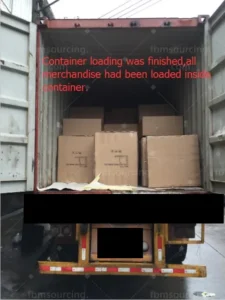
Tile is dense cargo: a container of porcelain usually reaches its payload weight before it is full, so tile is planned by weight and spare volume goes to lighter categories. Sometimes, on a large project, the ceramic tiles alone fill full containers; sometimes the ceramic tiles share containers with the other product categories of the same project; and sometimes, in one batch, we combine a dozen or more product categories from several projects of the same client into a few containers — always full containers, and for us this is routine, well-practised work. The Australian side — biosecurity, GST and port handling — is described in how Australian commercial builders source from China.
Where FBM Sourcing Fits
An Australian tile schedule rarely maps onto one manufacturer: floor tile from a listed group, back-of-house tile from a Gao’an plant, benchtops from a slab line, treads from a trim specialist. FBM Sourcing works as the China-side sourcing partner on that package — matching each line to the manufacturer type that makes it, collecting AS 4586 and AS 13006:2020 evidence against exact product codes, managing control samples and shade approval, carrying out inspection by our own team at the factory before shipment, with photo and video records, and loading the tile in full containers with the project’s other categories.
Pricing a ceramic tile package for an Australian project?
Send your finishes schedule or BOQ and we will match each tile line to the manufacturer type that makes it, with the AS 4586 evidence for each finish.
Frequently Asked Questions
Do ceramic tiles made in China meet AS 4586 for Australian projects?
They can, but the classification belongs to one product in one surface finish, not to a factory or a series. Ask for an AS 4586 report from an accredited laboratory naming the exact product code and finish, and check it against the specifier’s rating for each area and, for stairs, landings and ramps, against NCC 2022 Volume One Table D3D15.
Does AS 13006:2020 apply to tile trim and mosaics?
No. AS 13006:2020 classifies first-quality ceramic tiles by forming method and water absorption, but excludes accessory pieces such as edges, corners, skirting, steps and coves, and mosaic pieces that fit within a 7 cm square. Trim and mosaics need their own product data and a shade match to the field tile.
Are porcelain slabs affected by Australia’s engineered stone ban?
Porcelain and sintered stone are excluded from the prohibition that took effect on 1 July 2024, provided they contain no resin, and ceramic wall and floor tiles are excluded too. For porcelain benchtops, ask for a composition statement confirming a resin-free body; processing must still be controlled.
Who is responsible for wet-area waterproofing when tiles come from China?
The builder and the waterproofing installer. For Class 2 and 3 buildings, NCC 2022 Volume One F2D2 requires wet areas to be impervious to water in accordance with AS 3740, in the locations set out in Specification 26. The tile is the finish over the membrane, not the compliance.
How do you keep tile shade consistent across the phases of an apartment project?
Fire each series in one production run including wastage and attic stock, hold later phases from that run, require shade and calibre codes on every carton, and approve a control sample from the run itself. Two firings side by side on one floor cannot be corrected once laid, so the decision is made when the order is placed.
About FBM Sourcing
FBM Sourcing manages the entire China procurement package for overseas construction projects. Since 2014 we have worked with developers, general contractors, builders, commercial project owners, interior design and construction companies and FF&E solution providers across more than 20 countries and over 1,000 containers, as their sourcing partner in China — from the schedule or BOQ through factory selection, sampling, inspection by our own team before shipment, consolidation and shipping. All quotations, invoices and shipping documents are issued by FBM Sourcing, and sea freight is quoted to you before shipment. If you have a ceramic tile package to price, start at China building materials and FF&E procurement.