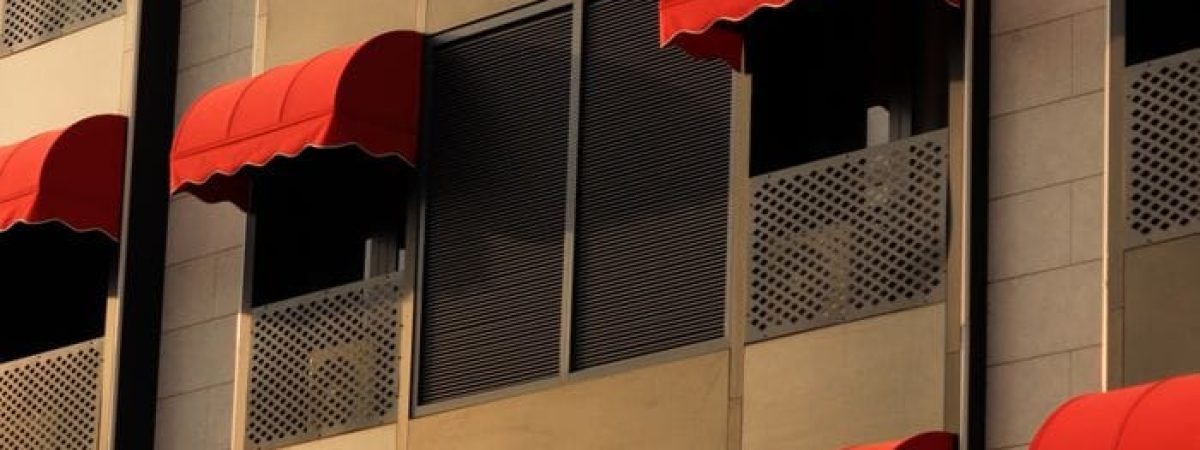
Commercial awnings — motorized folding-arm systems, cassette units and fixed-frame structures — are manufactured at genuine scale in Guangdong and Zhejiang, and a project team can buy them factory-direct through a building material sourcing agent and sourcing partner instead of paying distributor margins at the destination. Awnings sourcing from China works best when the order is project-shaped: a hotel shading forty terrace bays, a restaurant group standardizing one frontage system across twelve locations, or an apartment development putting operable shade over every amenity deck. FBM Sourcing runs the factory shortlist, drawing approval, production inspection and container consolidation from Foshan, so the awning package lands at port together with the rest of the project’s materials.
Key numbers a specifier should hold before requesting quotes:
- Production lead time: 20–30 days for motorized retractable awnings after drawing sign-off
- Frame standard: 6063-T5 extruded aluminum, powder coated 60–80 μm film thickness
- Fabric weights: solution-dyed acrylic around 300 g/m²; PVC-coated polyester 650–900 g/m²
- Wind resistance: EN 13561 Class 2–3 on quality folding-arm systems
- FBM Sourcing agency fee: a 5% commission for suppliers you nominate (direct price for products we source)
Awning Types and Specifications
Chinese factories build every awning format that appears on commercial shade schedules. The distinctions matter at quotation stage, because two systems that look identical in a rendering can differ by half in extrusion weight and arm quality.
| Type | Typical Commercial Use | Key Specification Points |
|---|---|---|
| Folding-arm retractable | Restaurant frontage, hotel terrace dining | Projection to 4 m, coupled widths to 12–14 m, double-cable or belt-tension arms |
| Full-cassette retractable | Apartment balconies, facade-mounted shade | Fabric and arms fully enclosed when closed; cleanest facade line; longest fabric life |
| Semi-cassette | Mid-budget hospitality projects | Hood protects fabric roll only; lower cost than full cassette |
| Fixed-frame / canopy awning | Entrance identity, walkway cover, storefront signage band | Welded aluminum or steel frame, tensioned or laced fabric, printable skins |
| Drop-arm window awning | Hotel and office window shading | 45–90° pitch adjustment, crank or motor drive |
| Conservatory / skylight awning | Rooftop bars, glazed atriums | Track-guided fabric under or over glazing, motor drive standard |
Frames on commercial-grade systems are extruded from 6063-T5 aluminum alloy with stainless steel 304 fasteners and torsion-spring arms tested for repeated cycling. Folding-arm units above 5 m width run on a coupled square torsion bar of 40 mm or larger; undersized bars are the most common cost-cut and show up later as fabric sag at mid-span.
Fabric is the second specification battleground. Solution-dyed acrylic (the Sunbrella-class material, roughly 300 g/m²) holds color for 5–8 years of daily sun and is the default for hospitality projects where the awning is part of the brand image. PVC-coated polyester at 650–900 g/m² is waterproof and suits all-weather dining covers and fixed canopies; a PVDF topcoat version adds a self-cleaning surface for high-visibility frontages. Motor options are Somfy (European brand, assembled in China) or Dooya (domestic), both available in 110 V and 230 V windings with hand-crank override.
Controls and automation
Commercial awning schedules increasingly specify automation, and Chinese factories package it as standard options rather than premium add-ons. Wind sensors that auto-retract the fabric above a set threshold are close to mandatory on folding-arm systems over public areas — an extended awning in a gust is the classic failure event, and insurers know it. Sun and rain sensors, wall switches, handheld remotes with multi-channel grouping, and dry-contact or RS-485 interfaces for building management systems are all available; what matters at inquiry stage is stating the control philosophy once, in writing, because retrofitting group control across forty installed motors is an electrician’s week that a two-line specification would have avoided.
Branding is the other commercial-specific option. Valances and fixed-frame skins can be digitally printed or heat-welded with logos and lettering — restaurant and hotel groups typically order one printed sample skin for brand sign-off before releasing the batch.
Projects that need continuous rigid coverage rather than fabric shade — porte-cochères, walkways between buildings — usually specify polycarbonate or aluminum canopies instead, and the two product lines can be quoted and shipped together.
Sourcing Process for Awnings from China
Awning procurement follows a fixed sequence, and the calendar is predictable enough to slot into a construction program.
- Inquiry. Send elevations or a marked-up facade drawing with opening widths, projection requirement, fabric preference and destination country. Motor voltage and control preference (switch, remote, building management integration) should be stated here, not discovered later.
- Factory comparison — 5–7 days. FBM Sourcing prices the package across two to four vetted factories and returns a comparison that normalizes what each quote actually includes: arm brand, torsion bar size, fabric grade, motor origin.
- Sampling — 7–12 days. For most projects a fabric swatch card, powder-coat color plates and an arm assembly sample are enough. Full unit samples are worth the time only on orders above roughly 30 units or on custom cassette profiles.
- Drawing approval. The factory issues production drawings showing bracket positions, fixing types and electrical points. This is the document the site team will install from, so it gets checked against the architect’s facade drawings before any metal is cut.
- Production — 20–30 days. Motorized retractable systems in standard RAL colors sit at the short end; custom-printed fixed canopies and non-standard coupled widths run longer.
- Inspection and shipping. Pre-shipment QC (detailed below), then loading. Awnings rarely fill a container on their own, so FBM Sourcing consolidates them with other packages — balcony shades, carport shade structures, doors, sanitary ware — from the same project. Ocean transit runs 18–22 days to the US West Coast, 28–35 days to the East Coast, and 12–18 days to Australian ports.
End to end, a project team that approves drawings promptly can hold awnings on site within 8–10 weeks of the first inquiry. The schedule risk sits almost entirely in the approval steps, not the factory: a fabric color decision that drifts for three weeks costs exactly three weeks at the far end. FBM Sourcing’s project managers chase those approvals with the same discipline applied to the production dates, because to a general contractor a shade package that misses the facade access window is late no matter whose signature was slow.
Sourcing this for a commercial project?
FBM Sourcing works with project owners, developers, main contractors and FF&E contractors on hotel, apartment, school, office and other commercial building projects. Send us your BOQ, drawings or product list — our team will review it and get back to you.
Payment structure is conventional export practice: a deposit against order confirmation with the balance tied to passed pre-shipment inspection — which keeps the leverage where it belongs until the goods are verified.
Quality Standards and Inspection
Awning failures are concentrated in four places — fabric, arms, coating and motors — so inspection concentrates there too.
Fabric compliance. For US hospitality and public-building projects, shade fabrics over exits and dining areas are commonly required to pass NFPA 701 flame propagation testing; European and Australian projects reference EN 13501-1 classifications instead. Certificates must name the actual fabric batch, not just the mill — fabric substitution between quotation and production is the single most frequent quality problem in this category, and FBM Sourcing verifies roll labels against the approved sample before shipment. UV performance is checked against the datasheet: solution-dyed acrylic should carry UPF 50+ and a colorfastness rating of grade 7–8 on the blue wool scale (ISO 105-B04).
Structure and coating. Powder coating is measured at 60–80 μm and cross-hatch tested for adhesion; frames destined for coastal projects should show 500–1,000 hours of neutral salt spray testing to ASTM B117 without creep from scribe. Arm springs and torsion bars are checked against the approved drawings by measurement, not by trust.
Function. Each motorized unit is cycle-tested at the factory on destination voltage — 110 V/60 Hz for North America, 230 V/50 Hz for Australia, the UK and Europe — with limit stops set and remotes paired and labeled per the unit schedule. Motors carry CE marking for European and Australian destinations; North American projects that require UL or ETL recognized components must state this at inquiry stage, since it narrows the motor options and adds cost. Reputable factories rate folding-arm systems to EN 13561 wind class 2 (usable in winds around 38 km/h) or class 3, and the rating should appear on the test report, not just the brochure.
Packing. Retractable awnings ship as long, heavy cartons that crush easily when stacked wrong. FBM Sourcing’s loading supervision checks carton crush protection, bracket and fixing kits packed per unit, and a manifest keyed to the facade drawing so the installer can send each carton straight to its bay.
Why Source Awnings Through FBM Sourcing
The awning market in China is deep but uneven: export-grade factories with EN test reports share industrial districts with workshops assembling look-alike systems from bought-in arms and unbranded motors. Price alone cannot separate them, because the differences — bar diameter, spring cycles, fabric batch — are invisible in a quotation PDF.
As a China sourcing agent working on a 5% commission for suppliers you nominate (products we source for you are quoted at a direct price), FBM Sourcing sits on the buyer’s side of that information gap. We audit the factories before they quote, hold the approved sample as the enforceable standard, inspect the finished goods before shipment, and consolidate awnings with the project’s other freight so a 15-unit order doesn’t carry the cost of its own container. Because we procure across the whole shade category — awnings alongside the full sunshade range — a hotel or apartment project can put terrace awnings, balcony screens and car park shading through one drawing-approval process, one QC program and one shipping plan.
There is also a practical warranty point. An awning bought through a destination-market distributor carries that distributor’s warranty; an awning bought factory-direct carries the factory’s, which is only as good as your ability to enforce it from another continent. FBM Sourcing’s continuing relationship with its vetted factories — and the future orders they want from us — is the enforcement mechanism. When a motor fails in month eight, the replacement ships because the factory’s next three projects depend on it.
The same structure serves developers, general contractors and FF&E contract firms on hotel, apartment, restaurant, school and municipal projects — the buyers for whom a shade package is one line on a much larger procurement schedule. For a restaurant group, that can mean one approved specification re-ordered city by city as the rollout advances, with FBM Sourcing holding the drawings, fabric references and coating codes so every new location matches the first.
Get a Quote for Your Project
Send us your facade elevations or a marked-up plan, the number of awning units, your destination port and your installation deadline. You will receive one quotation covering specifications and lead time — and a clear view of what each price actually buys. Reach FBM Sourcing through the contact form, WhatsApp or email, and put the awning package on the same procurement track as the rest of your project.