
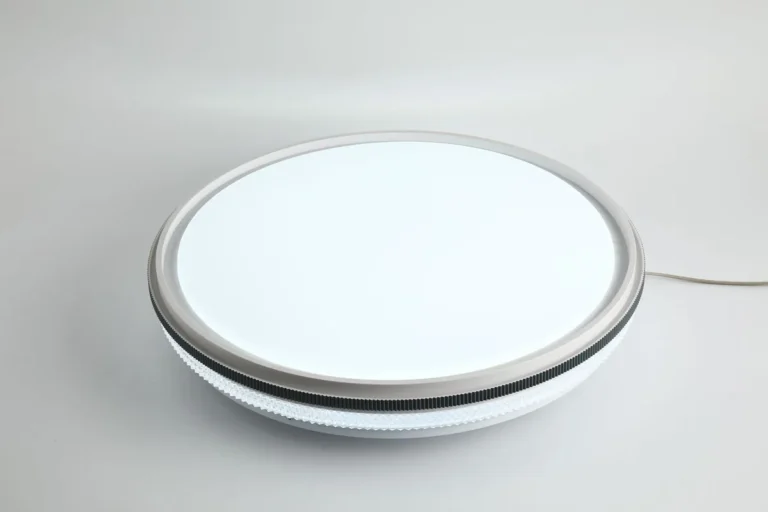
Commission Regulation (EU) 2019/2020 sets ecodesign requirements for light sources and separate control gears placed on the EU market. It has applied since 1 September 2021, and it reaches further than a lamp on a shelf: its first article says the requirements “also apply to light sources and separate control gears placed on the market in a containing product”, and its definition of containing product names luminaires and “furniture (shelves, mirrors, display cabinets) containing light source(s)”. For a project buyer who orders lighting, or furniture with built-in lighting, from China for an EU job, the text answers what the product must be able to show.
This article reads the consolidated text of the Regulation dated 1 September 2021 (EUR-Lex), which we downloaded from the Publications Office on 25 October 2026. The consolidated text lists one amending act, Commission Regulation (EU) 2021/341, and a query of the Publications Office’s linked-data service on the same day returned no later amending act. We did not read the energy-labelling Regulation (EU) 2019/2015, the outcome of the review that Article 9 required by 25 December 2024, the verification tolerances in Annex IV, or any national market-surveillance practice. It is a reading of the text, not legal advice.
Scope: what counts as a light source
Article 2(1) defines a light source by its optical characteristics: chromaticity coordinates within a stated range, a luminous flux below 500 lumen per mm² of projected light-emitting surface area, a luminous flux between 60 and 82,000 lumen, and a colour rendering index above 0. The technology is incandescence, fluorescence, high-intensity discharge, inorganic LED or OLED, or a combination, and the product must be one “that can be verified as a light source according to the procedure of Annex IV”. LED dies, LED chips and LED packages are not light sources under the definition, and neither are light-emitting parts contained in a light source from which they cannot be removed for verification.
A control gear is a device that prepares the mains supply for the electrical format a light source needs, and a separate control gear is one that is “not physically integrated with a light source and is placed on the market as a separate product or as a part of a containing product” (Article 2(2) and (3)). The definition of a containing product in Article 2(4) is broad: a product containing one or more light sources or separate control gears, “including, but not limited to, luminaires that can be taken apart to allow separate verification of the contained light source(s), household appliances containing light source(s), furniture (shelves, mirrors, display cabinets) containing light source(s)”.
Article 1(2) and (3) carve out the products listed in Annex III. The list is covered below.
The efficiency requirement is a formula, not a single number
Annex II point 1(a) does not set one efficacy figure for all lamps. From 1 September 2021 the declared on-mode power of a light source “shall not exceed the maximum allowed power” calculated as Pon,max = C × (L + Φuse / (F × η)) × R. Φuse is the declared useful luminous flux; η (threshold efficacy) and L (end loss factor) come from Table 1 by light source type; C is a correction factor from Table 2; F is 1.00 for non-directional light sources and 0.85 for directional ones; and R is a colour-rendering factor, 0.65 for a CRI of 25 or below and (CRI + 80) / 160 above that, rounded to two decimals.
For the large group of “other light sources in scope not mentioned above”, which is where an LED product falls, Table 1 gives η = 120.0 lm/W and L = 1.5 W, with L = 2.0 W for connected light sources. The Regulation states that these values “are constants used for computations and do not reflect true parameters of light sources” and that “the threshold efficacy is not the minimum required efficacy; the latter can be computed by dividing the useful luminous flux by the computed maximum allowed power”. So an LED product is compliant or not depending on its declared lumens, its declared CRI, whether it is directional and whether it runs on mains voltage, and the same declared power can pass at one flux and fail at another.
Standby limits are fixed numbers: the standby power of a light source and the networked standby power of a connected light source shall each not exceed 0.5 W, and the two allowed values are not added together. Separate control gears have their own minimum efficiency at full load in Table 3, set by the type of light source they serve and, for some types, by power, a no-load power limit of 0.5 W for gear designed for no-load mode, and the same 0.5 W standby limits.
Functional requirements: colour, flicker, lifetime and survival
Point 2 of Annex II adds functional requirements for light sources, also from 1 September 2021:
| Requirement | What Table 4 says |
|---|---|
| Colour rendering | CRI ≥ 80, except for HID light sources with more than 4 klm of useful flux and for light sources intended for outdoor, industrial or other applications where lighting standards allow a CRI below 80, when a clear indication to that effect is shown on the packaging and in all relevant printed and electronic documentation |
| Displacement factor (LED and OLED mains light sources) | No limit at 5 W or less; ≥ 0.5 above 5 W up to 10 W; ≥ 0.7 above 10 W up to 25 W; ≥ 0.9 above 25 W |
| Lumen maintenance (LED and OLED) | The lumen maintenance factor after the endurance test in Annex V must be at least a minimum calculated from the declared L70B50 lifetime, capped at 96.0 % |
| Survival factor (LED and OLED) | Light sources must be operational as specified in Annex IV, Table 6, after the Annex V endurance test |
| Colour consistency (LED and OLED) | Variation of chromaticity coordinates within a six-step MacAdam ellipse or less |
| Flicker (LED and OLED mains light sources) | Pst LM ≤ 1.0 at full load |
| Stroboscopic effect (LED and OLED mains light sources) | SVM ≤ 0.9 at full load; from 1 September 2024, SVM ≤ 0.4 at full load (with an exception for outdoor, industrial and other applications where lighting standards allow a CRI below 80) |
The lifetime row connects to the figure on many quotations. Annex I defines the lifetime of an LED or OLED light source as “the time in hours between the start of their use and the moment when for 50 % of a population of light sources the light output has gradually degraded to a value below 70 % of the initial luminous flux”, and adds “This is also referred to as the L70B50 lifetime”. The Regulation therefore ties the lumen maintenance a sample must show after the endurance test to the declared L70B50 lifetime, with the required value capped at 96.0 %. For what sits behind an L70 figure before it reaches a quotation, see our explainer on LM-80, TM-21 and L70.
Annex V describes the endurance test. The authorities of a Member State test 10 units of the model. Each unit is switched through 1,200 cycles, each cycle being 150 minutes on at full power and 30 minutes off, so the hours of operation counted are 3,000 and the total test time is 3,600 hours. The luminous flux is measured before and after, units that have failed are noted, and the final flux divided by the initial flux, averaged over the units that did not fail, gives the lumen maintenance factor.
What must be on the product, the packaging and the website
Point 3 of Annex II sets information requirements from 1 September 2021. On the light source itself, the useful luminous flux and the correlated colour temperature are displayed in a legible font on the surface “if, after the inclusion of safety-related information, there is sufficient space available”, and the beam angle too for directional sources.
For a light source placed on the market not in a containing product, in a packaging that carries information visible at the point of sale, the packaging must prominently show a list of items that includes: the useful luminous flux in a font at least twice as large as the on-mode power and with its reference to a sphere, a wide cone or a narrow cone; the correlated colour temperature; the beam angle for directional sources; electrical interface details; the L70B50 lifetime for LED and OLED sources in hours; the on-mode power; the standby power; the networked standby power for connected sources; the CRI; a clear indication if the CRI is below 80 for a source intended for the exempt applications; conditions for non-standard use; a dimming warning; a mercury warning where applicable; and a warning that the product shall not be disposed of as unsorted municipal waste where Directive 2012/19/EU applies.
Separate control gears sold as stand-alone products have their own packaging list (output power, type of light source, efficiency at full load, no-load, standby and networked standby power, a dimming warning, and a QR code or internet address leading to a free-access website), and point 3(c) requires fuller information on at least one free-access website of the manufacturer, importer or authorised representative, including outer dimensions, mass, end-of-life recommendations under Directive 2012/19/EU and dimming compatibility. The same website information also goes into the technical documentation.
For the energy-labelling Regulation (EU) 2019/2015 that applies to the same light sources, see our reading of the A to G label and the product database.
Sourcing this for a commercial project?
FBM Sourcing manages the entire China procurement package for overseas construction projects. We work with Developers · General Contractors · Builders · Commercial Project Owners · Interior Design & Construction Companies · FF&E Solution Providers. Send your BOQ, drawings or product schedule for review.
Obligations the text places on importers of containing products
Article 4 names “manufacturers, importers or authorised representatives of containing products”. They must ensure that light sources and separate control gears “can be replaced with the use of common available tools and without permanent damage to the containing product”, unless a technical justification related to the functionality of the containing product is given in the technical documentation. They must also ensure that the light sources and control gears can be removed without being permanently damaged for verification by market surveillance authorities, and the technical documentation must give instructions on how to do so. Information on whether end users or qualified persons can replace the light sources must be on a free-access website and, for products sold directly to end users, on the packaging at least as a pictogram and in the user instructions. Dismantling instructions for end of life must also be on a free-access website.
Article 7 bars the manufacturer, importer or authorised representative from placing on the market products designed to detect that they are being tested and to react by altering their performance, and it provides that the declared energy consumption and other declared parameters “shall not deteriorate after a software or firmware update” measured with the same test standard, except with the end user’s explicit consent. Article 7 has applied since 25 December 2019, earlier than the rest of the Regulation.
Conformity assessment and technical documentation
Article 5 sets the route: the conformity assessment procedure is the internal design control system in Annex IV to Directive 2009/125/EC or the management system in Annex V to that Directive. The technical documentation must contain the information in point 3(d) of Annex II and “the details and the results of the calculations” under points 1 and 2 of Annex II. Where information for a model comes from another manufacturer’s model, or from calculation or extrapolation from another model, the documentation must include details of the calculation, the manufacturer’s assessment of its accuracy and, where appropriate, the declaration of identity between the models; and it must list all equivalent models with their model identifiers.
Article 5(4) adds that the technical documentation “shall include the information in the order and as set out in Annex VI of Regulation (EU) 2019/2015”, and that manufacturers, importers or authorised representatives may, for market-surveillance purposes, refer to technical documentation uploaded to the product database that contains the same information. For conformity with other EU rules on the same product, such as electrical safety, see our reading of the Low Voltage Directive 2014/35/EU.
Exemptions in Annex III, and what “specifically tested and approved” means
Annex III point 1 says the Regulation does not apply to light sources and separate control gears “specifically tested and approved to operate” in listed settings: potentially explosive atmospheres, emergency use, radiological and nuclear medicine installations, military or civil defence establishments, motor vehicles and trailers, non-road mobile machinery, civil aviation aircraft, railway vehicle lighting, marine equipment, and medical devices. The text defines the phrase: the product has been specifically tested for that operating condition under the European legislation or standards named; it is accompanied by evidence in the technical documentation, “in the form of a certificate, a type approval mark, a test report”; and it is placed on the market specifically for that condition, as evidenced at least by the technical documentation and, except for military and civil defence, by the packaging and any advertising or marketing materials.
Point 2 adds products outside the Regulation altogether, including double-capped fluorescent T5 light sources of 13 W or less, electronic displays, light sources and control gears in battery-operated products (the text lists torches, toys, battery-operated desk lamps and “solar-powered garden lamps” as examples), and light sources on bicycles and other non-motorised vehicles. Point 3 exempts light sources and control gears specifically designed and marketed for listed applications such as signalling, image capture and projection, germicidal use and disinfection, from everything except the information requirement in point 3(e) of Annex II. That requirement is that the intended purpose is stated in the technical documentation and on all forms of packaging, product information and advertisement, “together with an explicit indication that the light source or separate control gear is not intended for use in other applications”.
What to ask a lighting supplier to put in writing
The text turns into a short list of evidence requests. Each item corresponds to a provision above.
- The declared values the efficiency calculation uses: useful luminous flux, on-mode power, CRI, whether the source is directional and whether it runs on mains, and the standby and networked standby power. (Annex II point 1(a))
- The declared L70B50 lifetime for LED and OLED sources, and the report behind the lumen maintenance and survival factors. (Annex II point 2, Annex V)
- The flicker (Pst LM) and stroboscopic (SVM) results at full load for mains LED sources, and the SVM limit that applies from 1 September 2024. (Annex II Table 4)
- The technical documentation file, including the list of equivalent models, and whether the same information has been uploaded to the product database. (Article 5)
- For lighting built into furniture or luminaires: the instructions for removing the light source and control gear for verification and replacement, and the pictogram and website information on replaceability. (Article 4)
- For any claimed exemption: the certificate, type approval mark or test report, and proof that the product is marketed specifically for the stated use. (Annex III point 1)
- Whether the packaging carries the Annex II point 3(b) items in the required form, including the dimming warning and the disposal warning where they apply.
Frequently asked questions about Regulation (EU) 2019/2020
Does Regulation 2019/2020 cover LED luminaires and furniture with built-in lights?
Article 1(1) says the requirements also apply to light sources and separate control gears placed on the market in a containing product, and Article 2(4) defines a containing product to include luminaires that can be taken apart for separate verification and furniture such as shelves, mirrors and display cabinets containing light sources. Article 4 then sets replaceability, removal and information duties for manufacturers, importers or authorised representatives of containing products.
What is the efficiency requirement for an LED light source?
Annex II point 1(a) limits the declared on-mode power to a maximum calculated from the declared useful luminous flux, the colour rendering index, whether the source is directional and whether it runs on mains. For LED sources Table 1 gives a threshold efficacy of 120.0 lm/W and an end loss factor of 1.5 W, or 2.0 W for connected light sources, but the text states that the threshold efficacy is not the minimum required efficacy.
What flicker and stroboscopic limits apply?
For LED and OLED mains light sources, Table 4 requires Pst LM of 1.0 or less at full load and SVM of 0.9 or less, tightening to SVM of 0.4 or less from 1 September 2024, with an exception for outdoor, industrial and other applications where lighting standards allow a CRI below 80.
What is the L70B50 lifetime and where must it appear?
Annex I defines it as the time in hours until, for 50 % of a population of light sources, the light output has degraded below 70 % of the initial luminous flux. Annex II point 3(b) requires the L70B50 lifetime of LED and OLED light sources on the packaging where the packaging carries point-of-sale information, and point 2 ties the required lumen maintenance after the Annex V endurance test to the declared value.
Which products are outside the Regulation?
Annex III point 1 lists products specifically tested and approved for settings such as explosive atmospheres, emergency use and medical devices; point 2 lists, among others, T5 fluorescent sources of 13 W or less, electronic displays and light sources in battery-operated products; and point 3 exempts products designed and marketed for applications such as signalling, except for the information requirement in point 3(e) of Annex II.
Do importers have duties under the Regulation?
Yes. Article 4 names importers of containing products, Article 7 bars manufacturers, importers and authorised representatives from placing on the market products designed to detect testing, and Annex II refers to information on the websites of the manufacturer, importer or authorised representative.
How does FBM Sourcing support this kind of project?
We review the brief, collect comparable quotations and manage the package for the project. For suppliers you nominate, we charge a 5% commission; for products we source for you, we quote a direct price. Our own team performs one inspection after bulk production is complete and before shipment, and the client’s project team is welcome to attend.
FBM Sourcing manages the entire China procurement package for overseas construction projects. We work with Developers · General Contractors · Builders · Commercial Project Owners · Interior Design & Construction Companies · FF&E Solution Providers.





