
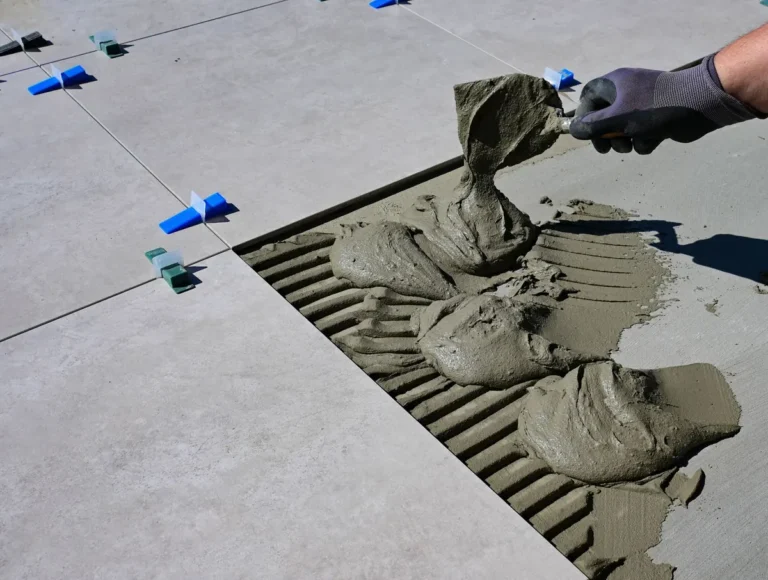
Tile adhesive, grout and sealant manufacturers in China include cement-based adhesive and grout makers, resin-based adhesive makers, silicone and polyurethane sealant makers, waterproofing and primer makers and full construction-chemical system suppliers. A tiled floor or wall is only as sound as the products that bond, fill and seal it, and each route supplies a different layer under the same words “tile adhesive”.
This guide sorts the supply side into five sourcing routes so a procurement team can send one brief to the right makers and compare the answers fairly. It is not a ranking. No factory is named or scored here, and no claim is made about the bond strength, movement capacity or approval status of any product. The tile maker’s instructions, the designer and the local authority define those requirements, and each maker must show evidence for the exact product it offers. For the tiles themselves, see our guides to ceramic tile manufacturers, porcelain slab manufacturers and waterproofing membrane manufacturers.
For the distinction between the sealant product standard and its application guide, see ASTM C920 and ASTM C1193 for project joint sealants.
What should a tile adhesive brief state?
A brief that says only “tile adhesive, grout and silicone for a hotel, 20 containers” cannot be quoted correctly, because the right product depends on the tile, the substrate and the place of use. State at least the following.
- Tile type and size: body type and the largest format, as the tile maker states them, since large formats and low-absorption tiles are bonded differently from small ones.
- Substrate: concrete, screed, board or an existing surface, and whether a waterproofing layer or primer sits beneath.
- Place of use: dry interior, wet area, pool, external or heavy-traffic floor, as the designer defines it.
- Movement and joints: where movement joints are required and which sealant fills them, per the drawings.
- Grout: joint width, colour reference and whether a cement-based or resin-based grout is called for.
- Colour matching: the colour references for grout and sealant, with an approved sample board.
- Packing and shelf life: pack sizes, pallet method and the shelf life the maker states, together with the planned installation date.
- Documents: the data sheet and instruction for each product and the tests the specification requires.
Five sourcing routes for tile adhesive, grout and sealant
1. Cement-based adhesive and grout makers
These makers produce powder adhesives and grouts for most floor and wall tiling. Ask for the data sheet of each grade, the list of tile types and formats each grade is intended for, and the mixing and open-time instructions. Ask the maker to state which grade it proposes for your largest tile format and your substrate.
2. Resin-based adhesive and grout makers
Epoxy and polyurethane products are used where the designer calls for chemical resistance, a very low water uptake or a stronger bond. Ask for the product description, the working time and the cleaning instructions, and a sample tile fixed with the product on a board for review.
3. Silicone and polyurethane sealant makers
Sealants fill movement joints and perimeters in wet areas, glazing and facades. Ask for the sealant type, the colour range, the cure description and which surfaces it is intended for. Request cartridges for an on-site adhesion trial with the actual tile and substrate before bulk shipment.
4. Waterproofing and primer makers
Coatings, membranes and primers sit under tile in wet areas and on balconies. Ask for the system description, the layer order and the recoat conditions, and compare them with the tile adhesive maker’s instructions, because the layers must be compatible. See our guide to waterproofing membrane manufacturers.
5. Full construction-chemical system suppliers
Some suppliers offer primer, waterproofing, adhesive, grout and sealant as one system. This gives one data set and one warranty conversation, but ask the supplier to quote each layer on its own line and to show a project where the same system was used on a similar tile and substrate.
Sourcing this for a commercial project?
FBM Sourcing manages the entire China procurement package for overseas construction projects. We work with Developers · General Contractors · Builders · Commercial Project Owners · Interior Design & Construction Companies · FF&E Solution Providers. Send your BOQ, drawings or product schedule for review.
How to compare tile adhesive quotations
- Product grade: the exact product name and grade for each use, not “standard adhesive”.
- Coverage assumption: the coverage per pack the maker assumes, and the trowel size behind it, so quantities can be checked.
- Pack and pallet: pack weight, pack material and pallet height, which affect damage in transit.
- Colour references: grout and sealant colour codes, matched to the approved board.
- Shelf life and batch dates: the production date to be marked on each pack, and the shelf life the maker states.
- Documents: the data sheets and test reports the maker will supply for each product.
Trials, samples and acceptance
Run an on-site trial before the full order. Fix the actual tile to the actual substrate with the proposed adhesive, grout it, seal one joint, and let the project’s tiling contractor review it after curing. Record the product names, batch codes and conditions of the trial in writing.
On delivery, check pack labels, batch codes and production dates against the order, look for damaged or caked packs, and photograph any problem on the day. Store powder products dry, off the ground and away from heat, as the maker’s instructions say.
What evidence to ask each route for
Evidence should be requested for the exact product, not for a product family.
- Cement-based makers: data sheet per grade and the maker’s stated tile and substrate range.
- Resin-based makers: product description, working time and a fixed sample board.
- Sealant makers: sealant type, colour range and cartridges for an adhesion trial.
- Waterproofing and primer makers: layer order and compatibility with the adhesive.
- System suppliers: separate sheet for each layer and a reference project with similar tile and substrate.
Specification gaps to close before quotation
Most failures on tiling jobs trace back to a mismatch between tile, substrate and product, not to the product alone. Check that the brief answers these questions.
- What is the largest tile format, and what body type is the tile?
- What is under the tile, and is it waterproofed or primed?
- Which areas are wet, external or heavy-traffic?
- Where are the movement joints, and which sealant fills them?
- Which grout and sealant colours are approved?
- When will the products be installed, and what shelf life is acceptable?
Next steps for a tiling materials package
Send each maker the same brief and ask for answers in writing, line by line, with samples or documents before bulk production. FBM Sourcing manages China procurement packages for overseas projects; furniture-only packages are also run through FBM Furniture.
Questions buyers ask about tile adhesive and sealant from China
Who decides which adhesive suits a given tile?
The tile maker’s instructions and the designer decide. Give each maker the tile type, format and substrate and ask it to state in writing which grade it proposes and why.
Should we trial the products before the full order?
Yes. Fix the actual tile to the actual substrate on site, review it after curing and record the product names and batch codes.
Does shelf life matter for sea shipments?
Yes. Agree the planned installation date and the shelf life the maker states, and ask for the production date on each pack.
Can one supplier provide primer, adhesive, grout and sealant?
Some can. Ask for a separate sheet for each layer and a reference project with a similar tile and substrate.
How does FBM Sourcing support this kind of package?
We review the brief, collect comparable quotations and manage the package for the project. For suppliers you nominate, we charge a 5% commission; for products we source for you, we quote a direct price. Our own team performs one inspection after bulk production is complete and before shipment, and the client’s project team is welcome to attend.
FBM Sourcing manages the entire China procurement package for overseas construction projects. We work with Developers · General Contractors · Builders · Commercial Project Owners · Interior Design & Construction Companies · FF&E Solution Providers.





