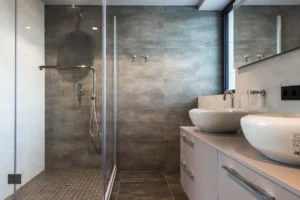
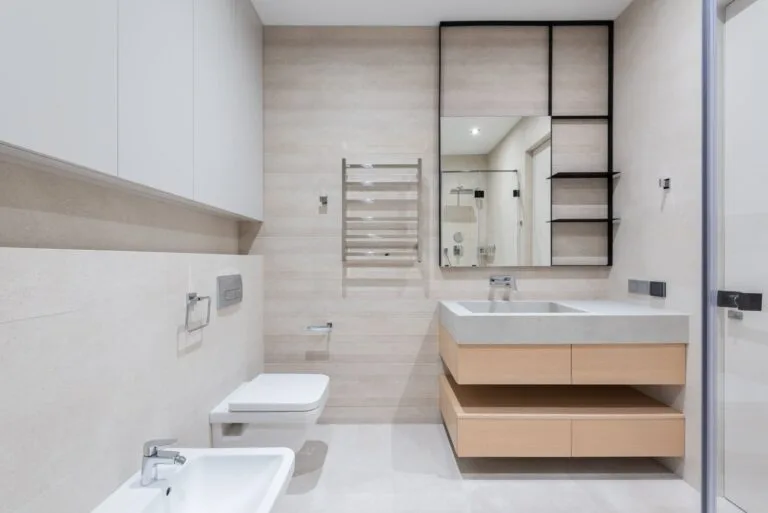
An Australian apartment bathroom vanity is an assembly of cabinet, top, basin, tapware interface and site waterproofing details. A useful China manufacturer shortlist separates those components before comparing a single catalogue photograph. Public disclosures identify Chinese listed bathroom-product groups including Arrow Home Group and Seagull Housing Industrial; their category disclosures do not establish that a proposed vanity, basin or plumbing component meets a particular Australian project’s requirements.
This guide is for developers, builders, general contractors and interior design and construction companies procuring repeatable apartment bathrooms. It profiles two exchange-listed product groups with official records, then sets out manufacturer types and item-level evidence to request. It is not a ranking by quality, a manufacturer audit or a claim that every component displayed under a brand is made by the listed company.
Where should the vanity package be divided?
Begin with the cabinet carcass and doors, top, basin, tapware, waste and trap, mirror or mirror cabinet, power if present, and the wall or floor installation interface. A supplier may quote these together, but the project schedule should identify each product and its maker or model. The local designer should show plumbing and waterproofing boundaries. A cabinet maker cannot determine the suitability of the whole bathroom from a furniture drawing alone.
Give every vanity a room and item code. Apartment schemes may repeat a standard bathroom, then vary the accessible unit, ensuite or mirrored layout. Record those differences in a matrix. A change in basin size, tap location or wall service can change the cabinet cut-out and shelf position. The factory should price the current drawing revision and flag proposed alternatives, not quietly reinterpret the photo.
The phrase “bathroom vanity” is used differently in catalogues. It may mean cabinet only, cabinet with top, or an assembled furniture-and-basin set. State exactly what is included. Ask whether fittings, mirrors, lights and installation hardware are inside the price. The receiving team needs the same item boundary on the packing list.
Which listed Chinese companies have relevant disclosed product lines?
Arrow Home Group Co., Ltd. (Shenzhen Stock Exchange: 001322) is identified by its 2026 half-year report as a current Shenzhen-listed entity. Its 2025 annual report identifies bathroom furniture within its wider bathroom-product scope; the group’s official website also lists bathroom cabinets. That supports its inclusion as a relevant listed bathroom-products group. Those sources do not say that every cabinet, basin and tap in a proposed apartment package shares one producing plant. Request the exact product maker, model, drawing and documentation for each line.
Seagull Housing Industrial Co., Ltd. (Shenzhen Stock Exchange: 002084) is identified in current exchange material and its 2025 social-responsibility report describes bathroom cabinets among its kitchen and bathroom components. It therefore has a publicly evidenced product-category connection. Its inclusion does not amount to a WaterMark approval, a project reference or a warranty conclusion. Confirm the actual producing entity and the specific cabinet, basin and fitting combination being offered.
The order of these two names is editorial, not a score. They have different publicly described product mixes and may be relevant for different parts of the package. A private custom-joinery plant can also be a valid production route, but a name should not be presented in a public “top manufacturer” list without equivalent current primary evidence.
Which manufacturer types may complete the shortlist?
| Manufacturer type | Likely product scope | Evidence to request |
|---|---|---|
| Custom vanity cabinet maker | Repeated cabinetry in unit bathrooms | Shop drawing, board and edge details, finish sample |
| Integrated bathroom-products group | Cabinet, basin and selected fittings | Producing entity and exact model for each component |
| Solid-surface or stone-top specialist | Top, upstand and basin cut-out | Material identity, template and joint details |
| Mirror-cabinet maker | Storage mirror or illuminated cabinet | Glass, electrical scope, mounting drawing |
| Plumbing-product maker | Basin, tapware, waste and trap | Model-level destination evidence where required |
The table is an allocation tool. It does not imply a mandatory number of suppliers. A coordinating company may consolidate several lines, but the project evidence must remain traceable to each product. A single quotation header is not proof of a single factory or a single conformity scope.
What must the Australian design team decide?
Australia’s National Construction Code contains wet-area waterproofing and water-resistance requirements for building elements. The official NCC text distinguishes requirements by building class, room and surface. It should not be paraphrased as a universal rule that a particular cabinet board or vanity unit is automatically compliant. The local designer should identify which room and building provisions apply, then show the waterproofing, wall, floor and vanity interfaces in the project details.
Ask whether the vanity is wall-hung, floor-standing or supported by a frame; show load path and fixing into the actual wall construction. Record where the waterproofing membrane, splashback and sealant joints end. The supplier can provide product dimensions, weight and proposed brackets, but the local design and installation team should verify the substrate and completed wet-area detail.
Plumbing products require their own model-level destination check. A cabinet photograph does not establish the status of the tap or waste. Ask the project’s plumbing designer or certifier to specify the required evidence for the exact basin, tapware and connection. Keep those documents separate from panel or furniture material evidence. Do not place a WaterMark claim on a cabinet simply because a separately supplied tap carries one.
Our hotel bathroom vanity manufacturer guide addresses a different building use and custom casegoods scope. This article focuses on repeated Australian apartment bathrooms and their local wet-area interfaces.
Planning vanities for an Australian apartment project?
Send bathroom drawings and a component schedule so cabinet, top, basin and fitting scopes can be compared.
Which cabinet construction details should be specified?
Ask for the carcass board or other substrate, face, back, bottom, edge treatment, door and drawer front, hardware, exposed finish and service penetrations. The cabinet base or lower edge needs particular attention if it may be reached by cleaning water. A “waterproof cabinet” label is too broad: exposed edges, joints, cut-outs and installation conditions still need review. The local project team should set the accepted construction, rather than rely on a generic material adjective.
Confirm whether the cabinet is delivered assembled, partly assembled or flat-packed. If assembled, check protection of doors and finished corners. If flat-packed, identify the site assembly method and who takes responsibility for squareness and sealing. A change in packing form may alter site labour, carton count and damage exposure without changing the catalogue image. Compare the actual proposed construction and installation scope.
Specify the mirror or mirror cabinet separately. A powered mirror requires an electrical product and installation scope beyond the furniture carcass. Ask for exact model, voltage and connection information from the appropriate party, with destination evidence defined by the project specifier. Our LED and bathroom mirror manufacturer guide covers that adjacent product category.
How should tops, basins and cut-outs be coordinated?
Show the top material, dimensions, visible edge, upstand, basin type, tap position and waste route in plan and section. A factory can cut to a design drawing, but a final template may need the actual site or the confirmed basin model. Name who supplies that template and who approves it before fabrication. If the cabinet and top come from different factories, their tolerances and fixing details should be checked together.
For an under-counter basin, a countertop basin or an integrated basin, the cut-out and sealing details differ. The supplier should propose the installation drawing for the chosen model. The local designer and plumber should resolve water management and service access. Avoid assuming that one basin report, one adhesive claim or one old detail is transferable to a different assembled vanity.
The submittal should include a coordinated bill of materials. When a basin model changes, identify every affected top, cabinet and plumbing component. Treat a sample vanity as a system: inspect doors and drawers with the basin and services in the proposed positions, not as disconnected showroom pieces.
What should a repeatable apartment mock-up prove?
The mock-up should confirm the appearance and operation of one defined vanity configuration against the approved room drawing. Check cabinet opening, drawers, mirror position, service access, basin fit, top joint and wall or floor interface. Record comments and revise the shop drawing before bulk production. A finish swatch can approve colour; it cannot approve a plumbing penetration or wall fixing.
Where there are accessible or differently arranged bathrooms, do not use the standard-unit mock-up as a blanket approval. Issue the relevant drawings and, where needed, a separate assembly check. The project team should decide dimensions and clearances from the applicable local design. No universal accessible vanity size is asserted here.
Keep an approval register with item code, model, material, drawing revision, sample date and decision. If the factory proposes a substitute basin, panel or hinge after approval, record which parts of the vanity must be reviewed again. A quotation with a new product photograph is not a substitute for the original approval chain.
How should the RFQ and quotation be structured?
Issue the same schedule, room drawings and component boundaries to each candidate. Ask for a line showing cabinet, top, basin, fittings and any mirror or electrical item. The response should state included hardware, packing, documentation and any proposed deviation. A lower overall number is not comparable if it removes the top, changes the basin or shifts installation responsibilities without saying so.
The company buyer should be able to trace each quoted item to its drawing and intended room. A private factory need not be publicly named in a blog to provide a useful project quote. Its legal identity, product evidence and subcontracted components can be checked in the actual sourcing process. The public article remains a category and specification guide.
For the wider bathroom-products evidence question, see our sanitary-ware certification guide. It should be read by product and destination scope, not as a blanket badge for a vanity package.
How should packing and delivery preserve product identity?
Mark each carton by building, apartment, room, item code and component. A basin and cabinet that form one finished vanity may be packed separately for protection. The receiving plan should still connect them. Protect corners, doors, visible top edges and fragile fixtures; identify loose hardware and installation instructions. The approved packing drawing should show what arrives assembled and what the site must assemble.
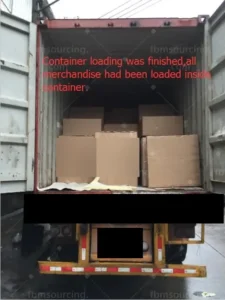
Sometimes, on a large project, the bathroom vanities alone fill full containers; sometimes the bathroom vanities share containers with the other product categories of the same project; and sometimes, in one batch, we combine a dozen or more product categories from several projects of the same client into a few containers — always full containers, and for us this is routine, well-practised work. The actual load plan should use carton dimensions and identify fragile pieces rather than assume a standard vanity count.
Our furniture packing guide addresses the broader transport questions. Add the apartment receiving and installation sequence to the project’s own plan.
Where does the furniture-focused site fit?
If the package is mainly bathroom cabinetry, see fixed furniture and joinery on fbmfurniture.com, the site of FBM Furniture, the furniture sourcing line of FBM Sourcing Limited. The product framing supports scope definition; the Australian apartment drawings and local specifier decide the actual detail.
FBM Sourcing can act as a China sourcing partner for company-led apartment packages. Our own team carries out one inspection at the factory once bulk production is finished, before shipment, with photo and video records. Your own project team is welcome to attend the inspection with us. Send the bathroom schedule, drawing set and component boundaries to start comparable quotations.
Primary sources: Arrow Home 2025 annual report discloses bathroom furniture, and the group website lists bathroom cabinets. Seagull 2025 CSR report names bathroom cabinets. ABCB wet-area provisions provide building-detail context, subject to project classification and design.
\n
Use the current drawings, schedule and destination requirements as the basis for any supplier comparison. Record open decisions before accepting a revised quotation.
Frequently Asked Questions
Does a listed bathroom-products company guarantee an Australian-ready vanity?
No. The public filing supports a product-category role. The proposed cabinet, basin, fittings and wet-area installation still need item-level review.
Is a WaterMark claim for tapware evidence for the vanity cabinet?
No. Check the evidence for the exact plumbing product and keep it separate from cabinet and material documents.
Can one vanity photograph define the quotation?
No. The quote needs dimensions, component scope, material and finish, cut-outs, hardware, drawing revision and installation boundary.
Can a standard bathroom mock-up cover an accessible-unit variation?
Only the represented configuration is approved. Use the relevant local design and a separate drawing or assembly check for a different unit type.
What should carton labels identify?
They should connect every cabinet, top, basin and fitting to its building, apartment, room and item code, even when parts are packed separately.
About FBM Sourcing
FBM Sourcing manages the entire China procurement package for overseas construction projects. Since 2014 we have worked with developers, general contractors, builders, commercial project owners, interior design and construction companies and FF&E solution providers across more than 20 countries and over 1,000 containers, as their sourcing partner in China — from the schedule or BOQ through factory selection, sampling, one inspection by our own team at the factory once bulk production is finished, before shipment, with photo and video records, consolidation and shipping. All quotations, invoices and shipping documents are issued by FBM Sourcing, and sea freight is quoted to you before shipment. If you have a bathroom vanity package to price, start at China building materials and FF&E procurement.