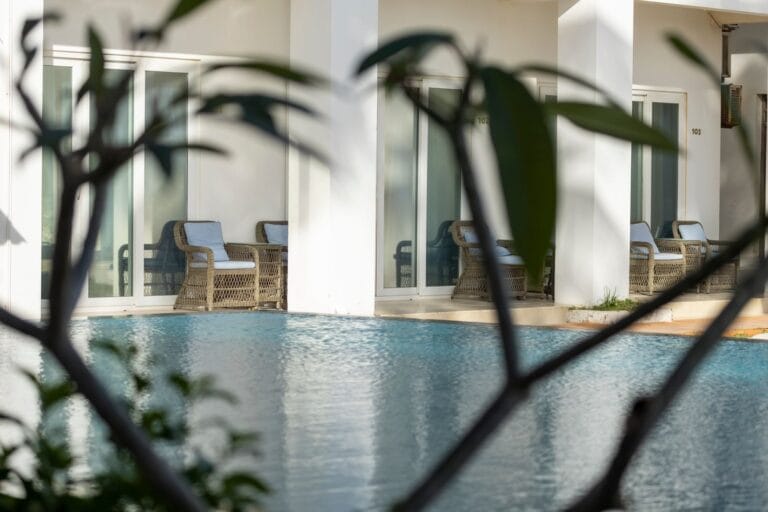
For uncovered resort positions such as pool decks, beach clubs and open terraces, synthetic PE rattan on a coated aluminium frame is the workable choice, and natural rattan is not. Natural rattan is the stem of a climbing palm, and the rattan industry’s own technical literature describes it as a material that degrades over time and is susceptible to fungal and insect attack. Synthetic strand avoids that biological problem but brings a chemical one: polyethylene is not UV-proof by nature, so outdoor life depends on the formulation of the exact strand, while salt air is mostly a question for the frame under the weave.
This article is written for developers, general contractors, builders, commercial project owners, interior design and construction companies and FF&E solution providers writing the outdoor furniture schedule for a resort, hotel or beach club. The manufacturer landscape and the weathering test table are in our list of synthetic rattan outdoor furniture manufacturers in China for resort projects, and the wider material decision is in aluminium vs teak vs rope outdoor furniture for resort projects. Every standard and regulation below was read in the original text as of 25 September 2026.
What Is the Difference Between Natural Rattan and Synthetic PE Rattan?
Natural rattan is a plant. A paper on rattan plantation management held in the FAO document repository describes rattans as climbing palms in the subfamily Calamoideae of the palm family, with about 600 species in 13 genera, most of them in Southeast Asia, and about 20 species in commercial use. Its behaviour outdoors is governed by biology: moisture content, the sugars and starch in the cane, and the fungi and insects that feed on them.
Synthetic PE rattan is an extruded plastic strand woven over a rigid frame. “PE” names the polymer, polyethylene; “synthetic rattan” on its own names only an appearance, which is why the polymer has to be written into the specification. Its behaviour outdoors is governed by chemistry, meaning resin grade, stabilisers and pigment, and by the frame that carries the load.
| Question | Natural rattan | Synthetic PE rattan |
|---|---|---|
| Main outdoor risk | Fungal staining, boring insects, shrinkage and splitting as moisture changes | Polymer degradation under UV if the formulation is not stabilised |
| Where salt air acts | Fixings and any metal parts | Frame coating, fasteners, mechanisms |
| Evidence to request | Treatment against fungi and borers; moisture content at manufacture | Polymer declaration; weathering report for the exact strand and colour; frame corrosion evidence |
Is Natural Rattan Suitable for Outdoor Resort Furniture?
Not for uncovered positions. The clearest source is a Transfer of Technology Model on rattan oil curing, bleaching and preservation published by the International Network for Bamboo and Rattan (INBAR) with the Forest Research Institute Malaysia. It is a processing manual rather than a furniture standard, but it states plainly that rattan is a natural material that degrades over time and is susceptible to fungal and insect attack. Four points matter on a resort:
- Fungal staining is permanent. Staining fungi enter through cut ends, abrasions, bruises and splits; once set in, the blemishes are rooted to the core and cannot be removed by scraping. The only remedy the manual gives is opaque paint.
- Moisture and humidity drive the fungi. The manual lists moisture content above 30%, storage temperature below 40°C, starch and sugar in the cane, and very high humidity as contributing factors, and notes that the fungi will not grow if moisture content is below 20%. A dry, covered lounge can hold a piece below those thresholds; a humid, uncovered pool terrace cannot.
- Boring insects are dealt with at the cane stage. Powder-post beetles are named as the most severe borers, and chemical treatment is to be carried out after oil curing but before manufacturing, not added to a finished chair.
- Rattan moves with moisture more than wood does. The manual states that rattan, unlike wood, starts shrinking above the fibre saturation point (about 30%), that its shrinkage is higher than wood’s, and that this leads to collapsing and splitting. Repeated wetting and drying outdoors works directly against a woven joint.
That makes natural rattan an interior and covered-area material: lobby lounges, restaurants, guestrooms and deep verandas that rain and pool splash do not reach. For humidity-related specification indoors, see our guide to moisture-resistant furniture for hotels and coastal projects. The FAO paper also records that rattan resources were dwindling because of over-exploitation of wild rattan and loss of tropical forest cover, which matters when a resort expects to reorder matching pieces for years.
Is Synthetic PE Rattan Waterproof and UV-Proof?
It is not biological, so it does not stain from fungi or feed borers the way cane does. But “all-weather” is a description, not a property of polyethylene.
United States Patent 4,321,190, granted in 1982 for polyolefin compositions stabilised against UV light, states in its description that polyolefins, especially polypropylene and polyethylene, degrade over time due to weathering, especially from UV light, shown as a loss of physical properties such as tensile strength and flexibility. A peer-reviewed study of UV stabilisers in polypropylene, published in the journal Materials in 2020, states that industrial formulations require UV stabilisers to preserve physical, mechanical and thermal properties over long exposure. Two strands both sold as PE rattan can therefore behave very differently in the same sun, and the specification should ask two separate questions:
- What is the strand? ASTM D4976, the specification for polyethylene molding and extrusion materials (D4976-12a, reapproved 2020, shown as the active version on the ASTM store), lets supplier and user agree on commercial lots by group, class and grade, and the properties it can call up include weatherability and water immersion stability. Its scope also says it is not intended to provide engineering data for design. Resin identification tells you what the strand is, not how long it will look right on a pool deck.
- How has that exact strand weathered? That needs a laboratory exposure report for the specific profile and colour, stating method, edition, cycle and total exposure time. The methods and current editions are listed in our synthetic rattan manufacturer list.
ASTM D4976 also notes that ethylene plastics are reprocessable and recyclable and allows recycled material where the agreed requirements are met, so if a strand contains recycled content, the weathering evidence has to belong to that formulation. On water, the question moves off the weave to where water collects: frame sections without drain holes, joints and fixings, and cushion cores that stay wet. Those belong in the specification as drainage and cushion lines.
Specifying rattan furniture for a resort’s indoor and outdoor zones?
Send us the FF&E schedule or BOQ and we will split it into natural and synthetic rattan lines by zone, with the strand, frame and treatment evidence each one needs.
Why Does the Polymer Name on the Strand Matter for EU Projects?
Because the EU restricts certain plasticisers by the material they sit in, and seating is in prolonged contact with skin. Entry 51 of Annex XVII to the REACH Regulation, as replaced by Commission Regulation (EU) 2018/2005, states that after 7 July 2020 DEHP, DBP, BBP and DIBP shall not be placed on the market in articles, individually or in combination, at 0.1% or more by weight of the plasticised material in the article. Plasticised material is defined to include polyvinyl chloride and any other polymer except silicone rubber and natural latex coatings, as well as surface coatings, finishes, adhesives and paints.
Articles for use exclusively in the open air are exempt only if no plasticised material comes into prolonged contact with human skin, defined as continuous contact of more than 10 minutes or intermittent contact over 30 minutes per day. A lounger or a dining chair is sat on for longer than that. For EU-bound projects, name the strand polymer and ask for a written declaration against entry 51 covering strand, frame finish and adhesives, and check the consolidated Annex XVII text again on the date of order, because entries are amended from time to time.
What Does Salt Air Do to Each Material?
Salt air rarely decides between natural and synthetic rattan directly. It decides whether the metal survives, and on a synthetic piece the metal is the whole structure.
ISO 9223:2012, the classification of atmospheric corrosivity, names the temperature-humidity complex, sulfur dioxide pollution and airborne salinity as the key factors in atmospheric corrosion of metals, and classifies environments into corrosivity categories that it says can be used for a rational choice of corrosion protection. For a coastal resort, the site’s corrosivity category, set by the project’s own engineering team, is the right starting point for the frame and fastener specification. Two further standards are often cited on aluminium frames and are best read by their scope:
- EN 12206-1:2021 covers powder coating of aluminium extrusions, sheet and preformed sections for architectural purposes, including pretreatment, coating powder, process and final product. Furniture is not named in that scope, so if a factory cites it for a frame, ask which parts were applied, especially the pretreatment.
- ISO 9227:2022, amended in 2024, sets out neutral, acetic acid and copper-accelerated salt spray tests. Its scope states that these methods check that the quality of a material is maintained, and are not intended for ranking materials against each other or predicting long-term corrosion resistance. A salt spray report is a consistency check, not a service life.
On either material, fastener material deserves its own specification line.
How Does Maintenance Differ?
Natural rattan has to be kept dry; per the INBAR manual, a stain that reaches the core can only be painted over, which changes the look the piece was chosen for, so housekeeping instructions should cover wet swimwear, spills and cleaning water as well as rain. Synthetic pieces should be cleaned to the strand and coating manufacturers’ written care instructions, requested with the sample and filed with the handover documents. For both, ask at sample stage how a damaged woven panel is repaired, and record the cane or strand reference, profile and colour against each item number so replacements can be ordered to the same reference.
Where Does Each Material Belong on a Resort?
| Resort zone | Natural rattan | Synthetic PE rattan |
|---|---|---|
| Uncovered pool deck, sun terrace | Not suitable | Suitable, with strand weathering evidence and a coated aluminium frame |
| Beach club, beachfront dining | Not suitable | Suitable, with frame and fasteners set to the site’s corrosivity category |
| Covered veranda | Only where rain and splash cannot reach | Suitable |
| Lobby lounge, restaurant, guestrooms | Suitable | Suitable |
Mixing both on one schedule is sensible, but sample the two ranges side by side so a synthetic strand chosen to sit next to natural cane is judged on physical samples in daylight rather than on photographs. For Gulf and other very high heat sites see our list of outdoor furniture manufacturers for Middle East and high-heat projects, and for the wider category our outdoor furniture manufacturers for hotel and resort projects.
What Should the Specification Say?
- Synthetic PE rattan: strand polymer and any recycled content; strand profile and colour reference; weathering report for that strand and colour; frame alloy, section and coating system including pretreatment; fastener material; for EU projects, a REACH entry 51 declaration; written care instructions.
- Natural rattan: intended zone stated as covered or interior; curing and treatment against fungi and borers before manufacturing; moisture content at manufacture; finish system and cleaning instructions; and the importer of record to check any destination biosecurity conditions for plant-based articles before ordering.
Where FBM Sourcing Fits
We work as the sourcing partner on the China side of the project. On a woven outdoor package that means turning the schedule or BOQ into a factory-readable specification that separates strand or cane, frame and soft goods; putting it to the manufacturer types that suit each zone; collecting the polymer, weathering, salt spray and compliance documents and checking them against what was specified; and running the sample round so natural and synthetic pieces are approved side by side. We carry out one inspection by our own team at the factory after bulk production is finished, before shipment, with photo and video records, and the inspection report goes to the client before the balance is paid.
Sometimes, on a large project, the woven outdoor furniture pieces alone fill full containers; sometimes the woven outdoor furniture pieces share containers with the other product categories of the same project; and sometimes, in one batch, we combine a dozen or more product categories from several projects of the same client into a few containers — always full containers, and for us this is routine, well-practised work.
Specifying rattan furniture for a resort’s indoor and outdoor zones?
Send us the FF&E schedule or BOQ and we will split it into natural and synthetic rattan lines by zone, with the strand, frame and treatment evidence each one needs.
Frequently Asked Questions
Is natural rattan good for outdoor furniture at a resort?
Not for uncovered positions. A manual published by INBAR with the Forest Research Institute Malaysia describes rattan as a natural material that degrades over time and is susceptible to fungal and insect attack, lists moisture content above 30% and very high humidity among the conditions for staining fungi, and states that stains rooted to the core cannot be scraped out. Natural rattan suits covered and interior zones; open pool decks and beach clubs call for synthetic strand on a coated frame.
Is PE rattan furniture waterproof and UV-proof?
It does not stain from fungi like cane, but polyethylene is not UV-proof by nature. US Patent 4,321,190 states that polyolefins, especially polypropylene and polyethylene, degrade over time from weathering, especially UV light, losing properties such as tensile strength and flexibility. Outdoor performance depends on the stabilised formulation, so ask for a weathering report for the exact strand and colour, and check frame drainage and cushion cores for water.
What is the difference between HDPE, PE and PVC rattan strand?
They are different polymers, and the name decides which evidence applies. ASTM D4976 identifies polyethylene molding and extrusion materials by group, class and grade, though it states it does not provide design data. For EU projects, REACH Annex XVII entry 51 restricts four phthalates at 0.1% or more by weight of plasticised material, a term that covers PVC, so state the polymer and ask for a declaration.
Does salt air damage synthetic rattan furniture?
Salt air mainly attacks the metal: frame coating, cut edges, fasteners and lounger mechanisms. ISO 9223:2012 names airborne salinity as a key factor in a site’s atmospheric corrosivity, so frame and fastener specifications should follow the site’s corrosivity category. A salt spray report to ISO 9227 shows coating consistency, but that standard says its methods are not for predicting long-term corrosion resistance.
Can natural and synthetic rattan be used on the same resort project?
Yes: natural rattan in lobby lounges, restaurants, guestrooms and deep verandas, synthetic PE rattan on pool decks, beach clubs and open terraces. Sample both ranges side by side in daylight, record the cane or strand reference against each item number, and state the intended zone on every natural rattan item so it is not moved outdoors later without review.
About FBM Sourcing
FBM Sourcing manages the entire China procurement package for overseas construction projects. Since 2014 we have worked with developers, general contractors, builders, commercial project owners, interior design and construction companies and FF&E solution providers across more than 20 countries and over 1,000 containers, as their sourcing partner in China — from the schedule or BOQ through factory selection, sampling, inspection by our own team before shipment, consolidation and shipping. All quotations, invoices and shipping documents are issued by FBM Sourcing, and sea freight is quoted to you before shipment. If you have an outdoor furniture package to price, start at China building materials and FF&E procurement.