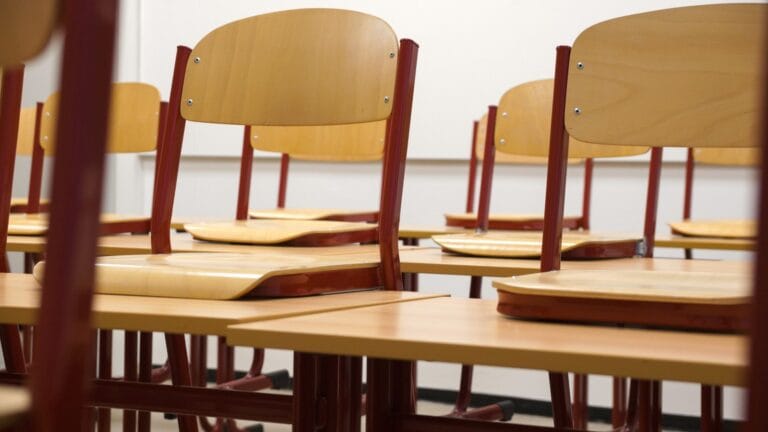
For an Australian school project, the shortlist of school furniture manufacturers in China is set by production route and documentation, not by brand: moulded shell seating, laminate tables, steel storage, fixed lecture theatre seating and laboratory joinery come off different plants. The right factory is the one that can hold the sizes and durability ratings in the state pattern book and produce the emissions, timber and treatment evidence Australian law requires.
It is written for developers, general contractors, builders, commercial project owners, interior design and construction companies and FF&E solution providers delivering school projects in Australia, where furniture lands on a construction handover date rather than on a catalogue lead time.
What Does an Australian School Project Actually Buy from China?
The clearest public picture of a school package is the NSW Department of Education pattern book FF&E item control schedule for public and high schools (Revision 01, dated 07/09/2026). Its notes state that item specifications are performance-based and non-proprietary, do not guarantee compliance with any specific supplier or product, and that compliance with relevant Australian Standards, work health and safety and accessibility requirements is to be confirmed at the time of procurement. Dimensions carry a tolerance of plus or minus 50 mm unless noted otherwise.
Against a Chinese production floor, it breaks into these families:
- Stackable student chairs: single moulded plastic shell on a four-leg frame with a grip handle, rated fit for purpose for primary school (100 to 120 kg) or secondary school (up to 150 kg), with compatibility to the matching table shown by prototype or 3D image.
- Student tables: laminate or writable tops on powder coated metal bases at 1200 x 600 x 720 mm, 1300 x 650 x 720 mm and 1800 x 650 x 720 mm, plus black heat-resistant tops for practical rooms.
- Height-adjustable desks: manually adjustable from 520 to 760 mm, rounded edges, lockable castors at one end, surface durability to be confirmed by testing.
- Storage and lockers: six-door and four-door units with laminate doors and steel frames at roughly 720 x 550 x 1800 mm, and single-door powder coated steel lockers at roughly 450 x 610 x 1800 mm, with keyless locking.
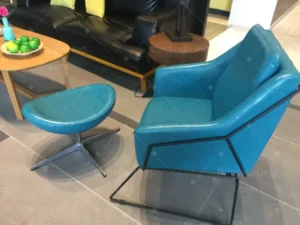
- Common-area and specialist furniture: lounge seating in fabric or vinyl over commercial-grade high-density foam with an antibacterial treatment, plus science tables, art and drafting tables, industrial workbenches and library ranges.
Note what the list does not contain: a brand. Each item instead carries a procurement group deciding whether the contractor, the department or the school provides and installs it — and who holds the container when it lands.
Why We Have Not Published a List of Named Factories Here
We name a manufacturer only when it is a listed company whose exchange and ticker we have checked ourselves, whose listing is current, and whose own annual report shows the product line in question. For Chinese school furniture we could not verify one listed manufacturer against that test: searches across mainland exchange filings for school furniture, education furniture and classroom desk and chair lines returned unrelated businesses, companies under special treatment status, or seating groups with no school furniture line in their product breakdown.
So this article names no factories, gives no scores and publishes no ranking. What follows is the manufacturer types a package splits across, the Australian rules on what can be shipped, and the evidence to request. Our round-up of school and education furniture manufacturers in China covers the category globally; this one deals with what changes when the destination is Australia.
Manufacturer Types That Cover a School Package
| Manufacturer type | What it produces | What proves capability |
|---|---|---|
| Moulded shell seating | Polypropylene shells on steel or aluminium leg frames, stacking, age-band sizes | Tooling ownership; stacking-cycle and load tests on the exact shell and frame |
| Panel and laminate tables | Laminate, writable and heat-resistant tops, edgebanded, on powder coated steel frames | Emission reports for the board actually used; edge details on drawings; frame load tests |
| Steel storage | Lockers, cupboards, tote storage, locking hardware | Gauge and finish records; lock cycle tests; anti-tip fixings for the wall type |
| Fixed seating engineering | Lecture theatre seating fixed to floor or riser | Row layouts against the room; anchorage details; fabric and foam evidence |
| Laboratory joinery | Science benching, fume cupboard casework, service spines | Worktop chemical and heat resistance data; service coordination drawings |
One school building rarely sits inside one plant: forty tables and eighty chairs can involve a shell moulder, a frame maker and a panel plant. That split is why the steel frame versus wood frame decision on school and university furniture changes which plant leads the order.
Which Australian Import Rules Decide What You Can Ship?
Two bodies of Commonwealth law sit over a wooden furniture import, and both fall to the importer. The first is the illegal logging law. The Department of Agriculture, Fisheries and Forestry states that as of 3 March 2025 these laws changed, including due diligence requirements for importers of regulated timber products, with the Illegal Logging Prohibition Rules 2024 replacing the earlier regulation under the Illegal Logging Prohibition Act 2012. Two reforms — timber testing to verify species and origin claims, and a notice requirement before import — are not implemented at this time, and importers must still meet their due diligence obligations and keep records.
Whether school furniture is caught depends on tariff lines. The schedule of regulated timber products includes wooden furniture of a kind used in offices (9403.30.00), other wooden furniture (9403.60.00), parts of wood (9403.91.00) and seats with wooden frames (9401.61.00 and 9401.69.00) — where most classroom tables, timber-framed chairs, shelving and storage land.
For a regulated product the Rules require the importer, before importing, to obtain as much of the following as is reasonably practicable: a description including type and trade name; the common and scientific name of the tree; the country and area of harvest; the country of processing or manufacture; the supplier’s name, address and trading name; the quantity by volume, weight or units; and the sales or delivery document. A certified timber product route is also recognised, where the importer holds a record from a Forest Stewardship Council or Programme for the Endorsement of Forest Certification database showing the product falls within the supplier’s certification scope. Products made entirely from recycled material are exempt, as are consignments below a customs value threshold. Put those questions to the plant in writing at quotation stage: a factory that cannot name the species in Latin is telling you something about its own supply chain.
Pricing a school furniture package for an Australian school project?
Send us your room schedule, FF&E item list or drawings. Our team reviews the package and comes back with a specification-level quotation, matched to the plant type that makes each family.
Biosecurity: Timber, Packing and the Stink Bug Season
The department states that all imported timber, wooden articles, bamboo and related products must comply with the import conditions in the Biosecurity Import Conditions system, which require pest risk to be mitigated through the manufacturing process or approved treatments, verified by documentation and by inspecting goods on arrival. Three details catch school furniture:
- Finished furniture is a wooden article: finished products, often lacquered, varnished or painted, made from solid wood or solid wood combined with plywood, veneer, plastic, glass or metal — the department’s examples include retail-ready flat packs, which is how most classroom furniture ships.
- Mixed construction changes the case: particleboard, MDF, HDF and OSB have their own listing, but products containing solid wood components fall outside it and must be imported as a wooden manufactured article. A table with an MDF top and solid timber legs is not the same import as one with a steel frame.
Packing is its own item. Packaging made from solid timber or bamboo must be treated and declared on the packing declaration, meet ISPM 15 bark tolerance requirements, and be treated to ISPM 15 or approved offshore conditions. Untreated packaging requires mandatory treatment on arrival, or may be exported or disposed of at the importer’s expense — exactly when a school is waiting on a handover date.
Then the season. Under the department’s brown marmorated stink bug seasonal measures, updated in August 2026, China is an emerging risk country: goods shipped between 1 September and 30 April inclusive may be selected for random onshore inspection, and for emerging risk countries those inspections extend beyond target high risk goods to tariff chapters 39, 94 and 95 — where furniture sits. The shipped on board date on the ocean bill of lading decides whether a consignment falls inside the season; gate-in dates are not accepted.
What the State Education Standards Ask For
Each state publishes its own design standard, and the furniture clauses are mostly about emissions and timber sourcing.
- New South Wales: the design technical requirements state that only low formaldehyde-emitting engineered wood products should be used, such as those meeting the Australian Standards for formaldehyde emission limit E1 or lower and not exceeding the Green Star Buildings limits, with engineered wood defined to include particleboard, plywood and medium density fibreboard; timber is to be recycled, or from plantations or sustainably managed regrowth forests certified under FSC, AFS or PEFC.
- Victoria: the building quality standards handbook requires engineered wood products in all applications to comply either through product certification under a recognised scheme or through laboratory testing to its table: plywood under AS/NZS 2269:2004 tested to AS/NZS 2098.11:2005 method 10 and MDF under AS/NZS 1859.2:2004 at no more than 1 mg/L, particleboard under AS/NZS 1859.1:2004 tested to AS/NZS 4266.16:2004 method 16 at no more than 1.5 mg/L, laminated veneer lumber under AS/NZS 4357.4 at no more than 1 mg/L. Its timber clause requires at least 95 per cent by cost of all timber to carry FSC or PEFC chain of custody certification, or be reused or wind-fall, and lists furniture made from or including timber among the uses caught.
- Queensland: the design standards for facilities require materials, finishes and adhesives with low concentrations of volatile organic compounds and formaldehyde.
- Western Australia: state agency furniture runs through a non-mandatory whole-of-government common use arrangement whose education sub-categories include student classroom desks, teacher desks, science lab tables and industrial workbenches; above a stated order value agencies formally request written quotations from panel members.
Both requirements attach to the board rather than the finished piece, so both belong in the request for quotation alongside the sizes: the emission report has to name the board grade used, and chain of custody can only be answered if the plant’s board supplier sits inside a scheme.
How a School Package Is Split, Packed and Shipped
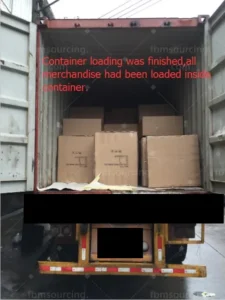
Tables and chairs are volumetric and light; lockers and benching are heavy; casework is dimension-critical; soft seating is bulky. Sometimes, on a large project, the school furniture items alone fill full containers; sometimes the school furniture items share containers with the other product categories of the same project; and sometimes, in one batch, we combine a dozen or more product categories from several projects of the same client into a few containers — always full containers, and for us this is routine, well-practised work.
What decides whether a programme works is room readiness: furniture arriving before floor finishes are down gets stored twice and damaged once. Where dormitory furniture sits on the same programme, our guide to dormitory and classroom furniture sourcing in China covers how those schedules combine, and packages mixing school and wider commercial ranges follow the logic in our round-up of commercial furniture manufacturers in China for Australian commercial projects.
Evidence to Request Before Production Starts
These are product evidence items. Each either exists for your order or does not:
- Panel emission test reports for the board grade in your order, current at production and matched to the state requirement.
- FSC or PEFC chain of custody evidence traced to the supplier whose certificate scope covers the product.
- Strength, stability and durability test reports for the exact construction quoted, against the standard edition named in your documents.
- Edge detail, corner radius and pinch-point clearance shown on the production drawing.
- Fabric and foam certificates for the exact fabric and filling combination, and lock and castor cycle data.
- A packing specification stating the packaging material and the treatment and declaration position for any solid timber packaging.
How FBM Sourcing Runs an Australian School Furniture Package
We work as the sourcing partner on the client side, turning a room schedule and a pattern book item list into specifications Chinese plants can quote against — sizes, board grades, frame gauges, finishes, packing — then matching each family to the plant type that makes it. We collect the test reports and timber evidence in the versions your documents require, and say plainly when a factory cannot produce one.
When bulk production is finished, our own team inspects at the factory before shipment, with photo and video records, and the inspection report goes to the client before the balance is paid. We then consolidate the families into full containers, and sea freight is quoted to you before shipment.
Pricing a school furniture package for an Australian school project?
Send us your room schedule, FF&E item list or drawings. Our team reviews the package and comes back with a specification-level quotation, matched to the plant type that makes each family.
Frequently Asked Questions
Can wooden classroom furniture be imported into Australia from China?
Yes, under two conditions: the Illegal Logging Prohibition Act 2012 with the Illegal Logging Prohibition Rules 2024 require statutory due diligence and record keeping by the importer for regulated timber products, which include wooden office furniture, other wooden furniture, furniture parts of wood and seats with wooden frames; and the biosecurity import conditions require pest risk to have been mitigated through manufacturing or approved treatment, verified by documentation and inspection on arrival.
Which standards apply to school tables and chairs in Australia?
Sizing, strength, durability and stability are covered by Australian and New Zealand joint standards, and the edition governing your project is the one nominated in your specification, so ask for the test report issued against that edition, not a general compliance statement; state design standards set formaldehyde limits and timber chain of custody requirements, and pattern books set the dimensions and durability ratings.
Does the time of year affect shipping school furniture from China to Australia?
It can: under the brown marmorated stink bug seasonal measures China is an emerging risk country, goods shipped between 1 September and 30 April inclusive may be selected for random onshore inspection, tariff chapter 94 sits within scope, and the shipped on board date on the ocean bill of lading decides whether a consignment falls inside the season.
Can one Chinese factory supply an entire school furniture package?
Some offer to, but the routes differ: a moulded chair shell, a laminate table top, a steel locker, fixed lecture theatre seating and laboratory benching involve different tooling, testing and quality risks, so a package built from the right plant per family and consolidated into full containers usually delivers better than one plant subcontracting the rest.
What should a factory provide before an order is confirmed?
The panel emission test report for the board grade in your order, chain of custody evidence for the timber, species in common and scientific name with country of harvest, strength and stability test reports for the exact construction quoted, fabric and foam certificates for the exact combination, and a packing specification covering solid timber packaging and its treatment.
About FBM Sourcing
FBM Sourcing manages the entire China procurement package for overseas construction projects. Since 2014 we have worked with developers, general contractors, builders, commercial project owners, interior design and construction companies and FF&E solution providers across more than 20 countries and over 1,000 containers, as their sourcing partner in China — from the schedule or BOQ through factory selection, sampling, inspection by our own team before shipment, consolidation and shipping. All quotations, invoices and shipping documents are issued by FBM Sourcing, and sea freight is quoted to you before shipment. If you have a school furniture package to price, start at China building materials and FF&E procurement.