China’s building-materials and furniture supply chain is far more specialized than most overseas buyers expect: factories are organized around narrow product categories, not broad ranges. In sanitary ware alone, toilets come from ceramic sanitary ware factories, faucets and mixers come from brassware factories, and bathroom accessories — towel rails, robe hooks, paper holders — come from a third, entirely different type of factory. In our experience, from sourcing work in this industry since 2014, a single factory’s production lines cover only a small fraction of the building-material and furniture categories a commercial project needs. That one fact explains most of what confuses buyers about quotations, showrooms and “one-stop” offers in China.
How Narrow Is a “Category” in Chinese Manufacturing?
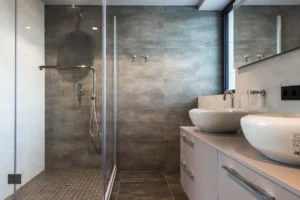
Take a hotel bathroom as a worked example. On a typical BOQ it reads as one section — “sanitary ware”. On the factory floor in China it is at least three different industries:
- Ceramic sanitary ware factories make toilets, basins and ceramic shower trays. Their core assets are kilns, slip-casting or high-pressure casting lines and glazing lines — equipment that has no use for anything non-ceramic.
- Faucet and mixer factories are metalworking plants: brass casting or forging, machining, polishing, electroplating or PVD coating lines, plus cartridge assembly and pressure testing.
- Bathroom accessories factories make towel bars, hooks, shelves and paper holders — stamping, welding, polishing and plating of tube and sheet metal, at a completely different tooling scale from a faucet plant.
A factory that runs glazing kilns does not also run brass casting. A sourcing agent who has walked these factories knows them as three separate supplier searches, three separate quotations and three separate quality-control plans — even though they land in one bathroom.
What Does That Look Like Across a Full Project BOQ?
The same pattern repeats in every section of a commercial project package:
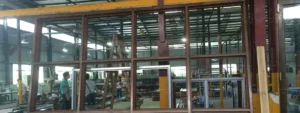
- Aluminium windows and doors: profile extruders, window assembly factories and window hardware makers are separate businesses; glass comes from yet another plant.
- Kitchen and wardrobe cabinets: board and panel mills, cabinet factories, countertop fabricators and cabinet hardware suppliers each run their own lines.
- Stone: quarrying, slab cutting and project fabrication are different companies more often than not.
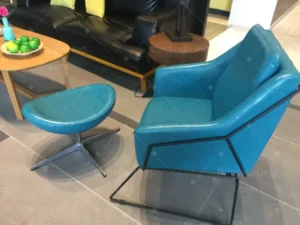
- Furniture: hotel casegoods, upholstered seating, metal-frame furniture and mattresses are four different factory types with almost no overlap in machinery.
- Lighting: decorative fixtures, architectural/commercial lighting and LED components sit in different plants and often different cities.
A 200-line commercial BOQ — a hotel, an apartment block, a school — typically touches somewhere between 15 and 30 distinct factory types. There is no single roof those lines sit under.
Why Did China’s Supply Chain Evolve This Way?
Industrial clusters. Chinese manufacturing towns specialize: Foshan is known worldwide for ceramics and furniture manufacturing, and entire towns in Guangdong are organized around a single product family — one for faucets, one for aluminium profiles, one for mattresses. Inside a cluster, a factory competes with dozens of direct rivals making the same narrow category, which drives deep tooling investment, genuine economies of scale and sharp factory-gate pricing within that category. Specialization is exactly why China is competitive — and exactly why no one factory can be good at everything.
This is exactly what a manufacturing sourcing agent does with this specialization.
Sourcing a multi-category package for a commercial project?
FBM Sourcing works with project owners, developers, main contractors and FF&E contractors on hotel, apartment, school, office and other commercial building projects. Send us your BOQ, drawings or product list — our team will map it to the right specialized factories and get back to you.
Buyers who want one China-side team to handle Foshan factories across several categories can read how FBM Sourcing works as a Foshan sourcing agent for commercial building projects.
If Factories Are This Specialized, How Can Anyone Offer “Everything”?
They can offer everything; they cannot manufacture everything. The arithmetic is simple: if one factory’s production lines cover only a small fraction of the categories a project needs, then any company presenting a full-range catalog is, for the overwhelming majority of that range, buying from other factories and reselling. That is not an accusation — it is how the supply chain works. Some suppliers genuinely own a production line in one or two categories, ceramic tiles for example, and trade the rest. The important thing for a buyer is simply to know which parts of an offer are manufacturing and which parts are trading, because the pricing structure behind each is different. We unpack that in what a one-stop building material supplier actually covers and in our sourcing agent vs one-stop supplier comparison.
What Does Specialization Mean for a Commercial Project Buyer?
It means the real question on a China package is never “which company has all of this?” — no manufacturer does — but “who will coordinate the 15–30 specialized factories my BOQ actually touches, and on whose side of the table do they sit?” A sourcing agent approaches the BOQ category by category: for each line, the search goes to mid-size and large factories that actually run production lines for that specific product, several of them are quoted against each other, and the client can visit those factories and see the lines in production before ordering. FBM Sourcing manages the entire China procurement package for overseas construction projects, and works only with specialized factories that genuinely manufacture the category they quote — that selection rule is what makes factory-gate pricing and meaningful in-factory quality control possible in the first place.
The same specialization runs through metal roofing: the coil mill, the roll-former and the sandwich panel line are usually three different businesses, often in different provinces. Our guide to metal roofing manufacturers in China sets out which type makes what and the test evidence each should produce.
Doesn’t Buying from 20 Factories Make the Project Harder?
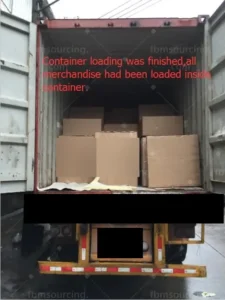
Only if the buyer has to manage those 20 relationships alone. This is precisely the job a China sourcing partner exists to do: one contract, consolidated quotations mapped line by line to your BOQ, sample and shop-drawing management across all factories, inspection at each factory before shipment, and consolidation of every category into complete containers under one procurement package. The specialization of Chinese manufacturing is a genuine advantage for commercial projects — sharper prices, deeper technical capability per category — provided the coordination layer sits on the buyer’s side.
The fastest way to see how your own project maps across China’s specialized factories is to send the actual BOQ or drawings: the category split, the factory types involved and the realistic quotation structure all become concrete once real quantities are on the table.
Since specialization means every factory you meet plays one of these roles, see how to tell a manufacturer, trading company and sourcing agent apart.