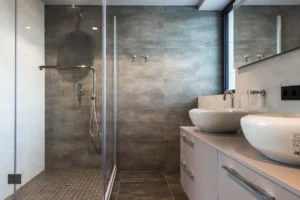
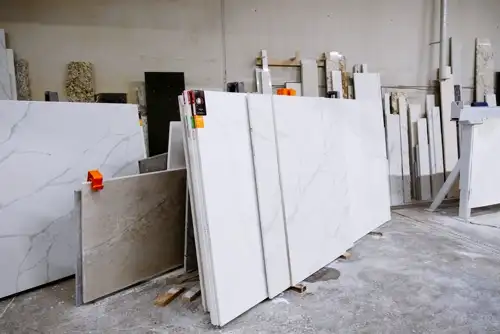
For most healthcare and hospitality projects, the decision comes down to seams and hardness. Solid surface is thermoformable and can be fabricated with virtually invisible, coved (integral) seams, which is why it dominates hospital nurse stations, clinical sinks and infection-control-sensitive counters. Quartz is harder and more resistant to scratching and heat, and it generally carries a higher material cost per square meter, which is why it is the more common specification for hotel reception desks, bar tops and other high-traffic public counters where pattern consistency and abrasion resistance matter more than a seamless join. Neither material is universally the “better” choice — the right one depends on whether the surface needs to be thermoformed into an integral sink (solid surface) or needs to resist heavy daily abrasion and heat without a visible joint (quartz).
What Is the Difference in Material Composition Between Quartz and Solid Surface?
Engineered quartz (also called quartz surfacing) is roughly 90-93% crushed natural quartz aggregate bound with polyester or acrylic resin under vacuum compaction and heat, which gives it a stone-like density, hardness on the Mohs scale close to natural granite, and a slab format typically 12-30mm thick. It is fabricated the way natural stone is — cut, edge-profiled and polished as solid slabs — and joints between slabs remain visible as seam lines unless disguised with color-matched adhesive.
Solid surface is a different chemistry entirely: acrylic or polyester resin filled with mineral trihydrate (usually alumina trihydrate, ATH), cast into sheets that are typically 6-12mm thick and, critically, are thermoplastic. Sheets can be heated and formed into curves, integral sinks, coved backsplashes and rolled edges, and seams between sheets can be chemically welded and sanded flush so they become effectively invisible and non-porous — a property natural stone and quartz cannot match. That thermoforming capability is the single biggest technical differentiator between the two materials for commercial specification.
Which Standards and Certifications Apply to Commercial Countertops?
Because these are two different material classes, they are tested against different reference standards, and a project spec sheet should call out the right one for the material actually being ordered:
- Solid surface is commonly benchmarked to ISO 19712 (Plastics — Solid surfacing materials), which covers physical and mechanical properties such as impact resistance, water absorption and dimensional stability. Where the countertop will contact food or sit in a clinical prep area, NSF/ANSI 51 (Food Equipment Materials) is the relevant certification to request from the factory, since it specifically addresses cleanability and material safety for food-zone and healthcare-zone surfaces.
- Engineered quartz does not have a dedicated food-equipment standard of its own; slabs are more commonly tested using the same physical test methods applied to natural and engineered stone — ASTM C97 (water absorption and bulk specific gravity), ASTM C170 (compressive strength) and ASTM C880 (flexural strength) — so a factory quoting quartz should be able to supply documented lab test data referencing those methods, not just a marketing spec sheet.
- Fabrication-side, respirable crystalline silica dust is a genuine occupational hazard in quartz cutting and polishing. Factories worth working with on quartz countertop packages run wet-cutting or fully enclosed dust-extraction CNC lines rather than dry-cutting — this is a fabrication-process detail worth confirming during factory selection, separate from the finished-product certifications above.
If a project’s specification simply states “quartz vs solid surface countertops” without naming a standard, the safest approach is to have the sourcing agent request the applicable test report for the specific material class before slabs are cut, not after.
Quartz vs Solid Surface: Quick Technical Comparison
- Hardness / scratch resistance: Quartz is harder and more scratch-resistant; solid surface scratches more easily but can be sanded out on-site.
- Heat resistance: Quartz tolerates brief direct heat contact better; solid surface can scorch or discolor from hot pans and should not be used as a direct trivet surface.
- Seaming and integral forming: Solid surface thermoforms into seamless, coved sinks and backsplashes; quartz seams remain visible lines between slabs.
- Repairability: Solid surface can be re-sanded and re-polished on-site to remove scratches, burns or stains, restoring an almost factory finish; damaged quartz generally requires full or partial slab replacement.
- Typical cost tier: Quartz slabs generally sit at a higher material cost per square meter than mid-tier solid surface, though pricing varies by color, brand and thickness — project teams should treat this as a directional comparison, not a quoted price.
Which Material Is Easier to Maintain and Repair, Quartz or Solid Surface?
Solid surface wins on repairability. Because the material is homogeneous through its full thickness, facilities teams can sand out cigarette burns, dark stains or deep scratches with an orbital sander and a fine-grit pad, and the repaired area blends back into the surrounding surface — a real advantage for hotels and hospitals that need to keep public-facing counters looking new for a 15-20 year asset life without slab replacement. Quartz, by contrast, is essentially maintenance-free under normal use (no sealing required, unlike natural stone) but is much harder to spot-repair — a deep scratch, chip or heat crack typically means replacing the affected section, which is why quartz is more forgiving for high-traffic public counters that see abrasion but less forgiving for accidental hot-pan or sharp-impact damage.
Daily cleaning is straightforward for both: mild soap and water or a non-abrasive cleaner, avoiding bleach-heavy or highly alkaline chemicals on solid surface seams, and avoiding abrasive scouring pads on polished quartz finishes. Neither material needs periodic sealing, which is one reason both have displaced natural stone on many commercial specs where facilities teams want to avoid a resealing maintenance schedule.
Sourcing this for a commercial project?
FBM Sourcing works with project owners, developers, main contractors and FF&E contractors on hotel, apartment, school, office and other commercial building projects. Send us your BOQ, drawings or product list — our team will review it and get back to you.
Where Do Hospitals and Hotels Typically Use Each Material?
Healthcare: Nurse Stations, Clinical Sinks and Infection Control
In healthcare projects, solid surface is the more frequent specification for nurse station countertops, clinical hand-wash sinks, and lab benches because the seamless, non-porous, coved-sink construction reduces the crevices where bacteria can collect — a real infection-control consideration, not a marketing claim, since coved integral sinks eliminate the caulk line where a drop-in sink meets a separate countertop. Quartz shows up in healthcare projects too, typically on waiting-room reception counters, cafeteria service counters and public-facing surfaces where abrasion resistance matters more than integral sink forming. Facility teams sourcing for senior living and assisted-living projects, which share many of the same infection-control and durability requirements as acute-care healthcare, follow a similar split between the two materials.
Hospitality: Reception Desks, Bar Tops and Bathroom Vanities
In hotels, quartz is the more common choice for lobby reception desks, bar tops and F&B counters, where the pattern consistency, scratch resistance and heat tolerance suit a high-traffic public surface that needs to look sharp for years between refreshes. Solid surface remains widely used in guest bathroom vanities, particularly where the vanity top is thermoformed with an integral bowl for a clean, joint-free look, and in back-of-house pantry and housekeeping counters where easy on-site repair matters more than showroom appearance. Many hotel FF&E packages specify both materials on the same project — quartz for public areas, solid surface for guestroom bathrooms — which means a single procurement package often needs to source, fabricate and ship two different material classes to the same delivery schedule.
How Does FBM Sourcing Handle Factory Selection and QC for Countertop Packages?
FBM Sourcing manages the entire China procurement package for overseas construction projects, and commercial countertop sourcing China work is a regular part of that scope. Because quartz and solid surface are made and fabricated by different types of factories — quartz by slab producers with CNC stone-cutting lines, solid surface by sheet manufacturers with thermoforming and welding capability — factory selection is the first real decision point in sourcing quartz or solid surface countertops from China for a commercial project. As a China building material sourcing agent, we work from the project’s drawings and BOQ to identify factories that already produce the specific material class, thickness and finish called for in the spec, request the applicable certification and test documentation referenced above, and run our own on-site QC — checking slab consistency, seam quality on solid surface pieces, edge-profile accuracy and packing before anything ships. For any material with real import-side complications, such as the anti-dumping and countervailing duties that currently apply to some quartz surface products manufactured in China and shipped to the United States, we flag the exposure to the project team as part of factory selection so it can be priced and planned for, rather than discovered at customs clearance.
Countertops are almost never a stand-alone shipment. Sometimes, on a large project, the countertops alone fill full containers; sometimes the countertops share containers with the other product categories of the same project; and sometimes, in one batch, we combine a dozen or more product categories from several projects of the same client into a few containers — always full containers, and for us this is routine, well-practised work. On a hotel or hospital job this typically means quartz or solid surface tops are consolidated with kitchen and casework cabinetry, bathroom vanity and sanitaryware fixtures, and hotel furniture or healthcare furniture from the same project, since the vanity carcass, the sink fixture and the countertop are usually specified, quoted and shipped as one coordinated package rather than three separate purchase orders.
On pricing and paperwork, the same rule applies whether the project specifies quartz, solid surface, or both on the same job. All quotations, invoices and shipping documents are issued by FBM Sourcing — you deal with us, and we carry the responsibility. For suppliers you nominate, we charge a 5% commission; for products we source for you, we quote a direct price. Whether a project team already knows exactly which quartz color and solid surface brand it wants, or is asking us to shortlist factories from a drawing set, working with a single sourcing partner for the full countertop-and-vanity package avoids the coordination gap that shows up when cabinetry, sinks and countertops are ordered from separate factories on separate timelines.
Frequently Asked Questions
Is quartz or solid surface better for a hospital nurse station?
Solid surface is more commonly specified for nurse stations and clinical sinks because it thermoforms into seamless, coved integral sinks, which reduces the crevices and caulk joints that are harder to keep sanitary in a clinical environment.
Can solid surface be repaired if it gets damaged on site?
Yes — because solid surface is homogeneous through its thickness, scratches, burns and stains can typically be sanded and re-polished on-site, restoring a near-original finish without replacing the section.
Does quartz countertop need sealing like natural stone?
No. Both quartz and solid surface are non-porous, engineered materials that do not require periodic sealing, unlike natural stone such as granite or marble.
What certification should I ask for on solid surface used in a food or clinical area?
Ask the factory for NSF/ANSI 51 (Food Equipment Materials) compliance documentation for the specific solid surface product, alongside ISO 19712 physical-property test data.
Can the same project order both materials in one shipment?
Yes — quartz for public areas like reception desks and bar tops, and solid surface for guestroom or clinical vanities, are commonly ordered together and consolidated into the same container shipment as part of one project’s countertop and casework package.