
To compare quotes from multiple Chinese factories like-for-like, you normalise five variables before looking at any price: the Incoterm (EXW, FOB and CIF quotes can differ by 10–20% on identical goods), the exact material specification line by line, what packing and loading is included, which branded components are named, and what is excluded — then restate every quote as a landed cost per item to your destination port. Skipping normalisation is how the “cheapest” quote becomes the most expensive purchase order: the gap between two factory quotes is more often a gap in what is being quoted than a gap in factory efficiency. FBM Sourcing is your sourcing partner in China: it holds no inventory and has no product range of its own.
The five variables that must match before prices mean anything:
- Incoterm: EXW excludes inland haulage, export clearance and loading; FOB includes them; CIF adds ocean freight and insurance. Compare all quotes on one basis — FOB is the cleanest for comparison.
- Material specification: board grade and thickness, foam density, metal gauge, glass thickness, finish system — verified line by line, not by product photo.
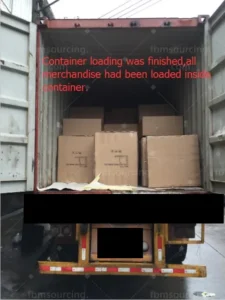
- Packing and loading: export carton spec, palletising, container loading and lashing — included in some quotes, invoiced separately in others.
- Branded components: hardware, runners, hinges, fabrics, appliances — a named brand versus “equivalent” can move a quote meaningfully per item.
- Validity and exclusions: quotes are typically valid 15–30 days; exclusions hide in footnotes — tooling, samples, certification documents, drawings.
Why Is the Cheapest Quote Rarely Comparable?
Chinese factories quote to win, and the fastest way to look cheaper is to quote less scope. One factory includes export-grade five-layer cartons, corner protection and container lashing; another assumes domestic packing and adds export packing later as an extra. One prices the drawer runner brand your specification names; another silently substitutes an unbranded runner. One quotes E1 board because your drawing said so; another quotes E2 and waits to see if anyone checks. None of this is necessarily deception — a factory quoting quickly against an incomplete enquiry fills the gaps with its own defaults, and its defaults are chosen to keep the number low.
That is why the quality of comparison is set before quotes arrive, at the enquiry stage: a complete RFQ package with drawings, specifications and quantities forces every factory to price the same scope. The second discipline is knowing how factory quotations are structured — what a unit price normally covers and where exclusions live — which we cover in how to read a Chinese factory quotation.
How Do You Normalise Quotes to One Basis?
Bid leveling — the construction-industry discipline of restating every bid on identical scope — applies directly to China procurement. The working method is a comparison sheet with one row per line item and one column per factory, built in this order:
- Restate every quote to FOB at the same Chinese port. Ask EXW quoters to add inland haulage and export clearance; strip freight and insurance out of CIF quotes.
- Verify the specification behind each line — request the material breakdown in writing where the quote just says “as per drawing”.
- Price the gaps: where factory A includes something factory B excludes (packing, tooling, documentation), add the missing cost to B’s column so both columns carry full scope.
- Separate one-time costs from unit costs: tooling, molds and sample fees belong on their own rows, not blended into unit price — otherwise volume changes distort the comparison.
- Convert to landed cost: add ocean freight by container count, destination charges and duty — a heavier product that loads fewer units per 40HQ can lose its ex-factory price advantage at the port of discharge.
On multi-category projects, run the sheet per category (casegoods, seating, tiles, lighting) rather than per factory — the goal is the best like-for-like supplier per package, and combining categories that could ship together follows the consolidation logic in our guide to combining multiple factories into one container.
Sourcing this for a commercial project?
FBM Sourcing works with project owners, developers, main contractors and FF&E contractors on hotel, apartment, school, office and other commercial building projects. Send us your BOQ, drawings or product list — our team will review it and get back to you.
What Do Chinese Factory Quotes Usually Leave Out?
Six exclusions account for most post-order surprises on project work. Export packing upgrades — the quote assumed standard cartons, your goods need pallets and corner protection. Tooling and sample charges — quoted separately after you commit, covered in our article on sample, mold and tooling costs. Certification documentation — test reports and compliance files for the destination market exist but are not included in the price. Drawings — shop drawings billed as an engineering charge. Port and documentation fees on EXW terms. And validity lapse: material prices are repriced continuously, so a quote older than its 15–30 day validity window is an opening position, not a price.
The protective habit is one question asked of every factory in identical words: “Confirm in writing everything not included in this price.” Factories answer it precisely when asked precisely — and the answers differ enough between suppliers to change the ranking of the bids.
When Does the Lowest Normalised Quote Still Lose?
After normalisation, price differences of 5–10% between competent factories are normal and negotiable. What should decide the award at that point is capacity and execution risk: whether the factory’s production slots actually fit your programme, how it performed on sample quality and revision speed, the coherence of its engineering questions (a factory that asks good questions about your drawings will build them correctly), and its payment structure — deposit and balance terms interact with your project cash flow, as covered in our guide to payment terms with Chinese factories. A building material sourcing agent running this comparison across its factory base adds the input a spreadsheet cannot: knowledge of how each factory actually performed on previous project orders, and pre-shipment inspection by the agent’s own team — at FBM Sourcing, with photo and video records delivered to the client — so the awarded price is also the delivered quality.
A Worked Example: Two Quotes for the Same Wardrobe
Factory A quotes a fitted wardrobe at a unit price 12% below factory B, and a procurement meeting is ready to award A. Normalisation tells a different story. A quoted EXW; B quoted FOB Shenzhen — adding inland haulage, export clearance and loading to A closes 5 points of the gap. A’s quote footnotes reveal standard cartons; the project needs palletised export packing, which A prices as an extra — 2 more points. A quoted E2 board with an “E1 available on request” note, while B priced E1 as specified — correcting A to the specified board closes another 3 points. A named no drawer-runner brand; B priced the specified brand. On identical scope, the 12% gap is now roughly 1–2%, inside normal negotiation range — and B’s included engineering drawings and earlier production slot decide the award.
Nothing in that example is unusual; it is the ordinary anatomy of a quote comparison done properly. The instrument that surfaces it is not expertise in any single line — it is the discipline of restating both columns to full, identical scope before anyone quotes a percentage saving to a project board.
Get a China Procurement Quote with Bid Leveling Included
FBM Sourcing runs exactly this process for commercial building projects: one RFQ package to matched factories per category, quotes normalised to a like-for-like landed-cost comparison, and a recommendation you can defend to your project stakeholders. Send your BOQ, drawings and destination port through our project procurement page and our team will review your bid comparison scope.