
An RFQ package for China sourcing should include seven things: dimensioned drawings (DWG or PDF), a quantity schedule broken down by room type or area, material and finish specifications with acceptable alternatives stated, certification requirements for the destination country, the destination port with your preferred Incoterm, a target delivery window, and packing and marking requirements. When a factory receives all seven, it can cost the actual project; when any item is missing, the factory prices the cheapest assumption that fits your description — and the gap surfaces later as extra charges or a full re-quote. A complete request for quotation is therefore not paperwork for its own sake: it is the single biggest lever you control over quote accuracy.
This article is the upstream companion to our guide on how to read a Chinese factory quotation. That piece explains how to decode the number that comes back; this one explains what you have to send so the number is worth decoding. The structure below is the same one FBM Sourcing uses as a building material and furniture sourcing agent on commercial construction projects — hotels, apartment buildings, schools, offices, restaurant chains — and it applies whether you are quoting a single product line or a full project package.
Why Does an Incomplete RFQ Produce an Inaccurate Quote?
A factory bidding on a commercial package has one commercial goal: win the order. Every gap in your request for quotation to China factories gets resolved in favor of the lowest cost, because the lowest number is the one that wins. Send “melamine wardrobes, about 200 sets” and a rational factory will quote domestic E1-grade board (formaldehyde emission ≤0.124 mg/m³ under China’s GB 18580-2017 standard), standard hinges, basic carcass construction and loose export packing — because nothing in your RFQ says otherwise. If your project actually needs CARB-compliant board for the US, soft-close hardware and room-by-room labeled packing, the real price only appears after award, when your negotiating position is weakest.
The second cost of a thin RFQ is time. Every missing item triggers a clarification round — the factory emails questions, you chase the design team, the factory re-opens the costing sheet. Worse, some factories skip the questions, hold the attractive headline price, and quietly downgrade material or hardware to protect their margin. An accurate quote is not something a factory gives you; it is something your RFQ documents make possible.
What Documents Belong in a Complete RFQ Package?
A complete RFQ package for China sourcing contains seven components:
- Drawings — dimensioned DWG or PDF with sections and material callouts
- Quantity schedule — itemized by room type or area, not a rounded total
- Material and finish specifications — including whether alternatives are acceptable
- Certification requirements — destination-country standards named explicitly
- Destination port and Incoterm — FOB, CIF or CFR, stated up front
- Target delivery window — the date range the project schedule actually needs
- Packing and marking requirements — how goods must arrive and be identified on site
If you want a ready-made structure, download our free commercial project RFQ template — it covers all seven components in a fill-in format you can send to any factory. The sections below explain what each component must contain and what happens when it is missing.
1. Dimensioned Drawings (DWG or PDF)
Drawings are the anchor of the whole package. For furniture and casework, that means plan, elevation and section views with dimensions in millimeters, internal layouts for wardrobes and cabinets, and material callouts written on the drawing itself. For doors and windows, it means structural opening sizes, profile series, glazing specification and hardware schedule. Native DWG files are preferred because the factory’s engineering team can measure directly; a PDF is acceptable only if every governing dimension is printed on it.
Without real drawings, the factory prices from photos or from “a similar item we made before.” That number is not a quotation — it is a placeholder, and it will be rebuilt from scratch once drawings finally arrive. After receiving a complete drawing set, factories typically need several working days to core the costing for a custom commercial package, so sending drawings late delays every downstream date on your schedule.
2. A Quantity Schedule, Not an Estimate
“About 200 sets” is not a quantity; it is a guess the factory must price around. A proper quantity schedule lists each item by room type or zone — for a hotel: king room ×120, twin room ×60, suite ×20; for an apartment project: unit type A ×96, unit type B ×48 — so the factory can calculate material purchasing tiers, machine setup amortization and container utilization on real numbers. On hotel projects this schedule falls straight out of the FF&E documentation; our guide to what a hotel FF&E spec book should include shows how the two documents connect.
Quantity also determines whether a factory will take the order at all. Many custom furniture and building material factories set minimum order quantities in the range of 50–300 pieces per SKU, and unit prices step down meaningfully as volume tiers rise — see our breakdown of MOQs Chinese factories require. If your RFQ omits real quantities, the factory assumes a volume; if the true number comes in lower, the price goes up or the order falls below MOQ entirely.
3. Material and Finish Specifications — With Acceptable Alternatives
Specify the board grade, timber species, veneer versus melamine versus lacquer, metal finish, stone type and thickness, and fabric by brand reference or performance rating. For contract seating, commercial-grade upholstery fabric is commonly specified by abrasion resistance — 40,000+ Martindale cycles is a typical heavy-duty contract benchmark — which is far more useful to a factory than “durable fabric.”
Just as important: state whether equivalents are acceptable. A line such as “or approved equivalent” lets the factory propose a locally available board or hardware brand that cuts cost without downgrading performance — and it obliges the factory to declare the substitution instead of making it silently. Remember that written specifications are confirmed physically later: the sample approval process is where paper specs become signed-off reference samples, and a precise RFQ makes that stage dramatically faster.
4. Certification Requirements for the Destination Country
Name the standards, do not imply them. For the United States, composite wood products must meet CARB Phase 2 / TSCA Title VI — the hardwood plywood formaldehyde emission limit is 0.05 ppm. For Europe, cite the relevant EN standards, such as EN 16139 for strength and durability of non-domestic seating. For Australia and New Zealand, cite the applicable AS/NZS standards for your product category. A factory that sees the standard number quotes the compliant material and the testing it implies; a factory that sees nothing quotes the domestic grade.
This is one of the most expensive items to leave out. Upgrading from standard E1 board to certified low-emission board after award changes the raw material cost of every panel in the project, and no factory will absorb that difference — it becomes a revised quotation, or a compliance problem at destination customs.
Sourcing this for a commercial project?
FBM Sourcing works with project owners, developers, main contractors and FF&E contractors on hotel, apartment, school, office and other commercial building projects. Send us your BOQ, drawings or product list — our team will review it and get back to you.
Which Commercial Terms Change the Quote Itself?
The last three components of the RFQ package are not technical, but they change the number on the quotation just as much as the drawings do.
5. Destination Port and Incoterm
An FOB price covers the goods, inland haulage to the Chinese port and export clearance; ocean freight and everything after the ship’s rail is yours. A CIF or CFR price additionally includes ocean freight (and, for CIF, cargo insurance) to your named destination port. The same container of furniture therefore carries two very different “prices” depending on the Incoterm — which is why an RFQ that does not name the term and the port produces quotes that cannot be compared at all. For reference, ocean transit from South China ports such as Shenzhen or Guangzhou (Nansha) typically runs 15–20 days to the US West Coast and 30–40 days to the US East Coast or Northern Europe, so the Incoterm decision also shapes who manages a month of transit risk.
State the actual discharge port — “CIF Long Beach” or “FOB Shenzhen, final destination Brisbane” — not just the country. Freight to different ports in the same country can differ enough to reorder which factory quote is cheapest.
6. Target Delivery Window
Give the factory the date range your construction schedule actually needs, not “ASAP.” Custom commercial furniture typically requires 30–60 days of production after deposit and approval of samples or shop drawings, and made-to-order building materials such as aluminum doors and windows commonly sit in a similar band depending on complexity and volume. A factory that knows your window can tell you honestly whether it fits, propose split shipments, or price the overtime needed to compress it. A factory that never saw a date will quote its relaxed-schedule price — and the expedite fees or air freight appear later, on your account.
7. Packing, Marking and Container Loading
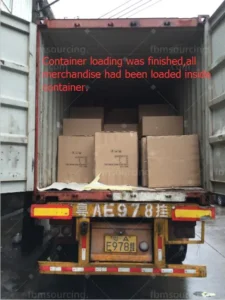
For a commercial project, packing is a site-logistics document, not an afterthought. Specify export-grade packing (five-ply cartons, corner protection, foam or EPE wrapping), and — critically — shipping marks that follow your site logic: room numbers, unit types or zones printed on every carton so a 40ft container unloads in installation order instead of becoming a sorting exercise on a construction site. As a capacity reference, a 20GP container holds roughly 28 CBM, a 40GP about 58 CBM, and a 40HQ about 68 CBM of usable volume, so the packing spec directly drives how many containers your quantity schedule fills. All inspections are carried out by FBM’s own team at the factory before shipment, with photo and video records delivered to the client — and a clear packing and marking spec in the RFQ is exactly what that pre-shipment check is verified against.
How Do You Compare Quotes From Multiple Factories?
Quotes are only comparable when every factory priced the same job. That means sending the identical RFQ package — same drawings, same quantities, same specs, same Incoterm — to every shortlisted factory, and then normalizing what comes back before reading a single unit price. Factories typically need 5–10 working days to cost a full custom commercial package after receiving complete documents, and most quotations are stated valid for only 15–30 days because raw material and exchange-rate movements erode the numbers.
Before comparing totals, align four things across the returned quotes:
- Same Incoterm and same named destination port on every quotation
- Same material grade and certification basis (no silent E1-for-CARB swaps)
- Exclusions listed and matched — molds, tooling, packing, samples, drawings
- Validity period and currency or exchange-rate basis stated on each quote
This normalization step is where a china sourcing agent earns its keep. FBM manages China building materials and FF&E procurement for commercial projects by issuing one engineered RFQ package to vetted factories, aligning the returned quotations line by line, and presenting a comparison in which the differences are real — not artifacts of who assumed what. Once the numbers are on the table, our guide on how to read a Chinese factory quotation walks through what each line actually contains.
Get a China Procurement Quote for Your Project
If you are sourcing furniture or building materials from China for a commercial building project — a hotel, apartment development, school, office, government facility, restaurant chain or gas station program — send us the four things every accurate quote starts from: your drawings, your quantity schedule, your destination port and your target timeline. FBM Sourcing works with project owners, developers, main contractors and FF&E contractors on commercial projects; we operate on a transparent agency fee of 5–8% of procurement value, so factory pricing stays visible to you. Not sure your documents are complete? Start with the free commercial project RFQ template, fill in what you have, and our team will review the package and come back to you on the gaps.
Written by Spring Dan · Founder, FBM Sourcing
Sourcing building materials and FF&E in China for commercial construction projects since 2008. About Spring · LinkedIn