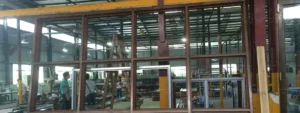
US commercial projects can source complete custom millwork and joinery packages from China — reception desks, wall paneling, built-in casework, banquettes, door frames and decorative screens — fabricated from your architectural drawings and delivered as one coordinated scope. Instead of splitting the package across 7–8 separate joinery shops, a general contractor or FF&E contractor deals with one china sourcing agent and sourcing partner that reads the CAD set, produces shop drawings, runs fabrication across specialized factories and consolidates everything into full containers. This is the model FBM Sourcing runs for hotel, office, apartment and food-and-beverage fit-outs, as part of our wider building materials and FF&E procurement service for commercial building projects.
- A typical millwork package covers 6 scope families: reception desks, wall paneling, built-in casework, banquettes and booth seating, door frames, and decorative screens or feature ceilings.
- Shop drawings are produced from your architectural CAD set before any fabrication starts.
- Composite wood cores are ordered to TSCA Title VI (EPA 40 CFR Part 770) formaldehyde limits; upholstered banquette foam follows CAL TB 117-2013; fire-rated veneer and laminate finishes are specified to ASTM E84 Class A (flame spread index 25 or less).
- Millwork rarely ships alone: it is consolidated with furniture, stone, tile and lighting, and most mid-size US projects close out at 2–4 x 40HQ containers (76 cbm each) for the combined interior scope.
- For suppliers you nominate, we charge a 5% commission; for products we source for you, we quote a direct price — one contract, one point of responsibility for the entire joinery scope.
What Does a Custom Millwork Package from China Actually Include?
“Millwork package” means every architecturally specified, shop-fabricated wood and panel element in the interior fit-out, built to the design intent drawings rather than picked from a catalog. On a US hotel, office or multifamily amenity project, the package FBM Sourcing typically prices as one scope includes:
- Reception and service desks — solid surface or stone tops on veneer or laminate carcasses, with integrated cable management, ADA-height transaction counters and concealed LED coves. See our detailed guide to custom reception desk manufacturing in China.
- Wall paneling — flat veneer panels, fluted and slatted feature walls, acoustic fabric-wrapped panels, and full-height lobby feature walls with integrated reveals and lighting channels.
- Built-in casework — back-of-house cabinetry, guestroom wardrobes and minibar units, amenity-space storage walls, mailroom and package-room fit-outs, and nurse-station or leasing-desk casework.
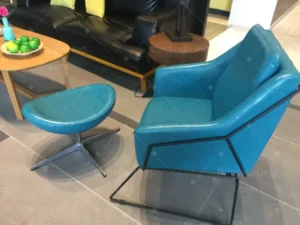
- Banquettes and booth seating — upholstered seat and back units on plywood frames with hardwood plinths, built in 1,200–2,400 mm modules for site assembly.
- Door frames and architraves — timber and engineered frames matched to leaf schedules, often coordinated with our fire-rated door set and hardware sourcing so frames, leaves and ironmongery arrive as matched sets.
- Decorative screens — CNC-cut MDF, solid timber or metal-and-wood hybrid screens used as space dividers, elevator lobby features and restaurant partitions.
Defining the boundary early matters. On most hotel and office fit-outs, millwork represents roughly 15–25% of the interior finishes and FF&E budget, and it is the scope with the highest drawing dependency — which is exactly why it should not be scattered across many small shops that each interpret the drawings differently.
How Does the CAD and Shop Drawing Process Work?
Everything starts from your architectural drawings, not from a product list. FBM Sourcing’s engineering side reads AutoCAD and PDF construction sets directly — plans, elevations, sections, finish schedules and door schedules — and turns them into factory-ready shop drawings. We covered the general capability in how a sourcing agent works from CAD and shop drawings; for millwork specifically, the sequence is:
- Drawing take-off. Every millwork item is extracted from the architectural set into an itemized scope register with dimensions, finishes and quantities, flagging missing details and clashes before pricing.
- Shop drawings. Fabrication-level drawings with core build-ups, veneer layons, edge details, hardware positions and site-fixing methods, issued for your architect’s review in the standard US submittal format.
- Finish samples. Veneer stain, laminate, paint and solid surface samples couriered for approval alongside the shop drawing review, so approvals run in parallel rather than in series.
- First-article build. For repeated items — a guestroom wardrobe, a banquette module, a typical wall panel bay — one full unit is built and reviewed in detail before batch production releases.
This engineering step is the real difference between buying millwork through a trading intermediary and working with a building material sourcing agent that has in-house CAD capability. Dimension errors caught on paper cost a drawing revision; errors caught on site in Dallas cost a re-fabrication cycle plus 30–35 days of ocean transit.
Materials and US Compliance: TSCA Title VI, CAL 117 and Class A Finishes
US commercial millwork has three compliance gates that must be locked into the purchase order, not promised verbally:
- TSCA Title VI formaldehyde limits (EPA 40 CFR Part 770) for all composite wood cores: 0.05 ppm for hardwood plywood, 0.09 ppm for particleboard and 0.11 ppm for MDF, with CARB Phase 2-aligned mill certificates and labeling on every panel batch.
- CAL TB 117-2013 for the foam and upholstery build-up on banquettes and booth seating — the smolder-resistance standard California requires and most US operators specify nationwide.
- ASTM E84 Class A interior finish ratings where the wall paneling scope lands in exits, corridors and assembly areas — flame spread index of 25 or less — achieved with fire-retardant cores and rated laminates or intumescent-coated veneers.
Core selection also drives stability and cost: our comparison of solid wood versus engineered wood for project joinery explains why most US commercial paneling and casework runs on engineered cores with real-wood veneers, with solid timber reserved for edges, plinths and profiles. For pieces that will not fit the box at all, see how oversized items ship from China by flat rack, open top and breakbulk.
Sourcing this for a commercial project?
FBM Sourcing works with project owners, developers, main contractors and FF&E contractors on hotel, apartment, school, office and other commercial building projects. Send us your BOQ, drawings or product list — our team will review it and get back to you.
Why One Sourcing Agent Instead of Seven or Eight Joinery Factories?
No single factory is genuinely best at reception desks, veneer paneling, upholstered banquettes, CNC screens and fire-rated frames at the same time. Splitting the package yourself means 7–8 parallel vendor relationships, 7–8 shop drawing formats, mismatched veneer lots between the desk and the wall behind it, and 7–8 separate freight bookings. The integrated model works differently:
- One contract, one engineering owner. FBM Sourcing allocates each scope family to the workshop that specializes in it, while one drawing office keeps veneer species, stain references and detail language consistent across the whole package.
- One QC standard. All inspections are carried out by FBM Sourcing’s own team at the factory before shipment, with photo and video records, so your project team can sign off remotely before containers are loaded.
- One firm price. For products we source, we quote one firm price; for suppliers you nominate, we charge a 5% commission.
Most of this fabrication capacity sits in the Foshan manufacturing cluster, where panel processing, veneer pressing, spray finishing and upholstery workshops operate within a short radius — the reason we base operations there, as explained on our Foshan sourcing agent page. Proximity means a finish issue found at inspection is corrected in days, not weeks.
Consolidated Shipping: Millwork Rides with the Rest of the Project
Millwork is volumetric but rarely fills containers efficiently on its own — desks and banquettes are bulky, panels are dense and flat. The economics improve sharply when the joinery scope is consolidated with the furniture, stone, tile, lighting and sanitaryware we are already buying for the same project. In practice, a mid-size US commercial project closes out at 2–4 x 40HQ containers (76 cbm each) for the combined interior package, with millwork panels crated flat and case goods used to fill vertical space. Loading is sequenced by installation phase where the program requires it — back-of-house casework in the first container, public-area feature millwork in the last — and every crate is labeled to room and drawing reference so site logistics stay simple.
Site Dimensions, Installation Drawings and Handover
Custom millwork only fits if fabrication dimensions reflect the building as built, not as drawn. Before batch production of wall-to-wall items — paneling runs, built-in casework, banquettes against fixed walls — we ask the GC to return verified site dimensions on our field measurement sheets; fabrication tolerances are held to ±2–3 mm, and scribe margins of 15–20 mm are engineered into end panels and fillers to absorb site variance. With the shipment, your install crew receives an installation drawing package: keyed setting-out plans, fixing details, hardware schedules and crate manifests cross-referenced to room numbers. US install teams fix China-fabricated millwork on commercial sites every week — the deliverable that makes it routine is that drawing package, not luck.
Where Millwork Packages Go Wrong — and How the Process Prevents It
Three failure modes account for most bad China millwork experiences, and each has a process answer rather than a hope-based one:
- Veneer mismatch across items. The desk, the wall behind it and the elevator surround are built in different workshops from different veneer lots and land on site three shades apart. Prevention: one drawing office controls a single veneer species and stain reference for the whole package, physical range samples are approved up front, and adjacent items are finished from sequenced veneer bundles. First articles are photographed side by side under D65 lighting before batch release.
- Design-intent drawings sent straight to fabrication. Architectural sets describe intent, not build-ups; a workshop that fabricates directly from them fills the gaps with its own habits. Prevention: the shop drawing stage is non-negotiable — every core build-up, edge detail and fixing method is drawn, reviewed and stamped before a panel is cut.
- Freight damage on finished faces. High-gloss and veneer faces are vulnerable in a 30–35 day ocean transit. Prevention: finished faces are film-protected, foam-interleaved and crated on purpose-built skids; crates are shock-labeled; and the packing method itself is part of the first-article approval, not an afterthought at loading.
None of this is exotic — it is the ordinary discipline of commercial joinery, applied on the factory side of the ocean by a team whose job is to protect your program rather than any single workshop’s schedule.
What Is the Realistic Timeline for a Millwork Package?
On timing, please plan for about four months between deposit and shipment. The drawing stage usually takes around two months, because custom items go back and forth until you are happy with them, and production takes about another two months; ocean transit to a US port follows. The variable that most often slips is not the factory: it is drawing approval turnaround, which is why we run samples and shop drawing reviews in parallel from day one.
Not every item in a joinery package needs to be bespoke — see modular standard vs fully custom millwork and the cost and lead-time trade-offs for how to split a package between the two before it goes out for pricing.
Get a China Procurement Quote for Your Project
If you have a US commercial project with a defined millwork and joinery scope — or a wider interior package where joinery is one line among furniture, tile, lighting and doors — send us the architectural set, finish schedule and program dates. FBM Sourcing will return an itemized scope register, budget pricing and a shop-drawing schedule, and manage fabrication, QC and consolidated shipping under one a 5% commission for suppliers you nominate (products we source for you are quoted at a direct price). Use the quote button above or WhatsApp +86 135 6007 5057 to start with your drawings.