The furniture hardware manufacturers in China most worth knowing for joinery and casegoods projects are DTC (Dongtai Hardware), Higold, Topstrong, Hutlon, Archie and Kinlong — six Guangdong-based producers whose hinges, drawer systems, sliding-door gear and door ironmongery run through a large share of the fitted furniture leaving Chinese factories. For a project buyer, the practical question is rarely “who makes good hardware in China” — it is which of these names to specify on the hardware schedule so the joinery factory cannot quietly substitute unbranded components. This guide profiles each manufacturer from a commercial project perspective and ends with a comparison table.
What a hardware and fittings package actually covers on a typical casegoods or joinery contract:
- Concealed cabinet hinges (35 mm cup, soft-close) and drawer runners or metal drawer-box systems
- Sliding and folding door hardware for wardrobes and room partitions
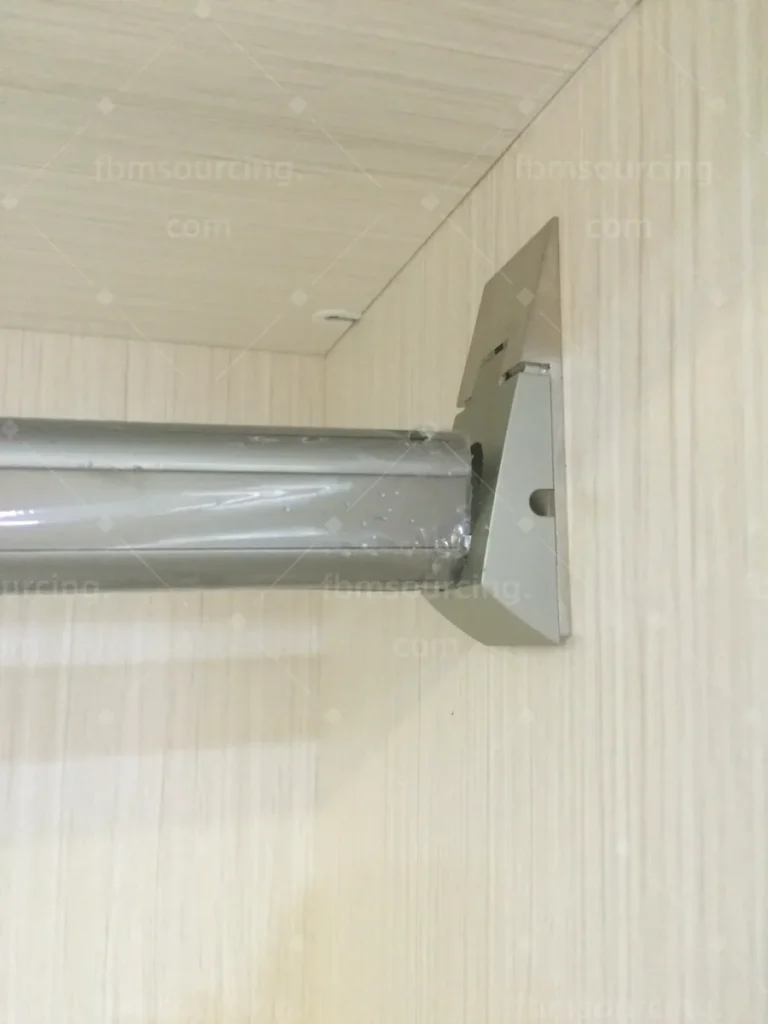
- Wardrobe internals: hanging rails, pull-out baskets, trouser racks, lift systems
- Door ironmongery: lever handles, locksets, hinges, closers for joinery doors
- Fixings, connectors and specialist fittings for flat-pack or site-assembled casegoods
How Is the Chinese Furniture Hardware Market Segmented?
The market splits into three visible tiers. At the top sit the European brands — Blum, Hettich, Häfele — imported or produced through their Chinese operations, priced at a premium and specified when the design brief demands them. The middle tier is the branded Chinese manufacturers profiled below: real R&D departments, published product systems, cycle-test documentation, and national distribution. The bottom tier is the unbranded commodity segment that fills wholesale hardware markets — usable on cost-driven work, but with no test traceability. The gap is measurable: a branded Chinese concealed hinge is typically documented to 50,000–80,000 open-close cycles under BHMA A156.9-style cabinet hardware testing, while unbranded equivalents ship with no test reports at all. Since the entire hardware package usually represents only 3–5% of a joinery contract value, stepping from commodity to branded Chinese hardware is one of the cheapest reliability upgrades available on a casegoods project.
The Manufacturers
1. DTC — Dongtai Hardware
Guangdong Dongtai Hardware, trading internationally as DTC, is the largest furniture hardware manufacturer in China and among the top three worldwide by scale, operating six production sites totalling around 650,000 square metres. Founded in 1991, DTC built its position on the two workhorse categories of casegoods hardware — concealed hinges and drawer slides — and has since expanded into full metal drawer-box systems and whole-house hardware.
For project buyers, DTC’s significance is simple: it is the default branded specification inside Chinese casegoods and cabinet factories. When a joinery quotation says “branded soft-close hinges” without naming a European brand, DTC is usually what arrives — and specifying it explicitly costs little while guaranteeing test-documented components.
| Location | Guangdong Province (six production sites) |
| Established | 1991 |
| Classification | Full-line furniture hardware group |
| Key products | Concealed hinges, drawer slides, metal drawer-box systems, lift systems |
| Credentials | ISO 9001; China’s no.1 home hardware maker by scale; cycle-test documentation on core lines |
Verdict: the default hinge-and-slide specification for hotel and apartment casegoods packages — name it on the schedule rather than leaving hardware generic.
2. Higold
Higold Group, founded in 2004 in Foshan’s Shunde district and listed on the Shenzhen Stock Exchange, concentrates on functional hardware — the pull-out baskets, corner units, wardrobe internals, cabinet lighting and sinks that turn a bare carcass into a working kitchen or wardrobe. The company runs a production base of roughly 200,000 square metres, holds over 1,200 patents, and exports to more than 90 countries.
On commercial projects Higold appears most in apartment and build-to-rent kitchens and in hotel wardrobe fit-outs, where its internal fittings are specified alongside another brand’s hinges and runners. Its design investment is unusually visible for the sector — the company collaborates with international industrial designers and holds a stack of international design awards.
| Location | Foshan (Shunde), Guangdong |
| Established | 2004 |
| Classification | Functional kitchen & wardrobe hardware; publicly listed |
| Key products | Pull-out baskets, wardrobe internals, cabinet lighting, sinks, outdoor furniture |
| Credentials | Shenzhen-listed; 1,200+ patents; exports to 90+ countries |
Verdict: first pick for the internal fit-out of kitchen and wardrobe cabinets on apartment and hotel projects.
Sourcing this for a commercial project?
FBM Sourcing works with project owners, developers, main contractors and FF&E contractors on hotel, apartment, school, office and other commercial building projects. Send us your BOQ, drawings or product list — our team will review it and get back to you.
3. Topstrong
Topstrong, established in 2002 in Zhongshan and publicly listed in Shenzhen, made its name in sliding-door hardware and complete wardrobe systems. Its sliding, folding and pocket-door gear covers the movement hardware that wardrobe and partition joinery depends on, and the company has expanded into locks, hinges and eco-board doors.
For projects with large sliding-wardrobe counts — apartments, student accommodation, hotel room dividers — Topstrong is the natural Chinese-brand specification for track and roller systems, where smooth running after thousands of cycles is the difference between a snag-free handover and a punch-list headache.
| Location | Zhongshan, Guangdong |
| Established | 2002 |
| Classification | Sliding-door & wardrobe hardware systems; publicly listed |
| Key products | Sliding/folding door gear, wardrobe systems, locks, hinges |
| Credentials | Shenzhen-listed; established engineering-channel presence in China |
Verdict: specify for sliding wardrobe and partition hardware on multi-unit residential and hospitality work.
4. Hutlon
Hutlon, founded in 1996 and based in Guangzhou, sits on the door-hardware side of the fittings package: lever handles, mortise locksets, hinges, and an aggressive smart-lock line, plus bathroom hardware. It positions itself in the premium domestic segment and supplies extensively through China’s engineering channel into residential towers and hotels.
On export projects, Hutlon is most relevant when joinery doors and their ironmongery ship together with the casegoods package — consolidating door leaves, frames and branded hardware from one supply cluster instead of splitting the schedule across continents.
| Location | Guangzhou, Guangdong |
| Established | 1996 |
| Classification | Door hardware, smart locks, bathroom hardware |
| Key products | Lever handles, locksets, smart locks, door hinges, bathroom accessories |
| Credentials | 30-year brand; strong China engineering-channel track record |
Verdict: door ironmongery and smart-lock packages for apartment projects sourcing doors and joinery together.
5. Archie
Archie, established in 1990, is one of the longest-standing names in Chinese architectural and furniture hardware, covering door hardware, cabinet fittings and bathroom accessories. Its historic strength is the project channel: hotels, office buildings and public projects across China have run on Archie ironmongery for three decades, and the brand maintains the finish ranges — satin stainless, PVD, matt black — that commercial interior schedules call for.
| Location | Guangdong Province |
| Established | 1990 |
| Classification | Architectural & furniture hardware |
| Key products | Door hardware, cabinet fittings, bathroom accessories |
| Credentials | 35+ years; extensive hotel and public-building project references in China |
Verdict: a proven project-channel choice for hotel and public-building door and cabinet hardware schedules.
6. Kinlong
Kinlong, headquartered in Dongguan and listed on the Shenzhen Stock Exchange, is China’s dominant architectural hardware group — door and window fittings, curtain-wall components and glass hardware — with product lines extending into interior and furniture applications. Its scale and nationwide distribution make it the crossover option when a fit-out package reaches beyond casegoods into glass doors, partitions and balustrade fittings.
| Location | Dongguan, Guangdong |
| Established | 2003 |
| Classification | Architectural hardware group; publicly listed |
| Key products | Door & window hardware, glass door fittings, partition and balustrade hardware |
| Credentials | Shenzhen-listed; the reference brand in China’s building hardware sector |
Verdict: use where joinery scope meets the building shell — glass doors, partitions, balustrades — and one hardware account is preferable to five.
Should You Specify Branded Hardware or Accept the Joinery Factory’s Default?
Specify. On an OEM casegoods order, hardware is the component the factory is most tempted to economise on, because substitution is invisible at handover and only shows up after months of use. The fix costs almost nothing: name the hardware brand and series on the schedule, require it in the contract, and have the pre-shipment inspection verify markings — branded hinges and slides carry the maker’s stamp. Two more numbers worth writing into any hardware specification: for coastal or high-humidity destinations, ask for salt-spray test reports of at least 48–96 hours on plated finishes; and order 2–3% spare hardware in the same batch, because a missing hinge plate discovered during installation should never hold a floor handover hostage. A sourcing agent managing the casegoods order writes these requirements into the purchase contract and checks them at inspection as standard practice.
Comparison Table: Chinese Furniture Hardware Manufacturers
| Manufacturer | Base | Est. | Core strength | Best fit on a project |
|---|---|---|---|---|
| DTC | Guangdong | 1991 | Hinges, slides, drawer systems | Default casegoods hardware spec |
| Higold | Foshan | 2004 | Functional kitchen/wardrobe fittings | Kitchen & wardrobe internals |
| Topstrong | Zhongshan | 2002 | Sliding-door & wardrobe systems | Sliding wardrobes, partitions |
| Hutlon | Guangzhou | 1996 | Door hardware & smart locks | Apartment door packages |
| Archie | Guangdong | 1990 | Project-channel ironmongery | Hotel & public-building schedules |
| Kinlong | Dongguan | 2003 | Architectural & glass hardware | Where joinery meets the shell |
Which Route Fits Your Project?
If your design brief mandates European hardware, the Chinese joinery factory can fit Blum or Hettich — you simply pay the premium and note it in the contract. If the brief is quality-led but budget-conscious, the six manufacturers above give you test-documented Chinese hardware at a fraction of the imported price, and the right split is usually DTC or Topstrong for movement hardware plus Higold for internals. If the whole package rides on cost, unbranded hardware exists — but on commercial projects with warranty obligations it is a false economy. Most project buyers do not manage this decision line-by-line themselves: the hardware schedule gets settled once, during casegoods contracting, which is exactly when a china sourcing agent locks brands and series into the purchase agreement. That is how we handle it on kitchen and wardrobe cabinet and hotel furniture programmes — and the same logic applies to kitchen cabinet manufacturers and casegoods factories themselves.
Evidence to Request Before You Shortlist
Catalogues and showrooms all look convincing. What separates a hardware manufacturer that will perform on a commercial project is the documentation it can produce for your specification — request these items with your RFQ, and treat slow or partial answers as information:
- Cycle-test reports per component family — hinges to BIFMA/EN benchmarks (200,000 cycles is the contract norm), drawer runners to EN 15338
- Salt-spray corrosion test hours for coastal or high-humidity projects, per finish
- Written confirmation of what is branded and what is compatible/unbranded in the quoted schedule — ambiguity here is where joinery packages lose quality silently
- Production-batch samples of the exact items quoted, not showroom demonstration boards
- Per-SKU packaging and labelling specification so hardware arrives sorted for site distribution, not as loose bulk
- Written MOQ and lead time per finish and plating option
On FBM-managed packages our own QC team collects and cross-checks every one of these documents against the actual production batch during factory visits and staged inspections — so the evidence file your project holds matches the goods in the container, not just the brochure.
Get a China Procurement Quote for Your Project
FBM Sourcing is a furniture sourcing agent and building material sourcing agent working with developers, contractors and FF&E companies on hotel, apartment, school and office projects. If you are contracting casegoods or joinery from China and want branded hardware specified, verified and delivered as part of one accountable package, send us your drawings, quantities, destination port and project timeline — our team will review your requirements and get back to you.
Written by Spring Dan · Founder, FBM Sourcing
Sourcing building materials and FF&E in China for commercial construction projects since 2008. About Spring · LinkedIn