If you are buying building materials or furniture in South China for a commercial project, at some point you will search for a shipping agent in Guangzhou. It is the natural question: your goods are finishing production in Foshan and Guangzhou factories, your site is in Sydney, Miami or Rotterdam, and somebody has to get loaded containers from factory floor to destination port with the paperwork right. This guide explains what a Guangzhou shipping agent actually does, how that role differs from a freight forwarder and a sourcing agent and sourcing partner, which ports your cargo really leaves from, and how commercial project buyers should structure the shipping side of a China procurement programme.
The short version for busy project managers: a shipping agent handles the physical and documentary export process — trucking, consolidation, customs declaration, container booking. What a shipping agent does not do is verify your factories, inspect your goods, or take responsibility for what is inside the boxes. For a construction project with money and a site programme on the line, who carries that responsibility is the more important question, and we address it directly below.
What a Shipping Agent in Guangzhou Actually Does for Project Cargo
Export Clearance and Documentation
Every container leaving China needs a customs declaration filed by a licensed export agent, supported by a commercial invoice, packing list and, where applicable, the manufacturer’s export licence. Many smaller Chinese factories sell domestic and have limited export documentation capability, so the shipping agent frequently acts as the exporter of record on their behalf. For project cargo the documentation layer also includes certificates of origin (which affect your import duty under trade agreements), fumigation certificates for wooden packing, and the HS-code classification that determines duty rates at your destination. Classification errors are one of the most common causes of customs delays on mixed building material shipments — a container carrying tiles, door hardware, sanitary ware and light fittings can require a dozen different HS codes on one bill of lading.
Trucking, Consolidation and Container Stuffing
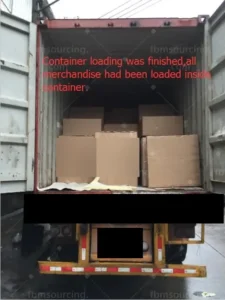
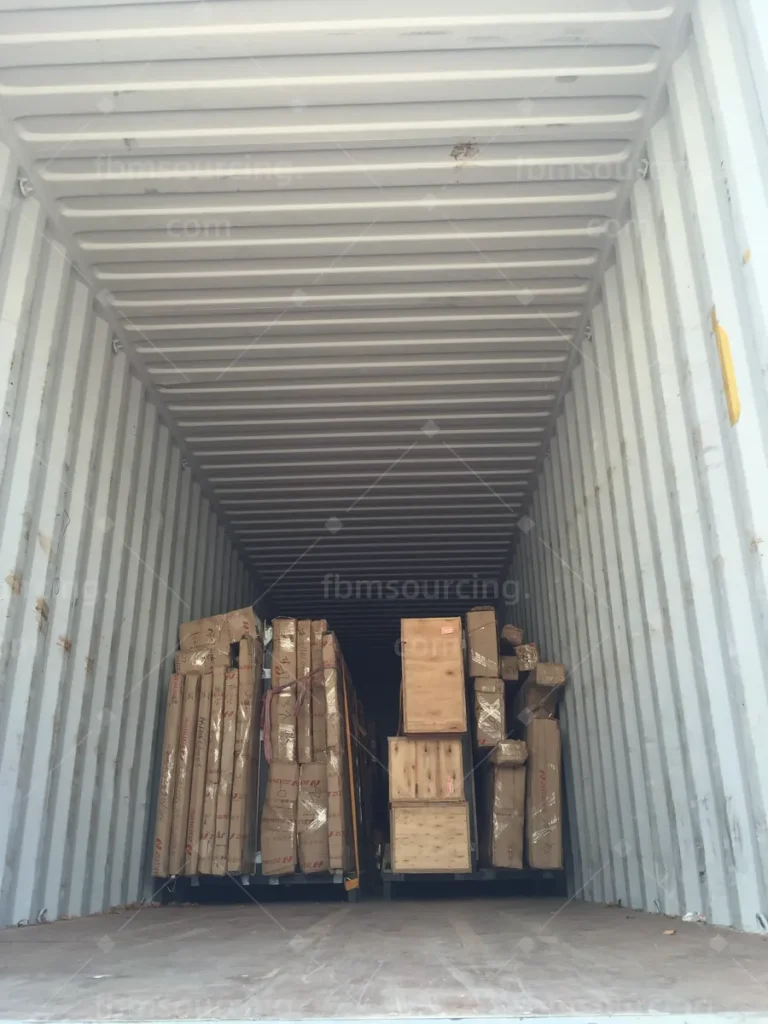
The second half of the job is physical. A Guangzhou shipping agent arranges trucking from each factory, receives goods into a consolidation warehouse, and books the container and vessel. For a single-factory full container this is routine. For a typical commercial project order — eight to fifteen factories across Foshan and Guangzhou, finishing production at different times — consolidation is where shipments are won or lost. Goods must be received, checked against packing lists, stored, and then loaded in a sequence that both protects fragile items and matches the order your site team wants to unload. Our article on full container consolidation for building material projects covers when consolidated full containers beat loose freight, and for most project-scale orders the answer is decisively FCL.
What a Guangzhou Shipping Agent Charges — and What Is Not in the Quote
Shipping-side costs on the China end are modest relative to the value of project cargo, but buyers should know the components so quotes can be compared like for like. A typical consolidation shipment involves factory-to-warehouse trucking (charged per truckload or per cubic metre), warehouse in-and-out handling, container loading labour, customs declaration fees per shipment, document fees for the bill of lading and certificates, and the ocean freight itself. Two things are routinely missing from a cheap headline quote. The first is destination-side charges — terminal handling, import clearance, delivery — which surface later as a surprise if your incoterm was not thought through. The second is marine cargo insurance, which is not automatic: standard carrier liability is capped at levels that are meaningless against a container holding an entire hotel floor’s materials, so project cargo should always travel under a specific marine policy, typically costing a fraction of one per cent of cargo value. Any agent quoting “all-in” should be asked to itemise against this list.
Shipping Agent, Freight Forwarder or Sourcing Agent: Who Does Your Project Need?
These three roles are constantly confused, and the confusion costs buyers real money. A freight forwarder sells ocean freight: they buy container slots from carriers and handle port-to-port (or door-to-door) transport and documents. A shipping agent, in the Guangzhou market, usually means a forwarder who also handles local trucking, export clearance and consolidation on the China side. A sourcing agent sits one level up: they manage the procurement itself — factory selection, contracts, production follow-up, quality inspection — and then manage the shipping agents and forwarders as part of the delivery. We compare all three roles in detail in 3PL vs freight forwarder vs sourcing agent.
The practical dividing line is responsibility for the goods. If a forwarder ships a container of defective windows on time and on budget, the forwarder has done their job perfectly — and your project still has a container of defective windows. No shipping agent opens cartons to check whether the cabinet hardware matches the specification, whether tile shades are consistent across the batch, or whether the glass in your door sets carries the safety markings your building inspector will look for. That inspection layer must exist before cargo reaches the consolidation warehouse, which is why project buyers who source through a Foshan sourcing agent treat shipping as the final step of a managed process rather than a standalone purchase.
Sourcing this for a commercial project?
FBM Sourcing works with project owners, developers, main contractors and FF&E contractors on hotel, apartment, school, office and other commercial building projects. Send us your BOQ, drawings or product list — our team will review it and get back to you.
Ports, Routes and Transit Times from Guangzhou
Which Port Your Cargo Actually Leaves From
“Shipping from Guangzhou” rarely means the city itself. Deep-sea container cargo from the Guangzhou and Foshan manufacturing belt loads at one of three gateways. Nansha, Guangzhou’s deep-water port at the mouth of the Pearl River, has grown into one of the world’s busiest container ports and offers the shortest trucking distance from Foshan for many routes. Shenzhen’s ports — Yantian on the east side and Shekou on the west — carry the densest sailing schedules to North America and Europe, and forwarders will often route project cargo there when a specific vessel date matters. Hong Kong remains an option for some destinations and for cargo needing its documentation environment. Your shipping agent’s job is to price all three against your deadline; trucking cost differences between them are minor compared with the cost of missing a vessel that your site programme depends on.
Typical Transit Times and What Drives Cost
Transit time on the water is set by the carrier’s schedule for your route and confirmed on the booking, including any transhipment. Add time in front of that for consolidation and export clearance, and destination-side time for import clearance and delivery. Freight cost is driven by container size, season, carrier and route — but on project cargo, the controllable costs are elsewhere: incoterm selection, load planning that avoids shipping air, and avoiding demurrage from documentation errors. If you have not yet fixed your commercial terms, our guide to FOB vs CIF vs DDP for building materials from China explains which incoterm keeps you in control of freight without taking on customs risk you cannot manage remotely.
Build schedule buffers honestly. Vessel schedules slip, ports congest seasonally, and pre-Chinese-New-Year weeks compress space on every route out of South China. For materials that gate your site programme — windows before facade close-in, tiles before wet-area fit-out — plan against the slow end of the transit band and hold a buffer between scheduled arrival and the date your installers actually need the goods. Freight saved by gambling on the fast end of a transit window is trivial next to the cost of a site crew standing idle.
The Document Set Your Import Broker Will Ask For
Whichever agent handles the China side, your customs broker at destination will need a consistent document set: the commercial invoice and packing list (with values and HS codes that match each other and reality), the ocean bill of lading, a certificate of origin where a trade agreement reduces your duty, fumigation or ISPM-15 treatment evidence for timber packing, and any product-level certificates your market requires — glass safety markings, fire-test reports for door sets, electrical certification for light fittings. The cheapest place to fix a documentation problem is Guangzhou, before the vessel sails; the most expensive is a bonded warehouse at your destination port with demurrage accruing daily. On mixed building material shipments we prepare this file in parallel with production rather than in the final week, so that a missing test report is discovered while the factory can still supply it.
One more planning note for multi-container projects: sequence containers to match the build. Site teams want first-fix materials — windows, doors, waterproofing, tile — ahead of cabinets, sanitary ware and loose furniture. A consolidation warehouse makes that sequencing possible; shipping each factory’s goods as they happen to finish does not. Our write-up on furniture container loading for mixed project orders shows how loading plans are built around installation order.
How FBM Sourcing Handles Shipping for Commercial Projects
FBM Sourcing is a sourcing agent, not a freight seller — and that is precisely why our clients’ shipping runs clean. By the time a project order reaches the port, every factory has been verified, every item has passed pre-shipment inspection against sealed samples, packing has been specified for ocean freight, and the container loading has been planned and supervised by our own team, with photo documentation of every stage. Our case write-up on office furniture container loading shows what supervised loading looks like in practice.
We then run the export through established shipping partners at Nansha, Yantian and Shekou, matching port and carrier to your destination and deadline, and we manage documents through to bill of lading and telex release. For buyers, the result is one accountable counterparty from factory deposit to destination port — one contract, one point of contact, one party responsible for what is inside the container as well as where it is.
Get a China Procurement Quote for Your Project
If you are pricing a shipping agent in Guangzhou, you already have production finishing or a purchase in motion — which means now is the right moment to get the whole chain reviewed, from factory verification and QC through consolidation and freight. FBM Sourcing manages building material and furniture procurement from South China for hotels, apartment buildings, schools, offices and other commercial projects in the USA, Australia, Europe and the Caribbean.
Send us your BOQ, drawings or supplier list, plus your destination port and target dates, and our team will review your requirements and get back to you. Start on our China building materials and FF&E procurement page.