
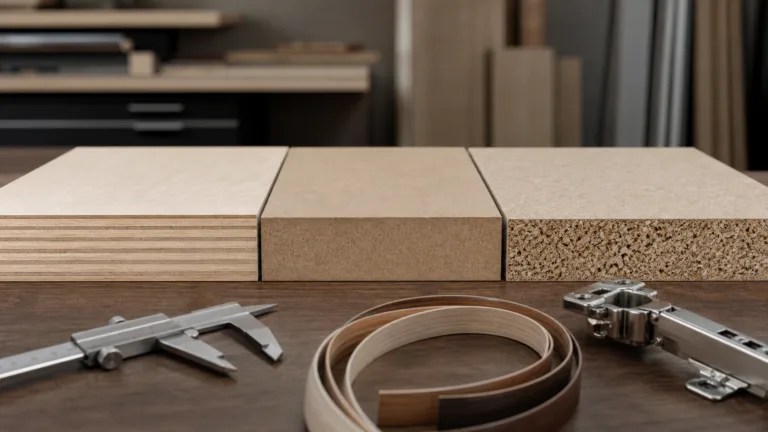
The short answer: choose plywood for components that need better screw holding, impact resistance, longer unsupported spans, or more tolerance of occasional moisture. Choose MDF for smooth painted or routed surfaces where flatness and a clean finish matter most. Choose particle board for cost-controlled, repeatable furniture carcasses and panels that will stay dry, be properly supported, and use hardware designed for the substrate. This is the kind of scope a sourcing partner such as FBM Sourcing takes on.
For a project buyer, the plywood vs furniture board choice is not a contest with one universal winner. It is a component-level decision based on load, fixing method, finish, moisture exposure, shipping risk, destination requirements and budget.
There is no single best board for an entire furniture order. A hotel wardrobe may use particle board for the carcass, MDF for painted doors, and plywood for a sink-unit base or heavily loaded fixing zone. The lowest-risk decision is therefore made component by component, not by asking a supplier for “18 mm good-quality board.”
Buyers comparing plywood vs furniture board should also know that furniture board is not a precise technical specification. Some factories use it to mean particle board; others use it for melamine-faced particle board, blockboard, or almost any panel sold for furniture. Define the construction, grade, thickness, face, edge treatment, intended load, moisture class, and required compliance evidence in the RFQ.
Table of Contents
- Quick comparison: plywood, MDF, and particle board
- What do these board names actually mean?
- How the three boards differ in real furniture
- Which board should you choose for each furniture component?
- Match the substrate to the finish
- RFQ checklist: turn “good board” into measurable fields
- US formaldehyde compliance: what importers should verify
- Factory QC checklist for engineered-board furniture
- Eight common buying mistakes
- Frequently asked questions
- Final recommendation
Quick comparison: plywood, MDF, and particle board
| Factor | Plywood | MDF | Particle board |
|---|---|---|---|
| Construction | Cross-laminated wood veneers bonded in layers | Refined wood fibers bonded and pressed into a uniform panel | Wood particles or chips bonded and pressed, often with finer surface layers |
| Main advantage | Strong all-round substrate with useful screw holding and toughness | Very smooth, consistent face and edge for paint, routing, and profiles | Economical, dimensionally consistent, and efficient for high-volume panel furniture |
| Main limitation | Quality varies with veneer species, ply count, core gaps, glue bond, and face grade | Heavy; edges can be vulnerable to impact and water; standard screws need careful design | Lower edge strength and moisture tolerance; repeated screw removal can damage fixing points |
| Surface finish | Veneer, laminate, melamine, paint with preparation | Paint, foil, veneer, laminate, melamine | Melamine, laminate, foil, veneer; exposed edges require sealing |
| Typical furniture use | Frames, bases, long shelves, wet-risk zones, fixing blocks, drawer boxes | Painted doors, routed fronts, decorative panels, headboards | Carcasses, short shelves, office desks, wardrobes, modular and flat-pack furniture |
| Buyer’s key check | Core construction, voids, thickness, bonding, flatness | Density/profile, thickness, moisture grade, edge integrity | Density/profile, internal bond, thickness, edge strength, hardware system |
This table is a selection shortcut, not a purchase specification. A well-made particle-board cabinet can outperform a poorly constructed plywood cabinet. Panel quality, joint design, surface sealing, hardware, workmanship, and use conditions all influence the finished result.
What do these board names actually mean?
Searches for types of furniture materials often mix solid timber, veneers, engineered panels, metals, glass, stone, and upholstery. This guide focuses only on three engineered wood panels used as furniture substrates.
Plywood
Plywood is made from thin wood veneers with adjacent layers normally oriented across one another. The layered construction helps distribute loads and limit directional movement. However, “plywood” alone says little about performance. Define the panel grade, veneer species if relevant, actual thickness, core, face quality, bonding or moisture classification, and permitted defects. Ply count does not guarantee quality: core gaps, overlaps, weak veneers, poor bonding, or excessive sanding can still produce an unreliable board.
MDF
Medium-density fiberboard is made from refined wood fibers and resin under heat and pressure. Its uniform structure gives a smooth face and predictable machining, making it useful for painted doors, routed profiles, and curved edges. Tradeoffs include weight, vulnerable unsealed edges, and the need to engineer fasteners carefully. Standard, moisture-resistant, fire-performance, and thin MDF grades are not interchangeable. “MR MDF” does not make a vanity waterproof.
Particle board
Particle board is pressed from wood particles and resin, usually with a layered density profile. It is common in carcasses, wardrobes, office furniture, and flat-pack products because it is economical, flat, and compatible with automated machining. A suitable panel with protected edges, short spans, and correctly placed connectors can perform well in dry interiors; weak edge zones, excessive loads, or water-exposed cutouts can cause early failure.
Is “furniture board” a fourth material?
Usually, no. The term is often commercial shorthand rather than a standardized construction. When buyers compare furniture board vs mdf, first ask the seller to define “furniture board” in writing. If it is melamine-faced particle board, compare the underlying particle board—not just the decorative face—with the specified MDF. If it is plywood or blockboard, the comparison changes completely.
The same warning applies to broad searches for furniture material types, wood furniture types, or types of wood used in furniture. A product label may describe the visible finish while hiding a different substrate. “Oak cabinet,” for example, could mean solid oak, oak veneer on MDF, oak veneer on plywood, or an oak-look melamine on particle board.
How the three boards differ in real furniture
1. Screw holding and joint design
Plywood is normally the most forgiving where screws sit near an edge, hardware carries repeated loads, or installers may refit a component. Results still depend on core quality, screw type, pilot hole, edge distance, and torque. MDF and particle board need suitable connectors, controlled drilling, and enough material around each fixing. Test the production joint—including hardware, hole diameter, depth, torque, and expected assembly cycle—rather than a loose board sample.
2. Stiffness, shelf span, and creep
Shelves can sag gradually after passing a brief factory load check. Plywood is often a better starting point for longer spans, but thickness, construction, load, support positions, humidity, and duration all matter. For MDF or particle board, shorten the span, add a stiffener or intermediate support, and specify the design load and allowable post-load deflection.
3. Edge and impact durability
Furniture is commonly damaged at corners, edges, plinths, and assembly points. Plywood generally tolerates knocks better, although face veneers can chip. MDF corners can crush, while particle-board edges depend heavily on machining and edge banding. Specify edge-band material, adhesive, glue-line quality, corner detail, and trimming; a peeled edge also creates a moisture path.
4. Machining and finish quality
MDF suits deep routing, molded profiles, and uniform paint; seal machined edges and approve the complete coating system. Plywood works well under veneer or laminate, but core gaps can affect routed or exposed edges. Particle board provides a flat, efficient base for melamine or laminate, but decorative routing exposes fragile particles. Seal every exposed edge and cutout.
5. Moisture exposure
None of these boards is automatically waterproof. Plywood can have a water-resistant bond while its veneers or edges still deteriorate. Moisture-resistant MDF and particle board handle humidity better than standard grades, but leaks and unsealed cutouts can still cause swelling. For kitchens, vanities, or frequently cleaned floors, map water paths, protect bottom edges, and inspect sealing around sinks, pipes, plinths, and joints.
6. Weight, packing, and installation
MDF and particle board can make units heavy; plywood weight varies by construction. Compare complete-unit weight, freight, wall fixing, carton strength, handling, and hinge loading—not board price alone.
Sourcing this for a commercial project?
FBM Sourcing works with project owners, developers, main contractors and FF&E contractors on hotel, apartment, school, office and other commercial building projects. Send us your BOQ, drawings or product list — our team will review it and get back to you.
Which board should you choose for each furniture component?
Use this matrix as a starting point, then qualify it with the actual design, load, environment, finish, and target price.
| Furniture component | Practical starting point | Alternatives | What to specify or test |
|---|---|---|---|
| Wardrobe or cabinet carcass | Melamine-faced particle board in dry interiors | Melamine MDF or plywood | Thickness, shelf span, back fixing, edge banding, connector pullout, wall anchoring |
| Long or heavily loaded shelf | Plywood or reinforced engineered panel | MDF/particle board with added supports | Distributed load, span, support spacing, deflection after sustained loading |
| Painted door or routed drawer front | MDF | Veneered plywood or solid timber frame | Density/profile, routed detail, edge sealing, primer build, finish adhesion, hinge cycle |
| Flat laminated door | Particle board or MDF | Plywood | Flatness, laminate balance on both faces, edge seal, hinge fixing, warpage |
| Drawer box sides | Plywood | MDF/particle board in light-duty designs | Joint strength, runner fixing, repeated opening, loaded drawer test |
| Drawer bottom | Thin plywood for higher loads | MDF/HDF-type panel for controlled loads | Groove engagement, load, sag, moisture risk, underside finish |
| Upholstered sofa or bed frame | Plywood at stressed zones | Mixed plywood, solid timber, and engineered panels | Joint map, staple holding, corner blocks, dynamic or cyclic load test |
| Bed headboard or decorative wall panel | MDF for routed/painted details | Plywood or particle board under upholstery/laminate | Wall fixing, flatness, edge finish, total weight, fire requirements if applicable |
| Desk or table substrate | Particle board/MDF under laminate for normal spans | Plywood for impact or longer spans | Support frame, edge profile, concentrated load, heat/moisture exposure, finish balance |
| Sink cabinet or vanity base | Suitable plywood plus full edge/cutout sealing | Qualified moisture-resistant MDF/particle board where appropriate | Water-path design, cutout sealing, plinth protection, leak simulation, destination requirements |
| Hotel casegoods | Mixed-board construction | One substrate if fully validated | Replaceable parts, repeated use, wall fixing, hardware cycles, room-cleaning exposure |
This mixed-material approach is common because furniture components do different jobs. It is more useful than ranking all types of wood furniture by a single material name. If you also need to compare solid timber species, veneer cuts, and the different kinds of furniture wood, treat that as a separate selection exercise; the substrate decisions in this guide remain relevant underneath many decorative finishes.
Match the substrate to the finish
The customer sees a finish, but the factory builds a system. Specify both.
- Paint: MDF is the usual first choice for smooth routed profiles. Require sealed edges, an approved primer/topcoat system, color and gloss tolerances, and adhesion checks.
- Natural veneer: Plywood, MDF, and particle board can all be veneered. Define veneer species, cut, grade, grain matching, backing or balancing layer, repair limits, stain sample, and clear-coat system.
- Melamine or decorative paper: Common on MDF and particle board. Specify décor code, texture, surface durability requirements, face balancing, and edge-band match.
- HPL or other laminate: Useful where abrasion and cleaning matter. Control laminate brand/code or agreed equivalent, thickness, adhesive, balancing layer, joint position, and edge detail.
- Exposed plywood edge: Treat it as a visible finish. Approve ply appearance, gap limits, sanding, radius, filler policy, and coating on the actual edge.
An approved golden sample should identify the hidden substrate. Otherwise, a supplier can match the appearance while changing the board, density, core, or surface construction in production.
RFQ checklist: turn “good board” into measurable fields
A sourcing RFQ should let two factories quote the same construction. Include these fields for each component:
- Component and drawing reference: identify the side, shelf, door, plinth, bottom, or fixing block.
- Exact substrate and grade: plywood, MDF, moisture-resistant MDF, particle board, or a defined alternative—not merely “furniture board.” State the required classification or standard.
- Source and traceability: panel mill or controlled brand, lot identification, and rules for substitutions.
- Thickness and tolerance: include finished thickness after facing where assembly depends on it.
- Construction: plywood ply count, core, face grade, and void limits; or relevant MDF/particle-board density and declared properties.
- Surface system: raw, painted, veneered, melamine-faced, foiled, or laminated, including the reverse face or balancing layer.
- Exposure: describe real humidity, cleaning, and water risks; “MR” alone is incomplete.
- Edges and cutouts: edge-band material, thickness, adhesive, glue coverage, exposed-edge coating, and sealing around sinks, pipes, or recesses.
- Hardware and joints: fitting model, screw or insert, pilot hole, depth, edge distance, torque, and expected assembly cycles.
- Loads and tests: span, shelf or drawer load, wall-fixing load, cycles, permitted damage, and permanent deformation.
- Compliance: destination declarations, certificates, reports, labels, and records linked to the mill, product, lot, and shipment.
- Packing: finished weight, carton limit, corner and moisture protection, pallet plan, spares, and part labels.
A concise line item can look like this:
Wardrobe shelf S-03: 18 mm nominal melamine-faced particle board; décor code and texture per approved sample; both faces balanced; all four edges banded; two concealed supports plus center support per drawing; pass the stated distributed-load and post-load deflection criteria; production board, edge band, adhesive, drilling, and fittings must match the approved first article; compliance documents and lot traceability required for the destination market.
The example does not invent a universal density or load. Set values from the design, use, applicable standard, and buyer’s acceptance criteria.
US formaldehyde compliance: what importers should verify
For products entering the United States, the EPA’s TSCA Title VI formaldehyde rule covers hardwood plywood, MDF, particleboard, and certain finished goods containing them. EPA states that regulated panels and finished goods manufactured in or imported into the United States after March 22, 2019 must be certified and labeled as TSCA Title VI compliant. The rule also includes third-party certification, testing, labeling, recordkeeping, and import provisions. See the official EPA Formaldehyde Emission Standards for Composite Wood Products and EPA consumer FAQ on covered composite wood products.
Ask which mill made each substrate, which EPA-recognized third-party certifier applies, how evidence maps to the mill and panel, what labels will appear, and which records will be retained. Confirm exact obligations with your importer or a qualified compliance professional.
Do not accept “E0,” “E1,” “CARB,” “eco board,” or “low odor” as automatic proof of US compliance. A grade name, factory claim, or smell check does not replace the shipment-specific evidence and labeling required for the market.
Requirements differ by destination and can change. Check the current rules, product scope, testing, labeling, documentation, chemical, fire, and furniture-safety obligations in every destination country. Do not assume a US document automatically satisfies the EU, UK, Australia, Gulf markets, or another jurisdiction.
Factory QC checklist for engineered-board furniture
Before production
- Freeze drawings, board schedule, finishes, hardware, and permitted substitutions.
- Match declarations and compliance documents to the mill, panel, grade, thickness, and destination.
- Approve a labeled board sample and complete first article; record board-edge photos and measurable acceptance tests.
Incoming-material inspection
- Check labels, mill, lot, panel type, thickness, décor, and quantity against the schedule.
- Sample flatness, damage, swollen edges, delamination, plywood voids, and contamination.
- Quarantine wet, warped, mislabeled, substituted, or damaged sheets before machining.
Final inspection and packing
- Verify finish, dimensions, function, hardware, labels, instructions, and traceability.
- Reject sag, warpage, loose or stripped fittings, open edges, and unsealed cutouts.
- Confirm corner, edge, and moisture protection; review the final compliance and shipping documents before release.
Eight common buying mistakes
- Specifying only “18 mm board.” Thickness does not define grade, construction, face, or performance.
- Assuming all plywood is premium. Core gaps or weak bonding can make it worse than a qualified engineered panel.
- Treating moisture-resistant as waterproof. No grade compensates for leaks or open edges.
- Approving only the face. Matching paint or melamine can hide a changed substrate.
- Ignoring the joint. Board, drilling, fastener, torque, and edge distance work as a system.
- Using a brief load demo. Creep, cycles, and shipping need suitable validation.
- Accepting generic reports. Evidence may cover another mill, panel, lot, or legal entity.
- Allowing silent substitutions. Require notice, evidence, samples, and buyer authorization.
Frequently asked questions
Is plywood stronger than MDF and particle board?
Plywood is generally the best starting point for demanding fixings, impact, and longer spans, but a component can still fail through its core, joint, hardware, or supports. Test the production assembly under the intended load.
Is MDF or plywood better for painted furniture?
MDF usually gives smoother opaque paint and routed profiles. Plywood may be preferable where tougher fixings, lower edge vulnerability, or moisture resilience matters more, but its face needs preparation before painting.
Is particle board always low quality?
No. It is a legitimate substrate for dry-interior carcasses and high-volume panel furniture. Grade, span, connector design, edge sealing, workmanship, and use determine performance.
Is furniture board the same as particle board?
Sometimes, but not reliably. It may mean particle board, melamine-faced particle board, MDF, plywood, or blockboard. State the actual substrate and grade in every commercial document.
Which board is best for kitchen cabinets?
There is no universal answer. Plywood is a common choice around sinks and demanding fixings, MDF suits painted doors, and faced particle board can suit dry carcasses. Seal water paths and choose hardware for the substrate.
Is moisture-resistant MDF waterproof?
No. It performs better than standard MDF under defined humid conditions but can still swell after leaks, standing water, or edge exposure. Verify the grade and design for real use.
Can one panel test report cover every furniture order?
Not automatically. Match evidence to the manufacturer, site, substrate, grade, test method, date, destination rule, and shipment. Verify labeling and recordkeeping, and seek qualified advice if scope is unclear.
Final recommendation
Buy a verified component system, not a material name. Start with plywood where fixing, span, impact, or water risk is high; MDF where smooth paint and routing dominate; and particle board where controlled cost, flat panels, and dry use make sense. Define the finish, edges, hardware, loads, compliance evidence, and QC criteria with the board.
FBM Sourcing can turn drawings and use conditions into a board schedule, compare quotations, audit production materials, coordinate testing, and inspect goods before shipment. Send your BOQ, drawings, destination, finish references, quantities, and performance concerns for a sourcing review.
Related guides: