TV cabinet sourcing from China for a hotel, apartment or serviced residence project comes down to three specification decisions that most buyers underestimate until a container of finished units doesn’t fit the room layout or fails a QC check: substrate material, sizing tolerance across a multi-unit order, and realistic lead time against the rest of the guest room furniture package. A TV cabinet looks like a simple casegood, but it is usually the piece with the most cable routing, hardware, and finish-matching requirements in the room set, and getting the spec sheet wrong is expensive to fix once 200 units are already in production. This guide covers what to specify before you request quotes, and what a proper factory should be able to confirm before your order is placed. FBM Sourcing works as your sourcing agent and sourcing partner throughout this process.
What Materials Should You Specify for a Commercial-Grade TV Cabinet?
Hotel and multi-unit residential projects should specify E0 or E1 grade MDF or melamine-faced particleboard as the substrate baseline, with formaldehyde emission at or below 0.05mg/m³ — this is the standard most hospitality brands and green building certifications require, and it is worth confirming in writing rather than assuming a factory defaults to it. Solid wood face frames or veneer over engineered substrate are common upgrades for higher-tier properties, but full solid-wood construction is rarely used for TV cabinets because of wood movement risk around the cable cutout and back panel.
Substrate Grade and Moisture Resistance
Coastal and humid-climate projects — Caribbean resorts, Gulf coast hotels, Southeast Asian developments — should specify moisture-resistant grade board (often marketed as “green core” or moisture-resistant MDF) for the base and back panel, even when the visible face is standard grade, because the back panel sits closest to the wall and is the first place moisture-related swelling shows up. This is a small cost addition per unit but avoids a callback issue after installation.
Hardware and Cable Management Detail
The cable routing cutout, back panel access panel, and cord grommets are where most factory-to-factory quality variance actually shows up on TV cabinets, more than the visible finish. Specify grommet size and placement against your actual TV mounting bracket and in-room power/data outlet locations — a generic cutout position that doesn’t match your electrical rough-in drawings is one of the most common on-site installation problems reported on hotel FF&E projects, and it is entirely avoidable by sharing MEP drawings with the factory before tooling.
How Should TV Cabinets Be Sized Across a Multi-Room Order?
Standard guest room TV cabinets typically run 1,400–1,800mm wide, but most hotel and apartment projects have at least two or three room types (standard king, double queen, suite) that each need a slightly different cabinet width or configuration to fit the wall layout. Buyers should provide the factory with a sizing schedule keyed to room type — not a single dimension — so the factory can quote and tool for the actual mix of sizes in the order rather than assuming one size fits every room.
Managing Sizing Tolerance Across a Large Order
On orders of 100+ units, dimensional tolerance matters more than it does on a small batch, because even a 3–5mm variance compounds visually when units are installed in adjoining rooms with sightlines through open doors during housekeeping. Request the factory’s standard tolerance (commonly ±2mm on width/depth for melamine casegoods) in writing, and confirm it will be checked on every sampled unit at the pre-shipment inspection.
What Lead Time Should You Plan for a TV Cabinet Order?
The lead time for a custom TV cabinet order, from confirmed sample approval to factory-ready-to-ship, is confirmed by the factory in writing and grows with the number of room types and tooling variations. Sample development and ocean freight transit come on top of that. Buyers planning a hotel opening date should work backward from that date through every stage, from first factory contact to on-site delivery, especially when the TV cabinet is part of a larger guest room furniture package with multiple product categories on different production schedules.
Coordinating TV Cabinet Lead Time with the Rest of the Room Package
TV cabinets are frequently the pacing item in a guest room furniture package because the cable management detail requires more back-and-forth on drawings than beds or nightstands. Confirm early in the process whether your TV cabinet supplier is on the same production timeline as the rest of your casegoods factory, or a separate factory — if separate, build in a buffer so container consolidation isn’t held up waiting on one product category.
Sourcing this for a commercial project?
FBM Sourcing works with project owners, developers, main contractors and FF&E contractors on hotel, apartment, school, office and other commercial building projects. Send us your BOQ, drawings or product list — our team will review it and get back to you.
Quality Control Before the TV Cabinet Ships
Pre-shipment inspection on a TV cabinet order should verify: surface finish consistency under natural and artificial light, squareness and joint tightness, drawer and door hardware operation (soft-close function, alignment), cable cutout position against the approved drawing, and formaldehyde compliance documentation if this was specified. A qualified furniture sourcing agent runs this check against the approved sample before authorizing container loading, and documents it with photo evidence for the buyer’s record.
Should You Choose a Freestanding Credenza or a Wall-Mounted TV Cabinet?
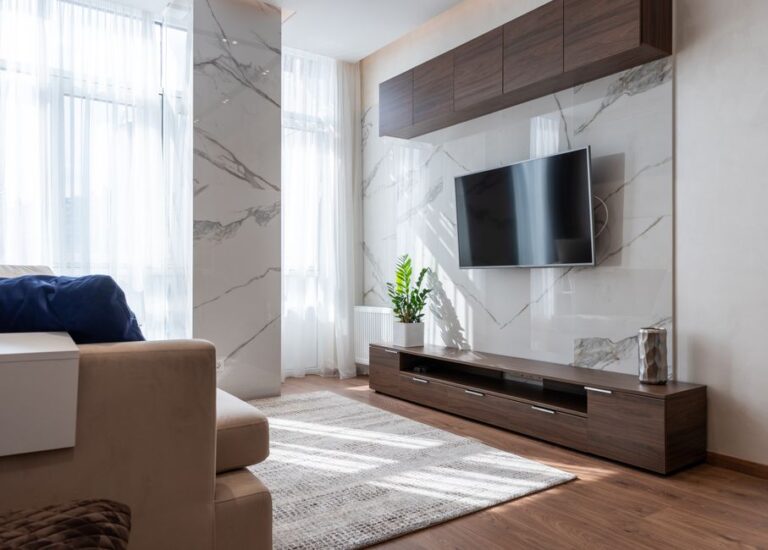
Freestanding credenza-style TV cabinets remain the standard for most hotel guest rooms because they double as luggage-height storage and are easier to service or replace during a future refresh without touching the wall finish. Wall-mounted or floating TV cabinet units are increasingly specified for boutique and higher-tier properties where floor space is at a premium or the design brief calls for a lighter visual footprint — but wall-mounted units require confirmed wall blocking or a mounting rail specification coordinated with the general contractor well before the furniture order is placed, since retrofitting blocking after drywall is closed up is a costly change order. Buyers should decide on mounting method during design development, not during furniture procurement, because it changes both the cabinet’s structural spec and the site coordination required.
Matching TV Cabinets Across Multiple Room Types in One Project
Projects with several room categories — standard king, double queen, suite — often want one consistent design language across all TV cabinets even though dimensions differ by room type. The most efficient way to achieve this is specifying one finish and hardware standard applied across a family of width variants (for example a 1,400mm, 1,600mm and 1,800mm version of the same design), rather than asking the factory to develop entirely separate designs per room type. This keeps tooling cost down and makes QC simpler, since inspectors are checking the same finish and hardware standard across every width variant rather than several unrelated designs.
Working with the Factory on Technical Drawings
TV cabinet quotes and tooling should always be based on dimensioned technical drawings rather than reference photos alone, specifically because the cable cutout, cord grommet position, and back panel access point cannot be accurately priced or tooled from a photo. Share your MEP (mechanical, electrical, plumbing) drawings showing outlet and cable point locations for each room type alongside the furniture drawing, so the factory can confirm cutout placement matches your actual in-room electrical rough-in before cutting the first prototype panel. Buyers who skip this step and rely on a generic factory-standard cutout position are the ones most likely to find a mismatch during on-site installation.
Confirming Fire and Emission Compliance Documentation
Beyond formaldehyde emission grade, some destination markets and hotel brand standards require additional fire-retardant certification on upholstered elements or specific finish coating compliance documentation. Confirm with your project’s fire marshal or brand standards manual what documentation is required before finalizing the factory’s finish specification, since retrofitting a compliant finish after production has started is far more disruptive than specifying it correctly from the first quote.
Comparing Quotes Across Different Factories
When comparing TV cabinet quotes from multiple factories, normalize the comparison against substrate grade, finish type, and hardware brand before comparing price — a quote using unbranded soft-close hardware and standard-grade MDF will always undercut a quote using name-brand hinges and moisture-resistant substrate, but the two are not the same product even if the rendering looks identical. Ask every factory to quote against the same written specification sheet rather than their own default assumptions, and request hardware brand and substrate grade in writing on the quote itself so the comparison is on equal terms.
Get a China Procurement Quote for Your TV Cabinet Order
If you are specifying TV cabinets for a hotel, apartment or serviced residence project, submit your drawings, room-type sizing schedule, quantity, destination port and project timeline through FBM Sourcing’s China procurement inquiry page. As your sourcing agent, we handle factory selection, sample approval, quality control and container consolidation from first drawing to site delivery.