
Furniture procurement cost from China is best estimated as a landed-cost structure, not a factory price: the ex-factory (FOB) value is the base, and ocean freight, destination port charges, import duty and inland delivery are added on top. For suppliers you nominate, we charge a 5% commission; for products we source for you, we quote a direct price. How much the layers beyond the FOB value add depends on the product mix, container count, route and destination duty, so each is budgeted as its own line. This guide walks through each cost layer, how the proportions relate to one another, and where budgets most often go wrong.
The audience here is project buyers — hotel developers, apartment builders, main contractors and FF&E contractors — comparing China factory quotations against local procurement budgets. If you want the full engagement model behind these numbers, start with our China building materials and FF&E procurement service.
What Makes Up the Landed Cost of Furniture from China?
Every China procurement budget resolves into the same seven layers. Getting the structure right matters more than any single line item, because the layers scale differently: some track FOB value, some track container count, and some are fixed per shipment.
- Factory (FOB) price — the goods produced, export-packed and loaded at a Chinese port. This is the base that every other layer is added to.
- Sourcing agent fee — for suppliers you nominate, we charge a 5% commission; for products we source for you, we quote a direct price.
- Ocean freight — priced per container, so it scales with cubic volume, not with product value. The container count comes from a cubic-metre loading plan for your package.
- Destination port charges — handling, storage and customs brokerage, charged per container and per shipment regardless of what is inside.
- Import duty — a percentage of declared value that varies by HS code and destination; confirm the rate for each HS code, including any free trade agreement preference such as ChAFTA for Australia.
- Inland delivery — port to site or staging warehouse, scaling with distance and site access constraints.
- Samples and destination testing — a small but real layer for any package with fire-rated, formaldehyde-regulated or performance-certified products.
One budgeting error is treating the FOB quotation as the delivered price. Another is comparing quotations that were never on the same basis to begin with — which is the next section.
How Do You Compare Factory Quotations on the Same Basis?
Two quotations for the same furniture package can differ substantially and both be “correct,” because Chinese factories quote on different terms unless instructed otherwise. Before any comparison, force every quotation onto the same footing:
- Same Incoterm. An EXW quote excludes export packing, domestic trucking and port loading; an FOB quote includes them. Comparing EXW against FOB systematically flatters the EXW factory. Our guide to FOB vs CIF vs DDP for China imports covers which term suits which project setup.
- Same specification. Board grade, veneer species, foam density, hardware brand and finish system must be identical line by line. An unexplained price gap is usually a specification gap.
- Same packing standard. Export-grade five-ply cartons with corner protection cost more than domestic-market packing — and weak packing converts a freight saving into a damage claim.
- Same scope. Confirm whether installation hardware, spare stock, assembly instructions and carton labelling by room type are included.
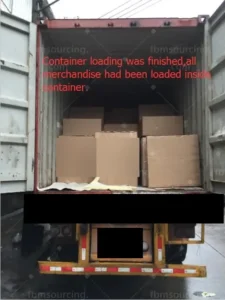
One hard planning constant sits underneath all freight comparisons: a container has a fixed internal volume, and your packing plan decides how much of it is usable. Any quotation that implies a container count should be checked against a cubic-metre schedule per room type — the method is in our FF&E container planning guide. An under-loaded container spreads the same freight cost over fewer goods, which quietly inflates per-unit landed cost.
What Does a Sourcing Agent’s Fee Cover?
For project-scale orders, FBM Sourcing quotes products it sources at a direct price and charges a 5% commission for suppliers you nominate. The fee covers the work that determines whether the rest of the budget performs: matching the specification to factories that can actually produce it, managing quotations onto a comparable basis, coordinating samples, monitoring production, inspecting quality before shipment, and planning consolidation and container loading across multiple factories. On FBM Sourcing projects, quality control is one inspection by our own team at the factory after bulk production is complete and before shipment, documented in photo and video records delivered to the client; you are welcome to join that inspection.
The full fee logic is broken down in how much a China sourcing agent costs.
Sourcing this for a commercial project?
FBM Sourcing works with project owners, developers, main contractors and FF&E contractors on hotel, apartment, school, office and other commercial building projects. Send us your BOQ, drawings or product list — our team will review it and get back to you.
How Much Does Ocean Freight Add — and What Actually Drives It?
Ocean freight is the most volatile layer of the structure, so budget it in relative terms rather than fixed numbers. Three drivers determine what your project pays:
Container count, not product value. Freight is charged per box. Knock-down casegoods and compressed mattresses can cut container count substantially versus assembled shipping, which is why packing decisions are freight decisions. Bulky, low-value items (sofas, outdoor loungers) carry a proportionally higher freight share than dense flat-packed joinery.
Route and transit time. Sailing time is set by the carrier’s schedule for your route, plus customs and inland delivery. Longer routes generally cost more per container, and rates swing with season and market disruption — plan at the conservative end of current quotes and refresh the freight line shortly before booking.
Consolidation quality. A hotel package sourced from five or six factories only ships efficiently if one party plans the loading sequence, books the containers and fills them to plan. Fragmented shipping across factories multiplies both freight and destination charges.
Get freight and destination handling quoted for your actual container plan and route, and keep them as separate lines from the goods.
What About Import Duty, Port Charges and US Tariffs?
Every arriving container incurs destination handling, port storage and customs brokerage charges before duty is even considered — these are per-container and per-shipment costs that reward consolidated shipping. Import duty itself is a percentage of declared value set by HS code and destination country, and free trade agreements such as ChAFTA can change the rate for Australia. Confirm HS classification for every product category with a customs broker in the destination market before the budget is finalised — misclassification is a source of “surprise” duty.
For US-bound projects, the principle to hold onto is that tariff rate ≠ landed cost. A headline tariff percentage applies to the declared customs value and is only one layer in the structure above. The correct response to tariff uncertainty is not to abandon the sourcing route but to model the full landed cost per container and compare it against local procurement on the same specification — and to refresh that model as rates move, since the duty line is the only layer that changes by policy rather than by market.
For a line-by-line view of what the service fee actually pays for, see our breakdown of China sourcing agent fees.
Which Hidden Costs Break China Procurement Budgets?
The layers above are predictable. The costs that blow up budgets are the ones nobody itemised:
- Late specification changes. A finish or dimension change after sampling triggers sample remakes and can reset the production slot. Freeze the specification before deposit.
- Staggered factory completion. When one factory finishes weeks before another, finished goods sit in a consolidation warehouse — storage is a real line item on multi-factory packages without a coordinated production schedule.
- Rework and re-inspection. Defects found at final inspection cost little to fix in the factory; the hidden cost is schedule, if no correction window was planned before the vessel booking.
- Under-loaded containers. Shipping a part-filled container because nobody built a loading plan early is pure waste.
- Destination testing. Fire-rated products, formaldehyde-regulated panels (E1/E0, CARB, TSCA Title VI) and performance-certified items may need accredited laboratory test reports for the destination market — budget per product type, per standard, before ordering.
- Damage from weak packing. The cheapest packing quote is often the most expensive line in the whole budget once replacements and delays are counted.
A Worked Structure: From FOB Value to Landed Cost
Because freight and duty move, the durable way to budget is to list every layer as its own line against the FOB value and refresh the moving lines before booking:
- FOB value of the goods
- Sourcing agent fee — for suppliers you nominate, we charge a 5% commission; for products we source for you, we quote a direct price.
- Ocean freight (consolidated, full containers), quoted before shipment
- Destination port charges and customs brokerage
- Import duty (HS-code dependent; nil in duty-free categories)
- Inland delivery to site
- Samples and destination testing
- Landed total: the sum of the lines above
The gap between FOB and landed cost is easy to leave out of a first budget, and it is also the number that keeps the comparison honest: compare the landed total against a local quotation for the identical specification, never FOB against retail. To see the structure applied to a real shipped order, read the two-container UK villa furniture procurement case.
How Do You Get a Landed Cost Estimate for a Real Project?
Send the item list or BOQ, drawings or reference photos, quantities, destination port and target delivery window. With those inputs, FBM Sourcing builds the estimate in the same order as this article: comparable factory quotations, service fee, container plan, freight and destination cost lines, and the duty questions to resolve with your customs broker. Before committing, it is also worth reading what to watch out for when sourcing hotel furniture in China — most budget failures are process failures, not price failures.