Office workstation orders rarely arrive as a single unit. Most fit-out projects specify workstations in runs of 20, 50, or several hundred, spread across open-plan floors, call center clusters, or shared workspace layouts. For developers, general contractors, and FF&E procurement companies managing these projects, the real challenge is not finding a factory that makes desks — it is finding a furniture sourcing agent and sourcing partner who can keep laminate finish, frame color, and cable management consistent across an entire production run, then get the whole order through inspection and into a container on schedule.
This guide covers how a china sourcing agent manages office workstation procurement from specification through container loading, what typically goes wrong when buyers skip a sourcing agent and deal with factories directly, and how FBM Sourcing structures the process for commercial-scale orders.
Why Office Workstation Orders Need a Sourcing Agent, Not Just a Factory Quote
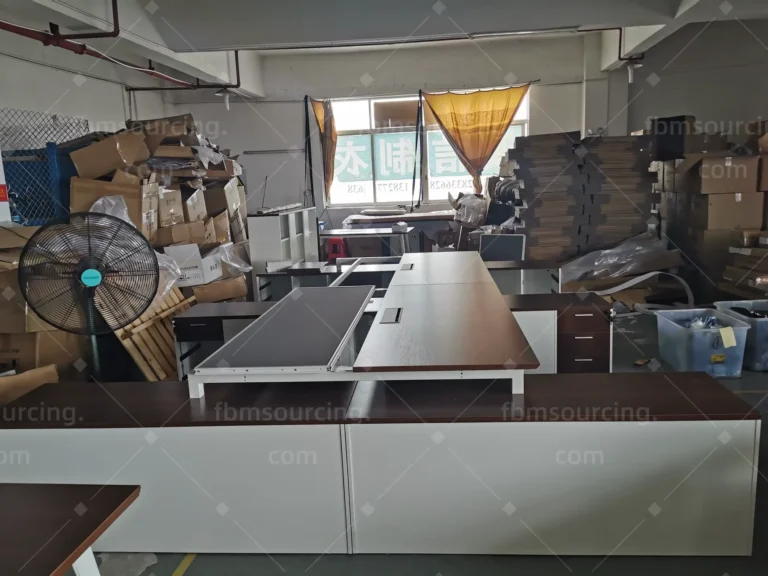
A single workstation is a simple product. A 60-unit workstation order for a three-floor office fit-out is a production and logistics problem. Every bench, panel, and leg frame in that order needs to match: same laminate batch, same powder-coat color, same cable grommet placement, same hardware. Factories quoting on a per-unit basis rarely flag these risks upfront, because their default answer to “can you do this” is almost always yes — the real question is whether they can do it consistently across the full quantity.
This is where a sourcing agent earns its role. FBM Sourcing does not manufacture workstations. Our value is in shortlisting factories with genuine export experience in commercial office furniture, managing sample approval so the whole team is working from one physical reference, and inspecting the finished run before it leaves China. For a project buyer managing a fit-out timeline against a lease handover date, this reduces the risk of arriving on site with 60 desks that do not all match.
What Changes Between a Retail Desk Supplier and a Project-Grade Factory
Many Chinese factories that list office workstations online are set up for small domestic retail orders, not export-scale commercial runs. The difference shows up in three places: material consistency across large batches, packaging designed for long-haul sea freight rather than local delivery, and willingness to accept agent-led inspection at the factory before shipment. A factory that cannot document its laminate supplier or powder-coat process is a higher risk for a 100-unit order, even if the sample looked acceptable.
Common Specification Gaps in Workstation Orders
Buyers frequently send a floor plan without specifying panel height, cable management style, or power module type, assuming these are standard. They are not. Panel height affects acoustic privacy and can vary by 100mm or more between factory default configurations. Cable management ranges from simple grommet holes to fully enclosed trunking with power modules built in, and each option has a different price and lead time. Confirming these details before quotation avoids receiving pricing that later needs to be revised once “hidden” specifications are clarified.
How FBM Sourcing Manages Office Workstation Procurement
Our process for office workstation orders follows the same discipline we apply across furniture and building material categories, adjusted for the scale typical of workstation runs.
Step 1: Specification Review
We start from your floor plan, workstation schedule, or CAD drawing set. We confirm total quantity, configuration mix (bench, panel-system, L-shaped, height-adjustable), laminate or finish codes, frame color, and cable/power requirements. Where drawings are incomplete, we flag the missing information before requesting quotations, so pricing from different factories can be compared on the same basis.
Step 2: Factory Shortlisting and Quotation Comparison
As a china sourcing agent, we maintain relationships with factories that have demonstrated export capability for commercial office furniture. We compare quotations not only on unit price but on laminate grade, frame gauge, hardware brand, and packaging method — because a cheaper quote using thinner laminate or unbranded cable grommets can create problems well after the deposit is paid.
Step 3: Sample Approval
Before mass production, we coordinate laminate swatches, edge-banding samples, and where the order size justifies it, a full sample workstation. This becomes the physical reference for every subsequent inspection. Approving a sample photo alone is a common shortcut that leads to disputes later, since photos do not reliably show texture, gloss level, or edge-banding quality.
Step 4: Production Tracking
During manufacturing we follow the production schedule with the factory. Quality is verified once production is finished: the pre-shipment inspection in Step 5 checks that the laminate batch and frame components on the actual order match the approved sample workstation, not just the sample unit shown at quotation stage.
Step 5: Pre-Shipment Inspection and Container Loading
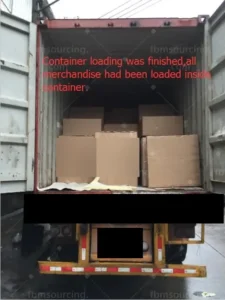
Before the order ships, we inspect a representative sample against AQL standards appropriate for commercial FF&E: panel-to-frame tolerance, laminate consistency, cable grommet fit, powder-coat finish, and packaging strength. We also confirm the container loading sequence, particularly when workstations are shipped alongside other office furniture categories such as office desks, office chairs, or filing cabinets, to avoid damage from mixed loading.
Sourcing this for a commercial project?
FBM Sourcing works with project owners, developers, main contractors and FF&E contractors on hotel, apartment, school, office and other commercial building projects. Send us your BOQ, drawings or product list — our team will review it and get back to you.
Consolidating Workstations with Other Office Furniture Categories
Most office fit-out projects need more than workstations. A single procurement schedule that includes desks, chairs, storage, and reception furniture is more efficient than managing four separate supplier relationships. FBM Sourcing consolidates related categories — including office reception sofas and office furniture more broadly — into one inspection and shipping schedule, which reduces the number of touchpoints a project buyer has to manage and keeps delivery dates aligned across categories.
This also matters for cost control. Combining workstation orders with other office furniture categories into fewer, fuller containers improves container utilization and reduces per-unit freight cost, particularly relevant for mid-size fit-out projects that do not have the volume to justify dedicated containers per product category.
Practical Guidance for Buyers Planning a Workstation Order
Before requesting quotations, confirm your total quantity and configuration mix, target laminate or finish palette, cable/power management requirements, and destination port. If drawings are not finalized, share your best estimate along with the project timeline — a sourcing agent can still begin factory shortlisting and flag specification questions in parallel with design finalization.
Timing also matters. Office workstation production, once specification and samples are approved, typically requires several weeks of manufacturing lead time before pre-shipment inspection and sea freight. Buyers who engage a sourcing agent early, before the fit-out schedule becomes urgent, have more room to compare factories properly rather than accepting the first available quotation under time pressure.
Cost Factors That Affect Office Workstation Pricing
Workstation pricing from Chinese factories is driven by more than the headline unit price. Laminate grade and thickness, frame gauge (steel or aluminum), powder-coat quality, cable management complexity, and whether the design is standard or requires custom tooling all move the number. Buyers comparing three quotations at very different price points are often comparing three different build specifications, not three prices for the same product.
Landed cost also includes elements that do not appear on a factory quotation: inland trucking to port, export documentation, sea freight, destination port handling, customs duties, and on-site assembly labor. For large workstation runs, container utilization has a meaningful effect on per-unit freight cost — a well-packed 40HQ container carrying workstations plus complementary office furniture will produce a lower landed cost per desk than a partially filled container of workstations alone.
We recommend evaluating workstation quotations on total project cost rather than unit price in isolation. A factory quoting a lower unit price but weaker packaging, less consistent laminate sourcing, or a longer defect-resolution process can end up costing more once replacement units, delays, and on-site rework are factored in.
Typical Timeline for an Office Workstation Order
A realistic timeline for a mid-size workstation order, from confirmed specification to goods arriving at destination port, typically spans several stages: specification and factory shortlisting, sample production and approval, mass production (the factory confirms its lead time in writing, depending on quantity and configuration complexity), pre-shipment inspection and documentation, and sea freight transit time, which the carrier confirms at booking. Buyers planning a fit-out around a lease handover date should build this full timeline into their project schedule rather than assuming production can start immediately after a quotation is accepted.
Office workstations are one of several categories typically consolidated into a single procurement program. For a full view of how meeting tables, storage cabinets, reception desks, and workstations are sourced together under one accountable partner, see our office furniture sourcing agent guide for multi-floor fit-outs.
The product-level specification detail — dimensions, panel systems, wiring options and finishes — is on our office workstation sourcing page.
Get a China Procurement Quote for Your Project
FBM Sourcing works with developers, general contractors, and FF&E procurement companies to source office workstations from China at commercial scale, with factory matching, sample coordination, quality inspection, and container consolidation managed end to end.
To get a sourcing plan for your workstation order, send your floor plan or workstation schedule, target quantity, finish preferences, destination port, and project timeline. Submit your project requirements and our team will respond with a procurement plan and preliminary cost framework.
Related reading