Gypsum ceilings are usually the largest single interior surface package on a commercial project — a 200-room hotel or a mid-size school easily spreads 15,000–25,000 square metres of ceiling across guest rooms, corridors, classrooms and public areas. The package is more than board: suspension grids, furring channels, access panels, moisture-resistant and fire-rated variants, and lay-in ceiling tiles all have to land on site as one compatible system. China produces every component of that system at scale, and because plasterboard is a heavy, low-value-per-kilo product, gypsum ceilings sourcing from China is won or lost on container planning as much as on factory price. FBM Sourcing runs the category as a building material sourcing agent and sourcing partner for commercial construction projects, packaging board, grid and accessories into one engineered shipment.
Gypsum Ceiling Types and Specifications for Commercial Projects
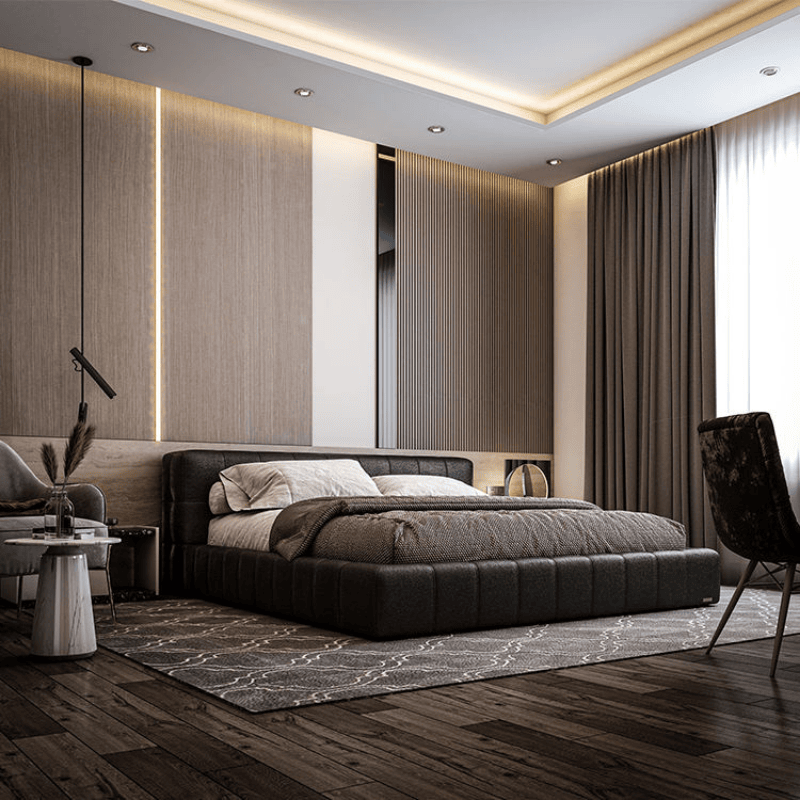
Commercial specifications generally draw from five system types. Suspended flush plasterboard ceilings — board screwed to a concealed furring-channel grid and jointed smooth — are the default for hotel rooms and corridors. Lay-in PVC-laminated gypsum tiles on an exposed T-grid, in 595 × 595 mm for 600 mm grids or 603 × 603 mm for 24-inch grids, dominate back-of-house, retail and office areas where ceiling access matters. Perforated acoustic gypsum panels reach noise reduction coefficients around NRC 0.70 with a backing fleece and are specified for classrooms, meeting rooms and restaurants. Moisture-resistant board goes into bathrooms and kitchens, and fire-rated board builds the rated ceilings and service shafts. The governing manufacturing standards are EN 520 in European-aligned markets and ASTM C1396 in North American ones, with standard thicknesses of 9.5, 12 and 15 mm. The gypsum core itself is non-combustible — classified A1 under EN 13501-1 and Class A under ASTM E84 — which is why plasterboard remains the fastest route to a fire-compliant ceiling. A 12 mm board weighs roughly 9–10 kg per square metre, a number that drives everything in the logistics section below. Ceiling systems are typically procured together with the wider ceiling and partition sourcing package so walls and ceilings share one grid and accessory logic.
Sourcing Process for Gypsum Ceilings from China
The order starts from your BOQ or reflected ceiling plans. FBM Sourcing’s team takes off square metres by area and system type, converts them into board counts, grid lengths, hanger and accessory quantities with a standard wastage allowance, and matches the specification — thickness, edge profile, moisture and fire class — to producers in the Guangdong building materials cluster around our Foshan base, the same cluster covered in our Foshan building material market guide. Physical sample panels and tile-and-grid mockups are approved before production. Manufacturing lead time for a standard commercial order is 15–25 days, among the shortest of any building material category. Container planning then does the real work: a 1200 × 2400 × 12 mm sheet weighs about 27 kg, so a 40-foot container reaches its payload limit at roughly 900–1,000 sheets — around 2,600–2,900 square metres — well before it runs out of space. Grid, tiles and lightweight accessories fill the remaining volume, which is why ceilings consolidate so efficiently with partitions, doors and other fit-out materials in a mixed-container program.
Quality Inspection Standards for Gypsum Ceiling Orders
Gypsum board rewards inspection because its defects are simple and visible. Before shipment, FBM Sourcing’s own team inspects at the factory: thickness checks with a gauge across sampled sheets, edge and corner integrity across pallets, surface flatness and paper-bond checks, spot weight checks as a proxy for core density, verification that moisture-resistant and fire-rated boards carry the correct facing color and edge marking so they cannot be confused on site, and grid checks covering coating quality and section dimensions. Packing is the second half of the inspection — gypsum is moisture-sensitive, so pallets must be verified for waterproof wrapping, corner protection and strapping suitable for humid sea transit, and tiles for face-protective interleaving. The whole inspection is carried out by our own team at the factory before shipment, documented with photos and video and delivered as part of the project record, the same discipline we apply on school and institutional programs like those in our guide to sourcing building materials for school construction.
Why Source Gypsum Ceilings Through FBM Sourcing
On a freight-heavy category, the landed cost is decided by how well the order is engineered: correct take-off, compatible board-and-grid system from matched producers, containers loaded to weight, and materials that arrive dry and unbroken. A sourcing agent adds exactly that layer. Because FBM Sourcing works as a china sourcing agent across the full project scope — ceilings, partitions, flooring, doors, lighting and FF&E — the ceiling package rides on one consolidated shipping program with the rest of the fit-out instead of paying for its own half-empty container. Hotels, apartment buildings, schools, offices and healthcare projects are the buyers this program is designed for.
Sourcing this for a commercial project?
FBM Sourcing works with project owners, developers, main contractors and FF&E contractors on hotel, apartment, school, office and other commercial building projects. Send us your BOQ, drawings or product list — our team will review it and get back to you.
Get a Quote for Your Project
Send us your ceiling BOQ or reflected ceiling plans with areas by system type, destination port and program dates. FBM Sourcing will return one quotation covering board specification, grid system, container plan and lead time. Start on our project inquiry page.