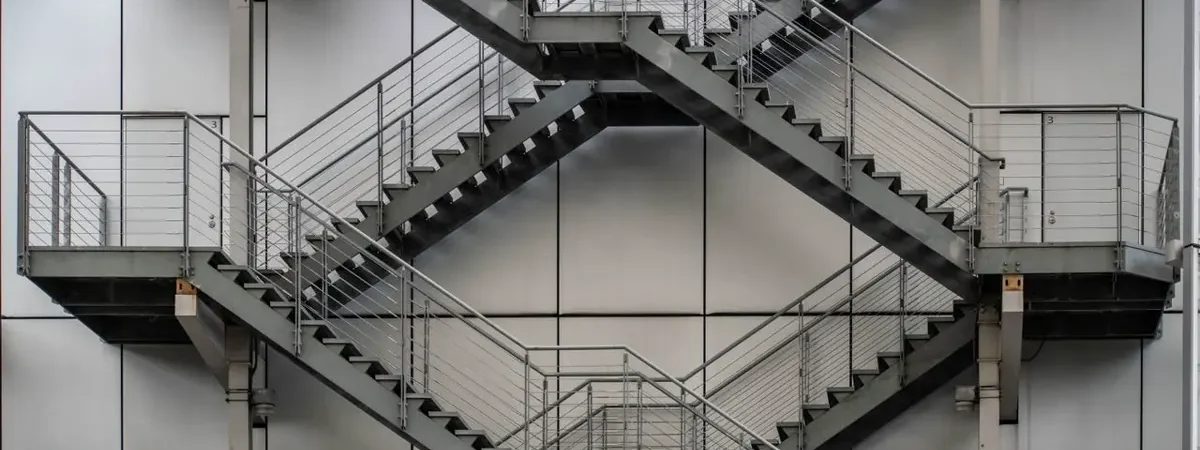
Metal stairs are one of the few building elements that are structure, life-safety system and architectural feature at the same time — and that combination is exactly why they get expensive when fabricated locally. A commercial project typically carries two distinct stair scopes: code-driven egress stairs in welded steel, repeated identically core after core, and one or two feature stairs in the lobby where the budget concentrates. Metal stairs sourcing from China gives commercial projects factory-direct access to both — certified structural fabrication for the egress cores and high-finish custom work for the feature stair — and FBM Sourcing manages the category as a building material sourcing agent and sourcing partner, from shop drawings through welding, finishing, trial assembly and container loading.
Types of Metal Stairs and Specifications for Commercial Projects
The workhorse of the category is the steel pan stair: stringers cut from 8–12 mm plate or channel sections, with folded steel tread pans filled on site with concrete or terrazzo. It is the standard egress solution for hotels, apartment towers, offices and car parks because it ships compact, erects fast and takes site tolerance well. Around it sit the other common types:
- Straight and switchback egress stairs — welded steel, pan or checker-plate treads, integrated landings and handrails
- Spiral and helical stairs — rolled stringers in steel, feature applications in lobbies, showrooms and duplex apartments
- Feature straight-flight stairs — plate stringers with timber, stone or glass tread inserts and glass or metal balustrades
- Industrial access stairs and platforms — galvanized steel with grating treads for plant rooms, roofs and back-of-house
- Exterior escape stairs — hot-dip galvanized assemblies designed for bolt-together site erection
Specification is geometry plus code. Riser and going dimensions must match the destination standard — IBC-referenced projects typically require risers no higher than 7 inches (178 mm) and treads no shallower than 11 inches (279 mm) for egress stairs, while Australian projects work to the NCC and AS 1657 for access stairs — and those numbers must be locked before fabrication, because a stair fabricated to the wrong rise cannot be adjusted on site. Structural steel fabrication standards travel with the order: EN 1090 execution classes for European-standard projects, AWS D1.1 welding for US-referenced work, and hot-dip galvanizing to ISO 1461 (typically 70–85 µm average coating) for exterior and egress applications.
How Does Metal Stair Sourcing from China Work?
Stairs are engineered-to-order, so the process runs on drawings rather than catalogues. From the architect’s stair sections and the structural engineer’s loading requirements, the factory develops fabrication shop drawings — stringer profiles, tread details, connection plates, anchor positions — which are reviewed and approved before any steel is cut. Native CAD files shorten this step considerably; see how we handle CAD and shop drawings as a china sourcing agent.
Two decisions made at this stage control cost and site programme. First, the splice strategy: flights and landings are designed to bolt together on site in container-sized modules, with splice positions agreed on the shop drawings — a full-height welded stair that cannot fit a 40ft container is a design error, not a shipping problem. Second, the finishing route: hot-dip galvanizing for egress and exterior stairs, duplex galvanize-plus-powder-coat where appearance matters, or fine-finished stainless and painted steel for feature stairs. For feature work, a sample tread-and-balustrade section is typically produced for sign-off before the full run — the same golden-sample discipline described in our sample approval guide.
Production for a typical multi-storey egress package runs 30–50 days from approved shop drawings, with trial assembly of at least the first flight-and-landing set in the factory to prove bolt-hole alignment before anything ships.
Quality Standards and Inspection
Stair quality is proven in the factory, not argued on site. FBM Sourcing’s own inspection team inspects the work before it ships: material verification against mill certificates, welding, dimensions and hole positions, and coating thickness readings, tread dimensions against the approved shop drawings and trial-assembly fit before loading. The inspection is documented in photos and video and delivered to the client’s project team, so the erector overseas knows the flights will bolt together before the container is opened. Welding qualifications and galvanizing certificates ship with the documentation package alongside the material certs — the paper trail an engineer of record expects to see. Lighter architectural elements such as cladding trims and feature frames are produced as aluminium fabrication in China rather than as fabricated steel.
Why Source Metal Stairs Through FBM Sourcing
Stairs sit at the junction of three trades — structural steel, architectural metalwork and balustrades — and buying them factory-direct means coordinating all three. As a building material sourcing agent we hold that coordination in one scope: the same package can carry the egress stairs, the feature stair, and the matching railing posts and railing hardware, produced to one finish standard and loaded in one container plan. Stair packages also consolidate naturally with doors, windows and other building materials in the wider project order — the logic covered in our full container consolidation guide — and for suppliers you nominate our commission is 5%, and products we source for you are quoted at a direct price on a scope we take full responsibility for, from shop drawing to delivered steel.
Sourcing this for a commercial project?
FBM Sourcing works with project owners, developers, main contractors and FF&E contractors on hotel, apartment, school, office and other commercial building projects. Send us your BOQ, drawings or product list — our team will review it and get back to you.
Get a Quote for Your Project
Send us your stair sections, structural requirements, storey count, finish intent, destination port and programme dates. FBM Sourcing will return shop-drawing-ready pricing for the egress and feature stair scopes, a finishing recommendation, a container and splice plan, and lead times — start on our project inquiry page.