Aluminum sunshades sourcing from China sits at the intersection of two things the country does at world scale: aluminium extrusion and architectural coating. External shading — fixed louvers, aerofoil blades, vertical fins, brise soleil screens, perforated panels — is increasingly written into commercial specifications not as decoration but as compliance, driven by energy codes and green-rating credits that reward solar load reduction on glazed facades. For a school, office building or hospital with hundreds of linear metres of shading, the gap between Chinese factory-gate pricing and domestic fabrication in Australia, North America or Europe is large enough to move the facade budget — provided the extrusion alloy, coating system and engineering support are specified with the same rigour as the curtain wall they attach to. This is exactly the kind of project FBM Sourcing, your China sourcing partner, is built to handle.
This is not a catalogue category. Almost every commercial sunshade package is project-specific: blade profiles chosen for sight lines and shading angles, brackets engineered to the structure behind them, panel perforation patterns cut to the architect’s artwork. That makes it a fabrication buy, not a product buy — and it is why working through a sourcing agent with people inside the Guangdong extrusion cluster changes the outcome. The factories that do this well are export-oriented facade fabricators sitting on top of the Foshan extrusion base; the factories that do it badly are extruders with a saw and optimism.
Sunshade Types and Specifications for Commercial Facades
Most commercial shading packages draw on five product families, frequently combined on one building:
- Fixed horizontal louvers and aerofoil blades — elliptical aerofoil profiles in 200 mm to 600 mm chord widths, single-span or continuous on aluminium carrier frames. The standard answer for north/south elevations (equator-facing glass) on offices and schools, mounted as horizontal eyebrow shades or full sunbreaker assemblies.
- Vertical fins — rectangular or aerofoil fins for east/west elevations where low-angle sun defeats horizontal shading; also the current architectural default for giving long apartment and office elevations rhythm and depth. Fins run structural sizes: 150–400 mm deep, spanning floor to floor with concealed fixings.
- Brise soleil systems — projecting frame-and-blade assemblies at roof or floor line, typically cantilevered 600–1,500 mm, engineered as a system with brackets, arms and blades from one fabricator.
- Perforated and folded panels — CNC-punched or laser-cut sheet in 2–3 mm aluminium, flat or folded, with custom perforation patterns and graduated open-area percentages. Popular on car parks, hospitals and school facades where shading, ventilation and screening combine.
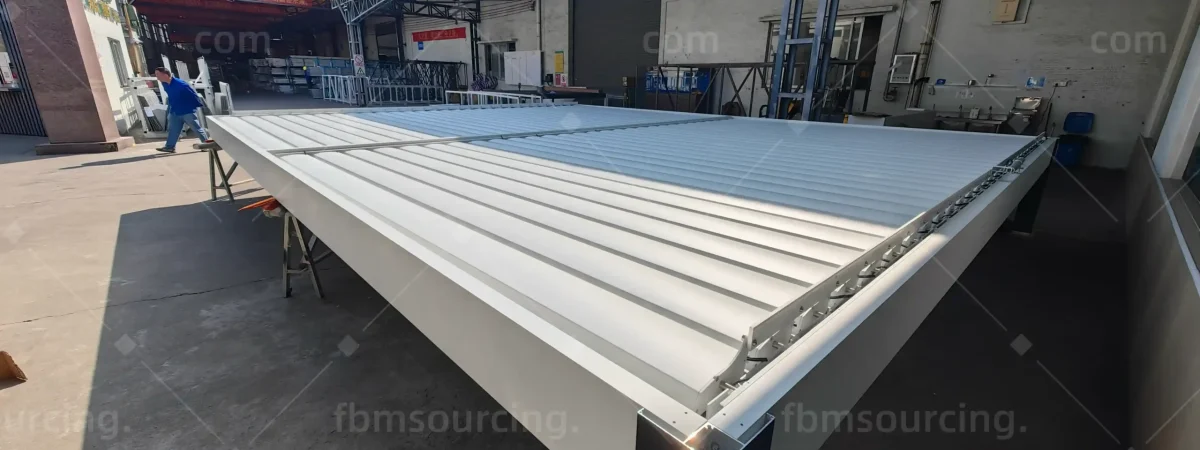
- Operable louvers — motorised aerofoil systems where the specification demands active solar control; these carry a controls scope and deserve a separate conversation early.
The base material for blades and fins is extruded 6063-T5 (6061-T6 where spans or wind pressures push structural demand), with wall thicknesses of 1.5–2.5 mm typical for aerofoil blades and heavier sections for structural fins and carriers. Brackets and anchors are aluminium or hot-dip galvanised steel, with stainless fasteners and isolation between dissimilar metals — a detail cheap fabricators skip and coastal buildings pay for.
Finish is the second half of the specification, and it is where facade packages are won and lost:
- Powder coating — the volume answer. For commercial facades, specify the coating class explicitly: AAMA 2604 (roughly equivalent to Qualicoat Class 2) for standard commercial exposure, AAMA 2605 (superior performing) PVDF-grade systems for premium and coastal work, with the strongest gloss and colour retention of the AAMA grades. Ask for the powder brand and batch traceability, and for coastal projects insist on certified pre-treatment — the coating fails at the pre-treatment line, not the spray booth. The Qualicoat specification is the cleanest common language for licensed applicators and testing.
- Anodizing — AA15 to AA25 class (15–25 micron) for the natural-metal architectural look and superior abrasion resistance. Colour consistency across production batches is the known risk; it is managed by ordering full elevations from single anodising runs and approving a light/dark range sample, not a single swatch.
Shading is also an engineering deliverable. A serious fabricator provides shop drawings from your architectural intent, blade and bracket structural calculations against the project wind loads, and deflection checks on spans — and will tell you when a 400 mm blade at 1,800 mm centres needs an intermediate carrier. If a quotation arrives without questions about wind pressure and fixing substrate, that is the quotation to discard.
Sourcing this for a commercial project?
FBM Sourcing works with project owners, developers, main contractors and FF&E contractors on hotel, apartment, school, office and other commercial building projects. Send us your BOQ, drawings or product list — our team will review it and get back to you.
How Aluminum Sunshade Sourcing from China Works
The supply base concentrates around Foshan — the Dali/Nanhai extrusion cluster produces a large share of the world’s architectural aluminium — with facade fabricators across the Pearl River Delta converting extrusion into engineered shading systems. Many of these plants sit alongside the window and curtain-wall factories profiled in our review of the top aluminum window and door manufacturers in China, and on projects buying both, shading and glazing should be coordinated as one aluminium package: same coater, same colour batch, one set of site tolerances. A visit through the Foshan building material market shows the range; separating fabricators with facade engineering capability from profile traders is what a building material sourcing agent does on the ground.
The procurement sequence for a shading package:
- Design package review. You send elevations, shading details or the architect’s intent drawings plus the wind load basis. We flag span problems, coating class against exposure, and whether the geometry suits extrusion or fabricated sheet.
- Fabricator shortlisting and quotation. Quotes are broken down by profile weight, coating system and brand, brackets and fixings, and engineering deliverables — so a 2.0 mm AAMA 2605 aerofoil is never compared against a 1.4 mm commodity-powder blade on lump sum.
- Shop drawings and samples. The fabricator produces shop drawings for approval; blade samples in the specified finish (and an anodising range sample where relevant) go to the design team. For perforated panels, a full-size pattern sample panel is worth its freight many times over.
- Production and QC. A typical commercial package — extrusion, fabrication, coating, assembly — starts after shop drawing approval, on a lead time confirmed by the factory in writing for each order. Coating certificates, film thickness and dimensional checks are covered below.
- Packing and shipping. Finished blades travel with interleaving and edge protection, crated or racked by elevation and install sequence. Loading efficiency depends on profile, but a 40HQ typically carries 1,500–2,000 linear metres of assembled aerofoil louvers. Export runs through our shipping agent in Guangzhou, with shading sequenced against the facade programme rather than dumped on site in one delivery.
Quality Standards and Inspection
There is no single “sunshade certificate”; quality is verified through the coating system, the material, and the engineering paper trail:
- Coating compliance — applicator’s Qualicoat licence or AAMA 2604/2605 test reports for the specific powder system, plus batch certificates for the powder actually used on your order.
- Film thickness — measured on production parts, not samples: 60–80 micron minimum for standard powder, per specification for PVDF-grade systems; anodic film thickness verified by eddy-current gauge for anodised work.
- Alloy and temper — mill certificates for the billet, and hardness spot checks where structural fins carry load.
- Dimensional and visual QC — blade straightness and twist per length, cut length against the shop drawings, perforation pattern verification against approved artwork, colour check against the retained approval sample under daylight, and fastener/isolation completeness on assembled units.
- Engineering documentation — stamped-ready calculation packages and test data your facade engineer can review, because the shading attaches to someone’s certified structure.
Packing inspection matters more here than in most categories: powder-coated aerofoil blades that chatter against each other at sea arrive as touch-up work. We sign off the crating method on the first container and hold subsequent shipments to it.
Why Source Aluminum Sunshades Through FBM Sourcing
- Fabricators, not traders. We qualify plants on engineering output — shop drawings, calculations, coating traceability — inside the Foshan cluster where the real capability sits, as part of our wider sunshade sourcing scope.
- One aluminium package. Shading coordinated with windows and curtain wall from the same coating batch where the project buys both — one colour, one tolerance regime, one consolidated shipment.
- Coating diligence. Powder brand, class certificates and film thickness verified on production, because facade coatings fail slowly and expensively.
- Programme-sequenced delivery. Containers packed by elevation and released against the facade installation sequence, not the factory’s convenience.
- Landed-cost honesty. Freight on long, light, crated goods is a real fraction of this category’s cost; sea freight is quoted before shipment.
On a school or office facade, the difference shows up as blades that arrive straight, in sequence, in one colour, with calculations the facade engineer signs without a fight. That is what aluminum sunshades sourcing from China looks like when a china sourcing agent runs it as an engineered package rather than a commodity buy.
Get a Quote for Your Project
If your office, school, hospital or apartment project carries an external shading package, send us the elevations or shading details, approximate linear metres or panel areas, finish specification, wind load basis if available, destination port and programme dates. our team will review your requirements and get back to you. Submit your project details through our China building materials and FF&E procurement page and our team will review it and get back to you.