Frameless glass only works because of the metal that holds it: patch fittings on the lobby door, clamps on the balustrade, hinges on the shower door, spider fittings on the facade. The glass itself is a commodity — the hardware is where load, corrosion resistance and finish quality live, and where a cheap casting announces itself with tea-stained pitting a year after handover. Glass hardware sourcing from China gives commercial projects factory-direct access to the full fitting range in genuine 304 and 316 stainless, and FBM Sourcing manages the category as a building material sourcing agent and sourcing partner — usually inside the same package as the glass systems the fittings serve, from shower enclosures to balustrades to point-fixed facades.
Types of Glass Hardware and Specifications for Commercial Projects
Project glass hardware falls into five working families:
- Patch fittings and floor springs — corner patches, over-panel patches and lock patches for frameless entrance doors, paired with floor-mounted door closers
- Glass clamps and standoffs — D-clamps and square clamps for balustrade infill, adjustable standoff pins for point-fixed balustrades and signage
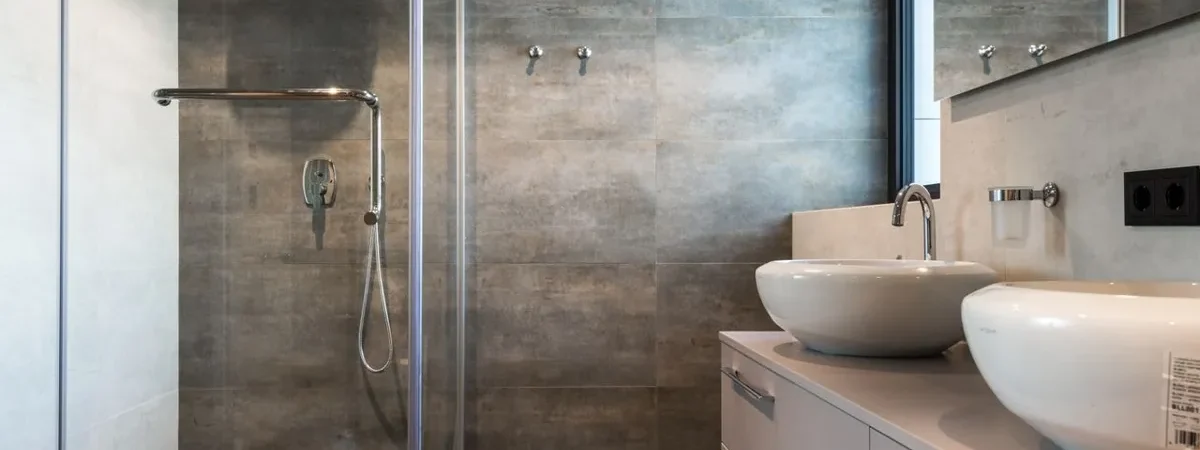
- Shower hardware — wall-to-glass and glass-to-glass hinges, header kits, sliding shower systems, knobs, towel bars and channel seals
- Spider fittings and tension systems — one- to four-arm spiders with swivel-head routel bolts for point-supported facades and canopies
- Sliding and partition hardware — top-hung rollers, guides and locking rails for frameless glass partitions and shopfronts
Two numbers govern almost every selection: glass thickness and steel grade. Fittings are machined for specific tempered glass thicknesses — 8, 10 and 12 mm cover most door, shower and balustrade work — and the glass itself should be specified to EN 12150 or ANSI Z97.1, the safety-glass standards unpacked in our guide to glass safety standards for projects. Steel grade follows exposure: 304 stainless for dry interiors, 316 for bathrooms, pools, coastal buildings and all exterior work — and it should be solid cast or machined stainless, not zinc alloy under a stainless-effect plating, which is the standard cost-cut in commodity fittings. Shower hinges carry door-weight ratings, typically 40–50 kg per pair for a 10 mm door; floor springs should be specified to EN 1154 with adjustable closing force; and spider systems need their routel bolts matched to the facade engineer’s load calculations, not bought generically.
How Does Glass Hardware Sourcing from China Work?
The clean route is to buy hardware and glass as one engineered scope. From the architect’s elevations FBM Sourcing builds a fitting schedule — fitting type, glass thickness, steel grade, finish, quantity per location — and prices it factory-direct alongside the glass packages it serves: the route already described for shower enclosures, frameless glass railings and glass partitions. Physical samples of each fitting type are approved before production — weight in the hand, finish match between brushed components from different tools, and damping feel on hinges are things a data sheet cannot settle.
Production for a project fitting package runs 15–30 days after sample approval. Hardware ships boxed by fitting type and labelled by location, and consolidates into the containers carrying the project’s glass, sanitary ware or wider building material order — a few cubic metres of dense cargo that costs almost nothing to move when the container is already booked. Buying fittings and glass through one agent also closes the classic interface failure: holes drilled by the glass factory that don’t match the fittings bought elsewhere.
Quality Standards and Inspection
FBM Sourcing’s own inspection team checks glass hardware in the factory before it ships. Material verification comes first — grade markings and, where specified, spectrometer certificates for 316 components — because grade substitution is invisible to the eye. Batch samples are then checked for casting quality, thread engagement, gasket completeness and finish consistency; hinges and floor springs are function-tested; and packing is verified against the location labelling. Where fittings ship pre-installed on glass assemblies, the team checks torque, alignment and edge clearances during the glass inspection. The inspection is documented in photos and video and delivered to the client’s project team.
Why Source Glass Hardware Through FBM Sourcing
Glass hardware belongs inside the glass package, and the glass package belongs inside the project order. As a building material sourcing agent FBM Sourcing carries all three levels at once — fittings matched to glass, glass matched to the specification standards covered in our guide to specifying glass balustrades from China, and the whole scope consolidated with the project’s doors, sanitary ware and building materials — on a 5% commission for suppliers you nominate (products we source for you are quoted at a direct price), with one party accountable from fitting schedule to installed glass.
Sourcing this for a commercial project?
FBM Sourcing works with project owners, developers, main contractors and FF&E contractors on hotel, apartment, school, office and other commercial building projects. Send us your BOQ, drawings or product list — our team will review it and get back to you.
Get a Quote for Your Project
Send us your elevations or glass schedule, fitting locations, glass thicknesses, exposure conditions, destination port and programme dates. FBM Sourcing will return a priced fitting schedule, steel-grade recommendations by area, a sample plan and a consolidation route — start on our project inquiry page.