Handrail systems sourcing from China covers the wall-mounted and post-mounted grab rails that run through every commercial building — corridor handrails in hotels and hospitals, stair handrails in apartment towers and schools, ramp rails at entries, and LED-integrated handrails on feature stairs and external steps. As a building material sourcing agent and sourcing partner for developers, contractors and FF&E companies, FBM Sourcing procures complete handrail packages from Guangdong metalwork factories: tube, brackets, bends, terminations and fixings, fabricated to your stair and corridor drawings, inspected at the factory and consolidated with the rest of your materials. Handrail looks like a simple product until a project needs three kilometres of it in four finishes across two code regimes — which is when it becomes a procurement exercise.
Handrail System Types and Compliance Specifications
Commercial handrail packages typically combine several systems. Stainless steel tube handrails — 38–50 mm diameter tube in grade 304, or 316 for coastal and external work, on cast or fabricated wall brackets — are the standard for stairs, ramps and corridors in hotels and offices, in satin, mirror or PVD-coloured finishes. Powder-coated steel and aluminum handrails serve schools, car parks and back-of-house circulation at a lower cost point. Timber-top handrails — oak or ash profiles on a steel core rail — carry the hospitality warmth brief in lobbies and feature stairs. Healthcare and aged-care systems add continuous PVC-sleeved crash-rail-and-handrail combinations with antimicrobial finishes and anti-ligature detailing. LED handrails integrate strip lighting and drivers into the underside of the tube for external steps, cinemas and hotel exteriors.
Accessibility geometry drives the fabrication drawings. For US projects, ADA design standards require a graspable circular section of roughly 32–51 mm (1¼–2 in) diameter, mounting height of 34–38 in (865–965 mm), 1½ in clear wall clearance, continuous rails with returns to the wall, and horizontal extensions at the top and bottom of stair flights. Australian and European projects carry equivalent rules with different numbers. These details — extension lengths, bracket positions clear of the grip zone, return radii — are exactly what a factory pattern won’t include unless your china sourcing agent writes them into the approved shop drawings.
How Handrail Systems Sourcing from China Works
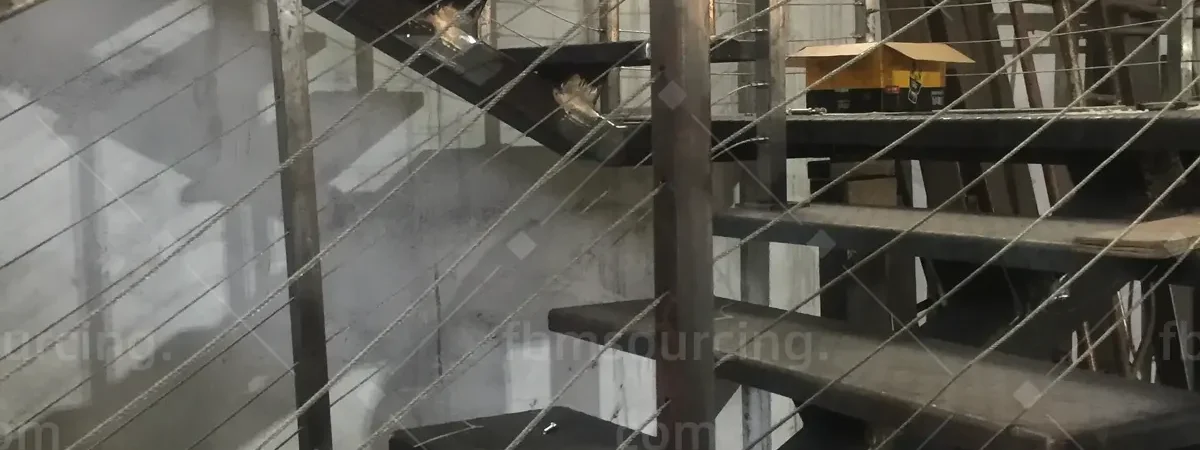
The package starts from your stair sections, corridor elevations and door schedule ancillaries — or a BOQ linear-metre count by area and finish. FBM Sourcing breaks this into a fabrication schedule: straight runs, factory-formed bends and ramps, wall returns, terminations and bracket counts per level. We then match the schedule to factories by system — a stainless tube specialist for the public areas, a powder-coating line for back-of-house, an LED handrail factory where the design calls for it — usually two factories under one programme, the same structure we run for full railing sourcing packages.
Sample approval covers a bracket with fixing set, a finished tube section per finish, a formed bend, and a working LED section with driver where applicable. The factory confirms the production lead time in writing; long runs ship as straight lengths with factory-formed corner and transition pieces, labelled by level and corridor reference so site crews assemble rather than fabricate.
Sourcing this for a commercial project?
FBM Sourcing works with project owners, developers, main contractors and FF&E contractors on hotel, apartment, school, office and other commercial building projects. Send us your BOQ, drawings or product list — our team will review it and get back to you.
Quality Standards and Inspection for China-Made Handrails
Handrail QC is a finish-and-fixing discipline. At the full inspection before shipment we verify: weld and polish quality — joints blended to a uniform 320-grit satin or mirror finish with no visible weld line at eye height, the single most common defect in exported handrail; material grade — spectrometer spot-checks that 316 is not substituted with 304 on external and coastal orders, the same verification we run on stainless steel railing; bracket integrity — casting quality, thread engagement and pull-off spot tests on sample brackets; geometry — tube diameter, bend radii, extension lengths and bracket centres measured against approved drawings; and for LED systems, IP rating and electrical certification of strips and drivers with a burn-in test before packing. Coated rails are checked for 60–80 µm powder thickness and packed with foam sleeving so finishes arrive unmarked.
Every order closes with a photo inspection report keyed to your fabrication schedule, issued before crating — so any reject is re-worked in the factory, not argued about on site.
What Drives the Cost of a Handrail Package?
Handrail budgets are dominated by finish labour rather than raw material. Grade and finish lead the list: satin 304 tube is the baseline, 316 adds a corrosion premium for external and coastal work, mirror polish and PVD colour finishes (black, bronze, brass tones) add polishing and coating labour that can double the per-metre rate on public-area rails. Bracket specification is the quiet cost line — cast stainless brackets with concealed fixings cost several times a standard fabricated bracket, and a hotel corridor package can carry thousands of them, so bracket selection often moves the budget more than tube diameter does. Formed components — bends, ramps, wall returns, helical sections for curved stairs — price as fabrication one-offs, which is why we schedule straight runs with factory-formed transition pieces rather than shipping fully welded assemblies. LED integration adds strips, drivers, machining and certification, and brings an electrical QC scope with it. As with every metalwork line, consolidation into the project’s main container programme — alongside stair guards, balustrade and doors — is what keeps landed cost competitive against local supply.
Lead time for a commercial handrail package is confirmed by the factory in writing; mirror and PVD finishes take longer because polishing is sequential labour that cannot be compressed by adding machines. Sea freight transit time is confirmed by the carrier at booking. For phased handovers we ship by level or building wing, with each crate labelled to corridor and stair references so the site team installs directly from the packing list. Allow time for sample sign-off — bracket, finish and bend samples — before production release; on handrail, the finish sample is the contract.
Why Source Handrail Systems Through FBM Sourcing
Handrail is rarely a standalone shipment — it belongs inside a wider stair and balustrade package. Because FBM Sourcing is a sourcing agent rather than a single factory, we procure your handrail together with stair railing, balcony balustrade and architectural metalwork, hold every factory to one drawing-approval and inspection standard, and consolidate the lot into your project containers. On a five-star hotel building materials project in a hurricane zone, handrail and guard systems moved through the same programme as doors, tiles and exterior metalwork — one responsible team, one QC standard, one shipping plan. That consolidation is routinely the difference between handrail landing at your site cost-effectively and it travelling as an expensive part-load on its own.
Get a Quote for Your Handrail Package
If your hotel, apartment, school, healthcare or office project needs commercial handrail systems, send your stair and corridor drawings or BOQ, approximate linear metres by finish, destination port and programme dates via our China building materials procurement page, WhatsApp, or [email protected]. Our team will review it and get back to you — from a team that runs handrail systems sourcing from China as part of complete building packages every month.