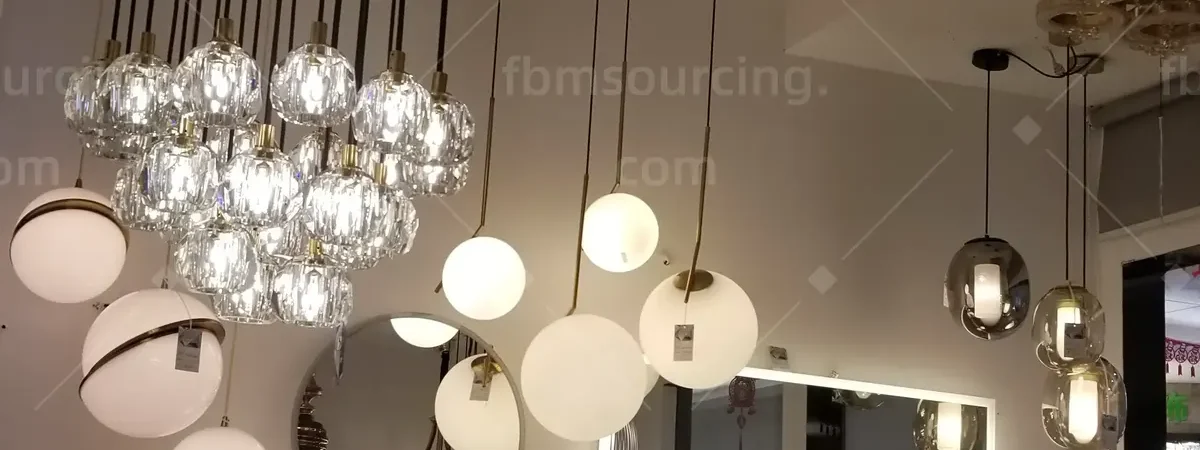
Indoor lighting is one of the highest-leverage packages a commercial project can move to China, because the world’s decorative and architectural lighting industry is concentrated in one region: Zhongshan’s Guzhen district and the surrounding Pearl River Delta produce the majority of global decorative lighting output, within a two-hour drive of FBM Sourcing’s base in Foshan. Indoor lighting sourcing from China through a sourcing agent and sourcing partner lets a hotel, apartment or office project buy chandeliers, downlights, wall lights and custom feature pieces factory-direct — specified to the destination’s electrical certification regime and consolidated into the same containers as the project’s furniture and building materials. The orders that suit this route are project-shaped: a 120-room hotel with a full guest-room lighting schedule, a 179-unit apartment development standardizing fittings across every plan type, or an office fit-out putting linear LED and feature pendants through one procurement channel.
Key numbers a specifier should hold before requesting quotes:
- Production lead time: 20–35 days for a mixed indoor lighting package after sample sign-off; large custom chandeliers 35–45 days
- Certification by destination: UL or ETL listing for the US, CE and ENEC for Europe, SAA/RCM for Australia
- LED performance: CRI ≥90 for hospitality interiors, L70 lumen maintenance of 50,000 hours on quality drivers, LM-80 test data on the chip
- Color consistency: 3-step MacAdam ellipse binning across a batch keeps a corridor of downlights visually uniform
- FBM Sourcing agency fee: a 5% commission for suppliers you nominate (direct price for products we source)
Indoor Lighting Types for Commercial Projects
A commercial lighting schedule mixes decorative and architectural product, and in China these come from different factory ecosystems — another reason a single project channel matters.
| Category | Typical Commercial Use | Key Specification Points |
|---|---|---|
| Chandeliers and feature pendants | Hotel lobbies, restaurants, stair voids | Custom sizes to 3 m+, glass/crystal/brass finishes, engineered hanging systems for site assembly |
| Guest room and apartment sets | Hotels, serviced apartments, multi-unit residential | Coordinated pendant, table, floor and wall fittings per room type; one finish standard across hundreds of rooms |
| Recessed downlights and spots | Corridors, lobbies, retail, offices | CRI ≥90, UGR <19 for work areas, 3-step MacAdam binning, IC-rated housings where required |
| Linear LED and profile systems | Offices, reception features, coves | Aluminum profiles cut to schedule lengths, 120 lm/W-class efficacy, flicker-free drivers |
| Wall lights and sconces | Corridors, guest rooms, F&B areas | Hard-wired to destination code, integrated or replaceable LED, custom finishes to match FF&E |
| Panel and troffer lighting | Back-of-house, offices, schools | 595×595 / 1,200×300 modules, DALI or 0–10 V dimming options |
Custom and project-matched fittings
The practical advantage of Guzhen-region factories is customization at production prices: a designer’s sketch of a lobby feature piece can be engineered, sampled and produced without the boutique premium the same drawing would carry in Europe or North America. Finishes are matched across categories — the brushed-brass tone on a guest-room wall light can be held on the corridor sconces and the restaurant pendants — and FBM Sourcing manages that finish control with physical approval samples, the same way it runs finish standards on hotel furniture packages that ship in the same containers.
Hotel projects add one more layer: brand standards. Flagged properties typically require the operator’s sign-off on guest-room lighting — color temperature bands (usually 2,700–3,000 K in rooms), switching logic and bedside control — and the approval submission has to carry the fitting’s photometric data and certification evidence in the operator’s format. FBM Sourcing assembles that submission package from the factory documentation as part of the sampling stage, so brand approval runs in parallel with golden-sample sign-off instead of adding weeks after it. Attic stock is handled the same disciplined way: a 3–5% spares allowance on decorative fittings and a driver-and-lamp spares kit per room type, agreed at order stage and shipped in the project containers.
Sourcing Process for Indoor Lighting from China
Lighting procurement runs on a documented sequence that slots into a construction or FF&E program.
- Inquiry. Send the lighting schedule, interior design references or a room-by-room fixture count, with destination country stated up front — certification regime shapes the factory shortlist more than any other single factor.
- Factory comparison — 5–7 days. FBM Sourcing prices the schedule across vetted factories in the relevant specializations — decorative, architectural, linear — and returns a normalized comparison: LED chip brand, driver origin, certification status, finish system.
- Sampling — 10–15 days. Golden samples of the key fittings are approved for finish, color temperature and build quality. For guest-room programs, one full room set is sampled and signed off before the batch is released; that set becomes the enforceable QC standard.
- Production — 20–35 days. Standard architectural product sits at the short end; custom chandeliers and long finish-matched sets run 35–45 days.
- Inspection and shipping. Pre-shipment QC (below), then export packing and consolidation. Lighting rarely ships alone: FBM Sourcing loads it with the project’s furniture, sanitary ware and building materials so a mixed order fills containers efficiently. Ocean transit runs 18–22 days to the US West Coast, 28–35 days to the East Coast, and 12–18 days to Australian ports.
End to end, a project that approves samples promptly can hold a complete indoor lighting package on site within 9–12 weeks of first inquiry — a schedule FBM Sourcing has run on live hospitality work, including a five-star hotel project in a hurricane zone where lighting shipped alongside the wider materials package.
Quality Standards, Certification and Inspection
Lighting is electrical product, and the certification question is binary: a fitting either carries the destination’s required marks or it cannot legally be installed. This is where an experienced agent earns the fee.
Sourcing this for a commercial project?
FBM Sourcing works with project owners, developers, main contractors and FF&E contractors on hotel, apartment, school, office and other commercial building projects. Send us your BOQ, drawings or product list — our team will review it and get back to you.
Certification by destination. US projects need UL or ETL listed fittings — and for recessed products, the correct listing category for the installation condition; Canada adds cUL/cETL. European projects require CE marking under the Low Voltage and EMC directives, with ENEC as the stronger third-party mark specifiers increasingly demand. Australian and New Zealand projects require SAA approval and RCM marking. FBM Sourcing verifies certificates against the certifier’s database — certificate numbers that do not match the issuing body’s records are a known failure mode in the lighting trade, and catching one at shortlist stage costs nothing; catching it at customs costs the program.
Photometric and electrical checks. Batch inspection measures color temperature against the approved sample (within a 3-step MacAdam ellipse), verifies CRI against the datasheet, checks driver labeling for destination voltage — 120 V/60 Hz for North America, 230 V/50 Hz for Europe and Australia — and confirms dimming compatibility (TRIAC, DALI or 0–10 V) against the project’s controls specification. Flicker performance matters in hospitality and residential settings; quality drivers should show <1% flicker at full output.
Build and finish. Fittings are checked against the golden sample for finish tone, weld and casting quality, glass clarity and hardware completeness. Chandelier hanging systems are load-checked and packed with assembly drawings keyed to each piece.
Packing. Glass and crystal components ship in divided, double-walled cartons with per-room labeling on guest-room programs, so site distribution runs by label rather than by opening boxes. A 5% overage on small fragile components is standard practice and is agreed at order stage, not negotiated after a breakage claim.
Why Source Indoor Lighting Through FBM Sourcing
The lighting market’s depth is also its hazard: Guzhen’s showrooms display near-identical fittings at wide price spreads, and the differences — chip bin, driver origin, plating thickness, certificate validity — are invisible in a quotation. As a building material sourcing agent working on a 5% commission for suppliers you nominate (products we source for you are quoted at a direct price), FBM Sourcing makes those differences visible before the order: we audit the factories, verify every certification claim against the issuing database, hold golden samples as the enforceable standard, and inspect at batch and pre-shipment stages.
The consolidation economics are just as decisive. A lighting schedule on its own rarely fills a container; shipped through FBM Sourcing it travels with the same project’s furniture, tiles and sanitary ware, sharing freight and clearing customs as one coordinated flow. For developers, general contractors and FF&E procurement firms running hotel, apartment, office or school projects, that means one supplier interface, one QC program and one delivery pipeline for the entire interior package — with the full range covered on our lighting sourcing category page.
Apartment and build-to-rent developers see the same economics at a different angle: a 200-unit building may repeat one fitting schedule across four plan types, which turns lighting into a volume product. Because FBM Sourcing also runs the furniture, cabinetry and tile packages on such projects as a furniture sourcing agent, the lighting order inherits an existing QC cadence and shipping plan rather than paying to set up its own.
Get a Quote for Your Project
Send us your lighting schedule or interior design package, room counts, destination port and program dates. You will receive one quotation covering specification, certification status and lead time — and a clear view of what each price actually buys. Reach FBM Sourcing through the contact form, WhatsApp or email, and put the indoor lighting package on the same procurement track as the rest of your project.
Related reading: Chandelier & Statement Lighting Sourcing from China for Hotel Lobbies